
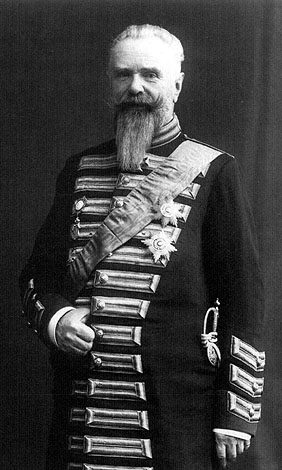
Boris Stürmer
Boris Stürmer was a Prime Minister of Russia. Born July 15, 1848, in Baykovo, Tver Oblast. Died August 20, 1917, in Saint Petersburg. Positions held include Minister of Foreign Affairs (1916), governor (1894–1902) and Minister of Internal Affairs of Russia (1916). Educated at Faculty of Law, Saint Petersburg State University and Imperial St. Petersburg University. Awards include Knight of the Order of St. Alexander Nevsky, Order of Saint Anna, 1st class and Order of the White Eagle.
Facts
32 facts · 0 confirmed by two sources · 2 cited · 28 from one source · 2 where the sources disagree
What’s different
- Born: we show July 15, 1848 (Sources disagree). Wikipedia says July 27, 1848
- Died: we show August 20, 1917 (Sources disagree). Wikipedia says September 2, 1917
Where this comes from
Papalocal keeps its own record. It started from these sources; what each one said is kept here as it was copied, so a change on their side never changes this page by itself. Tap one to read its version.
What Wikidata says · copied November 17, 2026 · revision 2568137366
- Described as
- Prime Minister of Russia (1848-1917)
- Other names
- Boris Vladimirovich Sturmer, Boris Shtyurmer
- Born
- July 15, 1848 · 1 reference
- Died
- August 20, 1917 · 2 references
- Born in
- Baykovo, Tver Oblast
- Died in
- Saint Petersburg · 1 reference
- Cause of death
- kidney failure
- Citizen of
- Russian Empire
- Occupation
- diplomat; politician · 1 reference
- Positions held
- Minister of Foreign Affairs (1916); governor (1894–1902); Minister of Internal Affairs of Russia (1916); Prime Minister of Russia (1916); member of the State Council of the Russian Empire
- Political party
- Russian Assembly
- Education
- Faculty of Law, Saint Petersburg State University; Imperial St. Petersburg University
- Awards
- Knight of the Order of St. Alexander Nevsky; Order of Saint Anna, 1st class; Order of the White Eagle; Order of Saint Stanislaus, 1st class; Order of St. Vladimir, 2nd class; Order of Saint Stanislaus · 1 reference; Commander of the Legion of Honour; Officer of the Order of Leopold; Order of the Rising Sun, 3rd class; Order of the Sacred Treasure, 1st Class; Commander of the Order of Saint-Charles; Commander of the Order of the Redeemer; Commander of the Order of Saints Maurice and Lazarus; Grand Cross of the Order of Isabella the Catholic; Commanders Grand Cross of the Order of the Polar Star
- Religion
- Eastern Orthodoxy
- Wikipedias with a page
- 25
Wikidata item Q834984 (wikidata.org/wiki/Q834984), public domain (CC0). Copied November 17, 2026.
What Wikipedia says · copied November 17, 2026 · revision 1378223994
Baron Boris Vladimirovich Shturmer (Stürmer) (Russian: Бори́с Влади́мирович Штю́рмер; 27 July [O.S. 15 July] 1848 – 2 September [O.S. 20 August] 1917) was a Russian lawyer, a Master of Ceremonies at the Russian Court, and a district governor. He became a member of the Russian Assembly and served as prime minister in 1916. A confidant of the Empress Alexandra, under his administration the country suffered drastic inflation and a transportation breakdown, which led to severe food shortages. During the course of his career, he was Minister of Internal Affairs and Foreign Minister of the Russian Empire.
- Born, in its opening lines
- July 27, 1848
- Died, in its opening lines
- September 2, 1917
From the Wikipedia article “Boris Shturmer” (en.wikipedia.org/wiki/Boris_Shturmer), by its contributors, under CC BY-SA 4.0 (creativecommons.org/licenses/by-sa/4.0/). Copied November 17, 2026; not changed.
Confirmed Two sources agree. Cited One source, and it names where it got it. One source One source, without a reference of its own. Sources disagree The sources disagree. We show the best-supported value and keep theirs below.
