
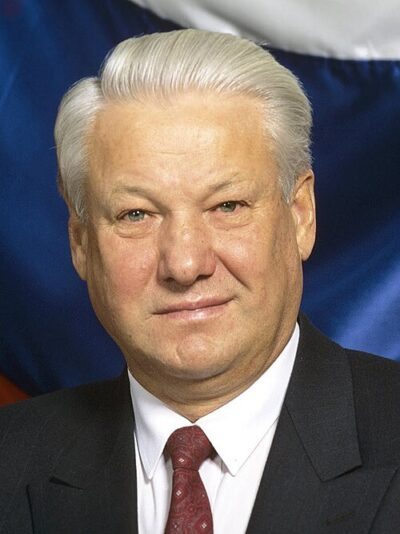
Boris Yeltsin
Boris Yeltsin was a Soviet and Russian politician, 1st President of Russia. Born February 1, 1931, in Butka. Died April 23, 2007, in Moscow. Positions held include Sverdlovsk regional committee of CPSU, member of the Presidium of the Supreme Soviet of the USSR and Secretary of the Communist Party of the Soviet Union. Educated at Ural State Technical University and Ural Federal University. Awards include Order of Lenin, Order of the Red Banner of Labour (2 times) and Order of the Badge of Honour.
Facts
61 facts · 2 confirmed by two sources · 8 cited · 51 from one source
Where this comes from
Papalocal keeps its own record. It started from these sources; what each one said is kept here as it was copied, so a change on their side never changes this page by itself. Tap one to read its version.
What Wikidata says · copied November 16, 2026 · revision 2568605939
- Described as
- Soviet and Russian politician, 1st President of Russia (1931–2007)
- Other names
- Boris Nikolayevich Yeltsin, Yeltsin, Eltsine Boris Nikolaevitch
- Born
- February 1, 1931 · 14 references
- Died
- April 23, 2007 · 12 references
- Born in
- Butka
- Died in
- Moscow · 2 references
- Buried in
- Novodevichy Cemetery · 1 reference
- Cause of death
- heart failure · 1 reference
- Citizen of
- Soviet Union (–1991); Russia (1991)
- Occupation
- civil engineer; politician · 3 references; master builder; engineer · 1 reference
- Positions held
- Sverdlovsk regional committee of CPSU · 1 reference; member of the Presidium of the Supreme Soviet of the USSR; Secretary of the Communist Party of the Soviet Union; First Secretary of the Moscow Communist Party (1985–1987); Council of Ministers of the USSR; people's deputy of union of socialist soviet republics; deputy of the Supreme Soviet of the Soviet Union; member of the Supreme Soviet of the Russian Soviet Federative Socialist Republic; Chairman of the Supreme Soviet of the Russian Federation (1990–1991); President of Russia (1991–1999) · 2 references; Prime Minister of Russia (1991–1992); Minister of Defense of Russia (1992); Supreme Commander-in-Chief of the Armed Forces of the Russian Federation (1992–1999)
- Political party
- Communist Party of the Soviet Union (1961–1990) · 1 reference; independent politician (1990–)
- Education
- Ural State Technical University; Ural Federal University
- Member of
- Central Committee of the Communist Party of the Soviet Union (1981–)
- Sport
- volleyball
- Awards
- Order of Lenin (1981); Order of the Red Banner of Labour (2 times) (1971, 1974); Order of the Badge of Honour (1966); Medal "In Commemoration of the 1000th Anniversary of Kazan" (2006) · 1 reference; Jubilee Medal "In Commemoration of the 100th Anniversary of the Birth of Vladimir Ilyich Lenin" (1969); Jubilee Medal "Thirty Years of Victory in the Great Patriotic War 1941–1945" (1975); Jubilee Medal "60 Years of the Armed Forces of the USSR" (1978); Gold Olympic Order (2 times) (1992, 1993) · 1 reference; Order "For Merit to the Fatherland", 1st class (2001); honorary citizen of Yerevan (2002) · 1 reference; VDNKh gold medal (1981); Order of the Three Stars, 1st Class (2000); Grand Cross of the Order of the Cross of Vytis (2011); Grand Cross of the Legion of Honour · 1 reference; Knight Grand Cross with Collar of the Order of Merit of the Italian Republic (1991) · 1 reference
- Spouse
- Naina Yeltsina (1956–2007) · 1 reference
- Children
- Tatyana Yumasheva; Elena Yeltsina
- Father
- Nikolai Ignatievich Yeltsin
- Mother
- Claudia Vasilievna Jeltsina
- Siblings
- Mikhail Yeltsin
- Religion
- Eastern Orthodoxy · 1 reference
- Military rank
- colonel; Supreme Commander-in-Chief of the Armed Forces of the Russian Federation
- Lived in
- Professor Мöxämmätyarof Street (1934–1937) · 1 reference; Qorı Yılğa (–1934) · 1 reference; Butka (1931–1934); Berezniki (1937–1949); Yekaterinburg (1949–1985)
- Height
- 1.87 m (6 ft 2 in)
- Wikipedias with a page
- 162
Wikidata item Q34453 (wikidata.org/wiki/Q34453), public domain (CC0). Copied November 16, 2026.
What Wikipedia says · copied November 16, 2026 · revision 1385342512
Boris Nikolayevich Yeltsin (1 February 1931 – 23 April 2007) was a Soviet and Russian politician who served as President of Russia from 1991 to 1999, having previously served as Chairman of the Supreme Soviet of the Russian SFSR from 1990 to 1991. He was a member of the Communist Party of the Soviet Union (CPSU) from 1961 to 1990. He later stood as a political independent, during which time he was viewed as being ideologically aligned with liberalism.
Yeltsin was born in Butka, Ural Oblast. Growing up in Kazan and Berezniki, he worked in construction after studying at the Ural State Technical University. After joining the Communist Party, he rose through its ranks, and in 1976, he became First Secretary of the party's Sverdlovsk Oblast committee. Yeltsin was initially a supporter of the perestroika reforms of Soviet leader Mikhail Gorbachev. He later criticized the reforms as being too moderate and called for a transition to a multi-party representative democracy. In 1987, he was the first person to resign from the Politburo of the Communist Party of the Soviet Union, which established his popularity as an anti-establishment figure and after which he earned the reputation of the leader of the anti-communist movement.
Elected chair of the Russian Supreme Soviet in 1990, Yeltsin was elected president of the Russian Soviet Federative Socialist Republic (RSFSR) in 1991, becoming the first popularly-elected head of state in Russian history. He allied with various non-Russian nationalist leaders and was instrumental in the formal dissolution of the Soviet Union in December of that year. With the dissolution of the Soviet Union, the RSFSR became the Russian Federation, an independent state. Through that transition, Yeltsin remained in office as president. He was later re-elected in the 1996 Russian presidential election, which critics assert was rigged. Yeltsin oversaw the transition of Russia's command economy into a capitalist market economy by implementing economic shock therapy, market exchange rate of the ruble, nationwide privatization, and lifting of price controls. Economic downturn, volatility, and inflation ensued. Amid the economic shift, a small number of oligarchs obtained most of the national property and wealth, while international monopolies dominated the market.
A constitutional crisis emerged in 1993 after Yeltsin ordered the unconstitutional dissolution of the Russian parliament, leading parliament to impeach him. The crisis ended after troops loyal to Yeltsin stormed the parliament building and stopped an armed uprising; he then introduced a new constitution which significantly expanded the powers of the president. After the crisis, Yeltsin governed the country in a rule by decree until 1994, as the Supreme Soviet of Russia was absent. Secessionist sentiment in the Russian Caucasus led to the First Chechen War, War of Dagestan, and Second Chechen War between 1994 and 1999. Internationally, Yeltsin promoted renewed collaboration with Europe and signed arms control agreements with the United States. Amid growing internal pressure, he resigned by the end of 1999 and was succeeded as president by his chosen successor, Vladimir Putin, whom he had appointed prime minister a few months earlier. After leaving office, he kept a low profile and was accorded a state funeral upon his death in 2007.
Domestically, Yeltsin was highly popular in the late 1980s and early 1990s. However, his reputation was severely damaged by the economic and political crises of his presidency, and he left office widely unpopular with the Russian population. He has received praise and criticism for his role in dismantling the Soviet Union, transforming Russia into a representative democracy, and introducing new freedoms to the country. Conversely, he has been accused of economic mismanagement, abuse of presidential power, autocratic behavior, corruption, and of undermining Russia's standing as a major world power.
- Born, in its opening lines
- February 1, 1931
- Died, in its opening lines
- April 23, 2007
From the Wikipedia article “Boris Yeltsin” (en.wikipedia.org/wiki/Boris_Yeltsin), by its contributors, under CC BY-SA 4.0 (creativecommons.org/licenses/by-sa/4.0/). Copied November 16, 2026; not changed.
Confirmed Two sources agree. Cited One source, and it names where it got it. One source One source, without a reference of its own. Sources disagree The sources disagree. We show the best-supported value and keep theirs below.
