
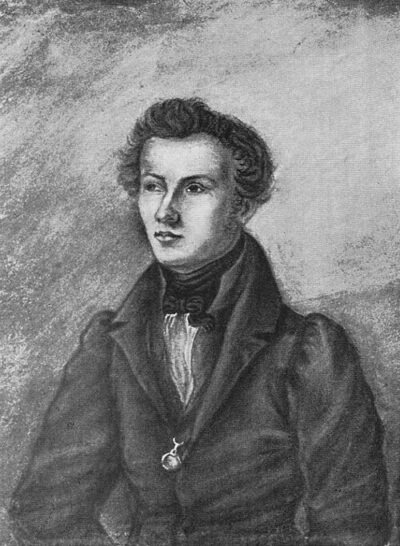
Bruno Bauer
Bruno Bauer was a German philosopher and theologian. Born September 6, 1809, in Eisenberg. Died April 15, 1882, in Neukölln. Educated at Humboldt-Universität zu Berlin and Friedrich-Wilhelms-Gymnasium.
Facts
13 facts · 1 confirmed by two sources · 5 cited · 6 from one source · 1 where the sources disagree
What’s different
- Died: we show April 15, 1882 (Sources disagree). Wikipedia says April 13, 1882
Where this comes from
Papalocal keeps its own record. It started from these sources; what each one said is kept here as it was copied, so a change on their side never changes this page by itself. Tap one to read its version.
What Wikidata says · copied November 16, 2026 · revision 2568850872
- Described as
- German philosopher and theologian (1809–1882)
- Born
- September 6, 1809 · 7 references
- Died
- April 15, 1882 · 3 references
- Born in
- Eisenberg · 1 reference
- Died in
- Neukölln · 1 reference
- Citizen of
- Duchy of Saxe-Altenburg
- Occupation
- philosopher · 1 reference; theologian · 1 reference; writer · 1 reference
- Worked for
- University of Bonn
- Education
- Humboldt-Universität zu Berlin; Friedrich-Wilhelms-Gymnasium
- Field
- Young Hegelians
- Religion
- atheism
- Wikipedias with a page
- 53
Wikidata item Q76878 (wikidata.org/wiki/Q76878), public domain (CC0). Copied November 16, 2026.
What Wikipedia says · copied November 16, 2026 · revision 1384565587
Bruno Bauer (; German: [baʊɐ]; 6 September 1809 – 13 April 1882) was a German philosopher, theologian, and historian. Initially a student of Georg Wilhelm Friedrich Hegel, he became a radical rationalist critic of the Bible and Christianity, and a prominent member of the Young Hegelians. Bauer was a central figure in the intellectual circles of the Vormärz, the period preceding the Revolutions of 1848, and his philosophical work was a major influence on, and target of critique for, Karl Marx and Friedrich Engels, with whom he had a close but tumultuous relationship.
Starting as a right-wing Hegelian, Bauer shifted to the left by 1839, developing a radical critique of religion and the state. He argued that the Christian gospels were not historical records but literary works of the human self-consciousness. His most significant work of this period, The Trumpet of the Last Judgement over Hegel the Atheist and Antichrist (1841), presented Hegel's philosophy as a revolutionary atheism that called for the overthrow of all existing religious and political institutions. Bauer's political thought was a form of republicanism based on the concept of "infinite self-consciousness," an ethical idealism that advocated for the constant transformation of society in pursuit of rational freedom.
During the 1840s, Bauer engaged with the emerging social question, developing a critique of both liberalism, for its basis in private interest, and the nascent socialist movements. His controversial writings on Jewish emancipation, in which he argued that both Jews and Christians must renounce their particular religious identities to achieve universal freedom, led to his isolation from many of his former allies. Though he participated in the 1848 Revolutions, their failure led him to abandon his revolutionary republicanism and turn to conservative causes. His post-1848 work focused on historical studies, particularly the origins of Christianity, and on the political development of Russia and the rise of global imperialism. Despite the profound change in his political orientation, his work continued to influence thinkers on both the left and the right, including Karl Kautsky and Friedrich Nietzsche.
- Born, in its opening lines
- September 6, 1809
- Died, in its opening lines
- April 13, 1882
From the Wikipedia article “Bruno Bauer” (en.wikipedia.org/wiki/Bruno_Bauer), by its contributors, under CC BY-SA 4.0 (creativecommons.org/licenses/by-sa/4.0/). Copied November 16, 2026; not changed.
Confirmed Two sources agree. Cited One source, and it names where it got it. One source One source, without a reference of its own. Sources disagree The sources disagree. We show the best-supported value and keep theirs below.
