
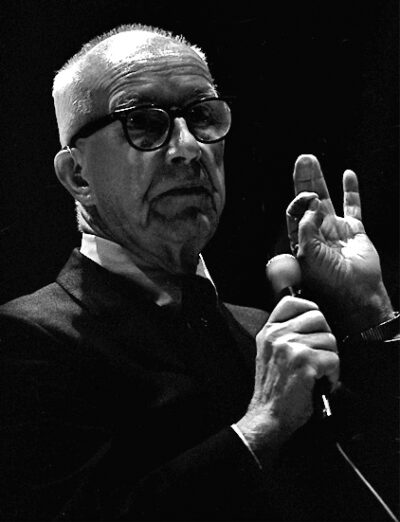
Buckminster Fuller
Buckminster Fuller was an American architect, systems theorist, author, designer, inventor and futurist. Born July 12, 1895, in Milton. Died July 1, 1983, in Los Angeles. Known for Montreal Biosphère, Nine Chains to the Moon and Operating Manual for Spaceship Earth. Educated at Harvard University and Bates College. Awards include Presidential Medal of Freedom, Humanist of the Year and Frank P. Brown Medal.
Facts
57 facts · 2 confirmed by two sources · 25 cited · 30 from one source
Where this comes from
Papalocal keeps its own record. It started from these sources; what each one said is kept here as it was copied, so a change on their side never changes this page by itself. Tap one to read its version.
What Wikidata says · copied November 13, 2026 · revision 2563889767
- Described as
- American architect, systems theorist, author, designer, inventor and futurist (1895–1983)
- Other names
- Bucky Fuller, Richard Buckminster Fuller, R. Buckminster Fuller
- Born
- July 12, 1895 · 17 references
- Died
- July 1, 1983 · 16 references
- Born in
- Milton · 3 references
- Died in
- Los Angeles · 5 references
- Buried in
- Mount Auburn Cemetery · 1 reference
- Cause of death
- myocardial infarction
- Name at birth
- Richard Buckminster Fuller
- Citizen of
- United States · 2 references
- Occupation
- architect · 8 references; inventor · 1 reference; writer · 1 reference; diarist; university teacher; scientist · 1 reference; poet · 3 references; artist · 2 references
- Worked for
- Washington University in St. Louis; Southern Illinois University Carbondale (1959–1975) · 1 reference; Black Mountain College · 1 reference
- Education
- Harvard University; Bates College; Milton Academy · 1 reference; Harvard College
- Member of
- American Academy of Arts and Sciences; American Academy of Arts and Letters; American Association for the Advancement of Science · 1 reference; American Institute of Architects (1974–) · 1 reference
- Known for
- Montreal Biosphère; Nine Chains to the Moon; Operating Manual for Spaceship Earth; Critical Path; Dymaxion house; Science World; R. Buckminster Fuller and Anne Hewlett Dome Home; Spoletosfera; Dymaxion map; Dymaxion
- Awards
- Presidential Medal of Freedom (1983) · 1 reference; Humanist of the Year (1969) · 1 reference; Frank P. Brown Medal (1960); AIA Gold Medal (1970) · 1 reference; Royal Gold Medal (1968); St. Louis Literary Award (1976); Fellow of the American Academy of Arts and Sciences (1968) · 1 reference; Honorary Royal Designer for Industry (1980) · 1 reference; John Scott Award (1979) · 2 references; Fellow of the American Institute of Architects (1975) · 1 reference; Toynbee Prize · 1 reference
- Field
- architect; design; engineer
- Spouse
- Anne Hewlett · 1 reference
- Children
- Allegra Fuller Snyder
- Father
- Richard Buckminster Fuller · 1 reference
- Mother
- Caroline Wolcott Andrews · 1 reference
- Siblings
- Caroline Leslie Fuller
- Lived in
- Maine
- Wikipedias with a page
- 89
Wikidata item Q102289 (wikidata.org/wiki/Q102289), public domain (CC0). Copied November 13, 2026.
What Wikipedia says · copied November 13, 2026 · revision 1384225595
Richard Buckminster Fuller Jr. (; July 12, 1895 – July 1, 1983) was an American architect, systems theorist, writer, designer, inventor, philosopher, and futurist. He styled his name as R. Buckminster Fuller in his writings, publishing more than 30 books and coining or popularizing such terms as "Spaceship Earth", "Dymaxion" (e.g., Dymaxion house, Dymaxion car, Dymaxion map), "ephemeralization", "synergetics", and "tensegrity".
Fuller developed numerous inventions, mainly architectural designs, and popularized the widely known geodesic dome; carbon molecules known as fullerenes were later named by scientists for their structural and mathematical resemblance to geodesic spheres. He also served as the second World President of Mensa International from 1974 to 1983.
Fuller was awarded 28 United States patents and many honorary doctorates. In 1960, he was awarded the Frank P. Brown Medal from the Franklin Institute. He was elected an honorary member of Phi Beta Kappa in 1967, on the occasion of the 50-year reunion of his Harvard class of 1917 (from which he had been expelled in his first year). He was elected a Fellow of the American Academy of Arts and Sciences in 1968. The same year, he was elected into the National Academy of Design as an Associate member. He became a full Academician in 1970, and he received the Gold Medal award from the American Institute of Architects the same year. Also in 1970, Fuller received the title of Master Architect from Alpha Rho Chi (APX), the national fraternity for architecture and the allied arts.
In 1976, he received the St. Louis Literary Award from the Saint Louis University Library Associates. In 1977, he received the Golden Plate Award of the American Academy of Achievement. He also received numerous other awards, including the Presidential Medal of Freedom, presented to him on February 23, 1983, by President Ronald Reagan.
- Born, in its opening lines
- July 12, 1895
- Died, in its opening lines
- July 1, 1983
From the Wikipedia article “Buckminster Fuller” (en.wikipedia.org/wiki/Buckminster_Fuller), by its contributors, under CC BY-SA 4.0 (creativecommons.org/licenses/by-sa/4.0/). Copied November 13, 2026; not changed.
Confirmed Two sources agree. Cited One source, and it names where it got it. One source One source, without a reference of its own. Sources disagree The sources disagree. We show the best-supported value and keep theirs below.
