
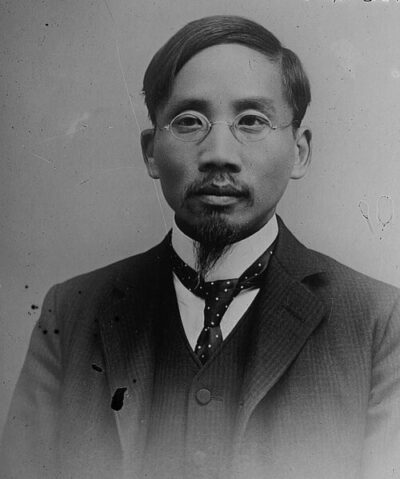
Cai Yuanpei
Cai Yuanpei was a Chinese educator, Esperantist and the president of Peking University. Born January 11, 1868, in Yuecheng District. Died March 5, 1940, in Hong Kong Sanatorium and Hospital. Positions held include Shujishi of Qing dynasty. Educated at Leipzig University.
Facts
25 facts · 2 confirmed by two sources · 5 cited · 18 from one source
Where this comes from
Papalocal keeps its own record. It started from these sources; what each one said is kept here as it was copied, so a change on their side never changes this page by itself. Tap one to read its version.
What Wikidata says · copied November 16, 2026 · revision 2568934613
- Described as
- Chinese educator, Esperantist and the president of Peking University (1868-1940)
- Other names
- min you, jie min, he qing, zhou zi yu, Heqing, Jiemin, cai zhen, zhong shen
- Born
- January 11, 1868 · 3 references
- Died
- March 5, 1940 · 1 reference
- Born in
- Yuecheng District · 1 reference
- Died in
- Hong Kong Sanatorium and Hospital
- Buried in
- Aberdeen Chinese Permanent Cemetery
- Citizen of
- Republic of China · 1 reference; Qing dynasty
- Occupation
- politician · 1 reference; Esperantist; philosopher · 1 reference; university teacher; scholar · 1 reference; educator · 1 reference
- Positions held
- Shujishi of Qing dynasty
- Political party
- Kuomintang; Tongmenghui; Guangfuhui
- Worked for
- Peking University; Shanghai Jiao Tong University · 1 reference
- Education
- Leipzig University
- Member of
- Chinese Academy of Sciences
- Spouse
- Zhou Jun
- Children
- Cai Weilian
- Lived in
- Cai Yuanpei's Former Residence; Former Residence of Cai Yuanpei
- Wikipedias with a page
- 32
Wikidata item Q19796 (wikidata.org/wiki/Q19796), public domain (CC0). Copied November 16, 2026.
What Wikipedia says · copied November 16, 2026 · revision 1383674864
Cai Yuanpei (Chinese: 蔡元培; 1868–1940), spelt Ts'ai Yuan-p'ei (Wade–Giles: Ts'ai⁴ Yüan²-p'ei²) during his lifetime, was a Chinese philosopher and politician who was an influential figure in the history of Chinese modern education. He made contributions to education reform with his own education ideology. He was the president of Peking University, and founder of the Academia Sinica. He was known for his critical evaluation of Chinese culture and synthesis of Chinese and Western thinking, including anarchism. He got involved in the New Culture, May Fourth Movements, and the feminist movement. His works involve aesthetic education, politics, and education reform.
- Born, in its opening lines
- 1868
- Died, in its opening lines
- 1940
From the Wikipedia article “Cai Yuanpei” (en.wikipedia.org/wiki/Cai_Yuanpei), by its contributors, under CC BY-SA 4.0 (creativecommons.org/licenses/by-sa/4.0/). Copied November 16, 2026; not changed.
Confirmed Two sources agree. Cited One source, and it names where it got it. One source One source, without a reference of its own. Sources disagree The sources disagree. We show the best-supported value and keep theirs below.
