
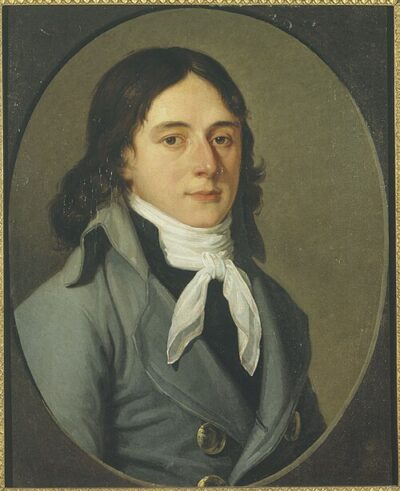
Camille Desmoulins
Camille Desmoulins was a French journalist, politician and revolutionary. Born March 2, 1760, in Guise. Died April 5, 1794, in Paris. Positions held include deputy to the National Convention (1792–1794). Educated at Lycée Louis-le-Grand. Awards include Concours général.
Facts
20 facts · 2 confirmed by two sources · 8 cited · 9 from one source · 1 where the sources disagree
What’s different
- Buried in: we show Errancis Cemetery (Sources disagree). Wikidata also lists Catacombs of Paris
Where this comes from
Papalocal keeps its own record. It started from these sources; what each one said is kept here as it was copied, so a change on their side never changes this page by itself. Tap one to read its version.
What Wikidata says · copied November 16, 2026 · revision 2558969328
- Described as
- French journalist, politician and revolutionary (1760-1794)
- Other names
- Lucie Simplice Camille Benoist Desmoulins
- Born
- March 2, 1760 · 11 references
- Died
- April 5, 1794 · 10 references
- Born in
- Guise · 3 references
- Died in
- Paris · 3 references
- Buried in
- Errancis Cemetery; Catacombs of Paris
- Cause of death
- decapitation
- Name at birth
- Lucie Simplice Camille Benoit Desmoulins · 1 reference
- Citizen of
- France
- Occupation
- journalist · 1 reference; politician · 1 reference; lawyer; jurist · 1 reference; revolutionary · 1 reference
- Positions held
- deputy to the National Convention (1792–1794) · 1 reference
- Political party
- Cordeliers · 1 reference; Indulgents
- Education
- Lycée Louis-le-Grand
- Awards
- Concours général
- Spouse
- Lucile Desmoulins
- Children
- Horace-Camille Desmoulins
- Wikipedias with a page
- 54
Wikidata item Q249313 (wikidata.org/wiki/Q249313), public domain (CC0). Copied November 16, 2026.
What Wikipedia says · copied November 16, 2026 · revision 1385887778
Lucie-Simplice-Camille-Benoît Desmoulins (French: [lysi sɛ̃plis kamij bənwa demulɛ̃]; 2 March 1760 – 5 April 1794) was a French journalist, politician and prominent figure of the French Revolution. He is best known for playing an instrumental role in the events that led to the Storming of the Bastille. Desmoulins was also noted for his radical criticism of the Reign of Terror as the editor of the journal Le Vieux Cordelier. He was a schoolmate and close friend of Maximilien Robespierre and a close friend and political ally of Georges Danton, who were leading figures in the French Revolution.
A lawyer by training, Desmoulins was enthralled by the Revolution from its outbreak. On 12 July 1789, shortly after Louis XVI dismissed his popular finance minister Jacques Necker, Desmoulins delivered an impassioned call to arms to a crowd before the Palais-Royal. His agitation sparked widespread unrest in Paris, which culminated in the Storming of the Bastille two days later. Through his newfound fame, Desmoulins quickly established himself as a prominent radical pamphleteer. He advocated explicitly in favour of republicanism and revolutionary violence, and mounted relentless attacks on not only the Ancien Régime, but also once-sympathetic revolutionary figures such as Jacques Pierre Brissot. His campaigns ultimately contributed to the fall of the Girondist faction and the beginning of the Reign of Terror.
During the Terror, Desmoulins and Danton distanced themselves from Robespierre's radical Montagnards. Through his new journal Le Vieux Cordelier, he criticized the excesses of the Revolutionary Government and made pleas for clemency, which enraged Robespierre and eventually led to his downfall. In April 1794, Desmoulins was sentenced to death by the Revolutionary Tribunal and guillotined alongside Danton and other accused Dantonists.
- Born, in its opening lines
- March 2, 1760
- Died, in its opening lines
- April 5, 1794
From the Wikipedia article “Camille Desmoulins” (en.wikipedia.org/wiki/Camille_Desmoulins), by its contributors, under CC BY-SA 4.0 (creativecommons.org/licenses/by-sa/4.0/). Copied November 16, 2026; not changed.
Confirmed Two sources agree. Cited One source, and it names where it got it. One source One source, without a reference of its own. Sources disagree The sources disagree. We show the best-supported value and keep theirs below.
