
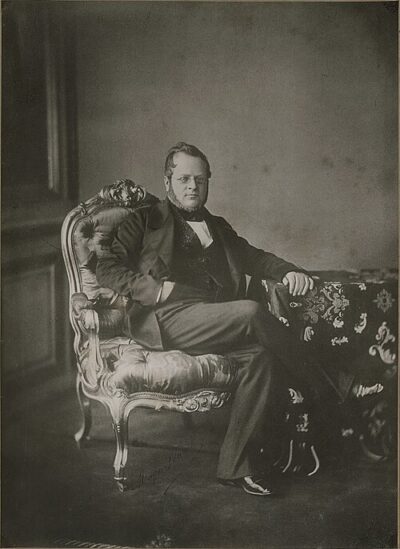
Camillo Benso di Cavour
Camillo Benso di Cavour was a first Prime Minister of the Kingdom of Italy from March to June in 1861. Born August 10, 1810, in Turin. Died June 6, 1861, in Turin. Positions held include Prime Minister of the Kingdom of Sardinia (1852–1861), Prime Minister of the Kingdom of Italy (1861) and minister of Foreign Affairs of the Kingdom of Sardinia (1855–1861). Educated at Royal Academy of Turin. Awards include Grand Cross of the Legion of Honour, Knight of the Order of St. Alexander Nevsky and Order of the Most Holy Annunciation.
Facts
42 facts · 2 confirmed by two sources · 14 cited · 26 from one source
Where this comes from
Papalocal keeps its own record. It started from these sources; what each one said is kept here as it was copied, so a change on their side never changes this page by itself. Tap one to read its version.
What Wikidata says · copied November 16, 2026 · revision 2562951306
- Described as
- first Prime Minister of the Kingdom of Italy from March to June in 1861
- Other names
- Cavour, Count Camillo Benso de Cavour, Camillo Paolo Filippo Giulio Benso
- Born
- August 10, 1810 · 13 references
- Died
- June 6, 1861 · 12 references
- Born in
- Turin · 5 references
- Died in
- Turin · 5 references
- Buried in
- Castle Cavour of Santena · 1 reference
- Cause of death
- malaria
- Name at birth
- Camillo Paolo Filippo Giulio Benso
- Citizen of
- Kingdom of Italy (1861–) · 1 reference; Kingdom of Sardinia (–1861) · 1 reference
- Occupation
- politician · 1 reference; diplomat · 1 reference; businessperson · 1 reference; writer · 1 reference
- Positions held
- Prime Minister of the Kingdom of Sardinia (1852–1861); Prime Minister of the Kingdom of Italy (1861); minister of Foreign Affairs of the Kingdom of Sardinia (1855–1861); minister of interior of the Kingdom of Sardinia (1858–1860); minister of Finance of the Kingdom of Sardinia (1851–1858); minister of War of the Kingdom of Sardinia (1860–1861); minister of the Navy of the Kingdom of Sardinia (1860–1861); minister of Agriculture and Trade of the Kingdom of Sardinia (1850–1852); minister of Foreign Affairs of the Kingdom of Italy (1861); minister of War of the Kingdom of Italy (1861); minister of the Navy of the Kingdom of Italy (1861); member of the Chamber of Deputies of the Kingdom of Sardinia (1848–1860) · 1 reference; member of the Chamber of Deputies of the Kingdom of Italy (1861) · 1 reference
- Political party
- Historical Right
- Education
- Royal Academy of Turin · 1 reference
- Awards
- Grand Cross of the Legion of Honour; Knight of the Order of St. Alexander Nevsky; Order of the Most Holy Annunciation · 1 reference; Civil Order of Savoy · 1 reference; Royal Order of the Welfs · 1 reference; 1st class, Order of the Medjidie · 1 reference; Order of the Lion and the Sun First class · 1 reference; Order of the Redeemer · 1 reference; Knight Grand Cross of the Order of Saints Maurice and Lazarus
- Father
- Michele Benso di Cavour · 1 reference
- Mother
- Adelaide Suzanne de Sellon · 1 reference
- Siblings
- Gustavo Benso di Cavour · 1 reference
- Religion
- deism; Catholicism · 1 reference
- Wikipedias with a page
- 95
Wikidata item Q166092 (wikidata.org/wiki/Q166092), public domain (CC0). Copied November 16, 2026.
What Wikipedia says · copied November 16, 2026 · revision 1380733524
Camillo Paolo Filippo Giulio Benso, Count of Cavour, Isolabella and Leri (Italian: [kaˈmillo ˈbɛnso]; 10 August 1810 – 6 June 1861), generally known as the Count of Cavour ( kə-VOOR; Italian: Conte di Cavour [ˈkonte di kaˈvur]) or simply Cavour, was an Italian politician, statesman, businessman, economist, and noble, and a leading figure in the movement towards Italian unification. He was one of the leaders of the Historical Right and Prime Minister of the Kingdom of Sardinia from 1852, a position he maintained (except for a six-month resignation) until his death, throughout the Second Italian War of Independence and Giuseppe Garibaldi's campaigns to unite Italy. After the declaration of a united Kingdom of Italy, Cavour took office as the first Prime Minister of Italy; he died after only three months in office and did not live to see the Roman Question solved through the complete unification of the country after the Capture of Rome in 1870.
Cavour put forth several economic reforms in his native region of Piedmont, at that time part of the Kingdom of Sardinia, in his earlier years and founded the political newspaper Il Risorgimento. After being elected to the Chamber of Deputies, he quickly rose in rank through the Piedmontese government, coming to dominate the Chamber of Deputies through a union of centre-left and centre-right politicians. After a large rail system expansion program, Cavour became prime minister in 1852. As prime minister, Cavour successfully negotiated Piedmont's way through the Crimean War, the Second Italian War of Independence, and Garibaldi's Expedition of the Thousand, managing to manoeuvre Piedmont diplomatically to become a new great power in Europe, controlling a nearly united Italy that was five times as large as Piedmont had been before he came to power.
English historian Denis Mack Smith says Cavour was the most successful parliamentarian in Italian history, but he was not especially democratic. Cavour was often dictatorial, ignored his ministerial colleagues and parliament, and interfered in parliamentary elections. He also practised trasformismo and other policies which were carried over into post-Risorgimento Italy.
- Born, in its opening lines
- August 10, 1810
- Died, in its opening lines
- June 6, 1861
From the Wikipedia article “Camillo Benso, Count of Cavour” (en.wikipedia.org/wiki/Camillo_Benso,_Count_of_Cavour), by its contributors, under CC BY-SA 4.0 (creativecommons.org/licenses/by-sa/4.0/). Copied November 16, 2026; not changed.
Confirmed Two sources agree. Cited One source, and it names where it got it. One source One source, without a reference of its own. Sources disagree The sources disagree. We show the best-supported value and keep theirs below.
