
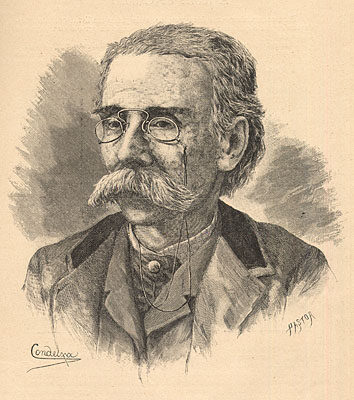
Camilo Castelo Branco
Camilo Castelo Branco was the 19th-century Portuguese writer. Born March 16, 1825, in Lisbon. Died June 1, 1890, in Seide. Known for Amor de Perdição and The Fall of an Angel. Educated at University of Porto.
Facts
20 facts · 2 confirmed by two sources · 4 cited · 14 from one source
Where this comes from
Papalocal keeps its own record. It started from these sources; what each one said is kept here as it was copied, so a change on their side never changes this page by itself. Tap one to read its version.
What Wikidata says · copied November 16, 2026 · revision 2565597717
- Described as
- 19th-century Portuguese writer (1825–1890)
- Other names
- Camillo Castello-Branco, Camilo Ferreira Botelho Castelo Branco
- Born
- March 16, 1825 · 10 references
- Died
- June 1, 1890 · 9 references
- Born in
- Lisbon · 2 references
- Died in
- Seide
- Buried in
- Cemitério da Lapa · 1 reference
- Cause of death
- gunshot wound
- Name at birth
- Camilo Ferreira Botelho Castelo Branco
- Citizen of
- Kingdom of Portugal
- Occupation
- writer · 2 references; translator; playwright; poet; historian
- Education
- University of Porto
- Member of
- Royal Sevillian Academy of Good Letters · 1 reference
- Known for
- Amor de Perdição; The Fall of an Angel
- Father
- Manuel Joaquim Botelho Castelo Branco
- Religion
- Catholic Church
- Website
- http://www.camilocastelobranco.org/
- Wikipedias with a page
- 31
Wikidata item Q365423 (wikidata.org/wiki/Q365423), public domain (CC0). Copied November 16, 2026.
What Wikipedia says · copied November 16, 2026 · revision 1383650656
Camilo Castelo Branco, 1st Viscount of Correia Botelho (Portuguese pronunciation: [kɐˈmilu kɐʃˈtɛlu ˈbɾɐ̃ku]; 16 March 1825 – 1 June 1890), was a prolific Portuguese writer of the 19th century, having produced over 260 books (mainly novels, plays and essays). His writing is considered original in that it combines the dramatic and sentimental spirit of Romanticism with a highly personal combination of sarcasm, bitterness and dark humour. He is also celebrated for his peculiar wit and anecdotal character, as well as for his turbulent (and ultimately tragic) life.
His writing, which is centred in the local and the picturesque and is in a general sense affiliated with the Romantic tradition, is often regarded in contrast to that of Eça de Queiroz – a cosmopolitan dandy and a fervorous proponent of Realism, who was Camilo's literary contemporary in spite of being 20 years younger. This tension between Camilo and Eça – often dubbed by critics the literary guerrilla – has been interpreted as a synthesis of the two great tendencies present in the Portuguese literature of the 19th century.
Allegations that he was initiated in Freemasonry in 1846, are somewhat contradictory as there are indications that, around the same time, during the Revolution of Maria da Fonte, he fought in favor of the Miguelists as "helper to the orders of the Scottish General Ranald MacDonell", who was active in the revived Order of Saint Michael of the Wing precisely to combat Masonry. Similarly, much of his literature demonstrates his ideals of legitimism and as a conservative and Catholic traditionalist.
- Born, in its opening lines
- March 16, 1825
- Died, in its opening lines
- June 1, 1890
From the Wikipedia article “Camilo Castelo Branco” (en.wikipedia.org/wiki/Camilo_Castelo_Branco), by its contributors, under CC BY-SA 4.0 (creativecommons.org/licenses/by-sa/4.0/). Copied November 16, 2026; not changed.
Confirmed Two sources agree. Cited One source, and it names where it got it. One source One source, without a reference of its own. Sources disagree The sources disagree. We show the best-supported value and keep theirs below.
