
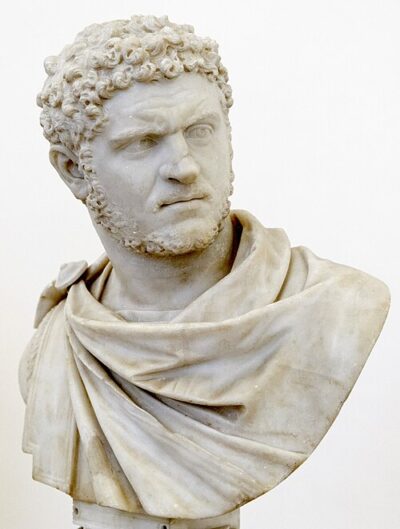
Caracalla was a Roman emperor from 198 to 217. Born April 4, 188, in Lugdunum. Died April 8, 217, in Carrhae. Positions held include Roman emperor (198–217), ancient Roman senator and Roman consul.
Facts
23 facts · 2 confirmed by two sources · 3 cited · 18 from one source
Where this comes from
Papalocal keeps its own record. It started from these sources; what each one said is kept here as it was copied, so a change on their side never changes this page by itself. Tap one to read its version.
What Wikidata says · copied November 16, 2026 · revision 2568841781
- Described as
- Roman emperor from 198 to 217
- Other names
- Marcus Aurelius Antoninus, Tarautas, Divus Antoninus Magnus, Caracallus, Marcus Aurelius Antoninus Caracallus, Antoninus Caracallus, Lucius Septimius Bassianus
- Born
- April 4, 188 · 3 references
- Died
- April 8, 217 · 3 references
- Born in
- Lugdunum
- Died in
- Carrhae
- Buried in
- Castel Sant'Angelo
- Cause of death
- stab wound
- Name at birth
- Lucius Septimius Bassianus
- Citizen of
- Ancient Rome
- Occupation
- politician; monarch
- Positions held
- Roman emperor (198–217); ancient Roman senator; Roman consul
- Spouse
- Fulvia Plautilla
- Children
- Aurelia Antonina; Elagabalus; Severus Alexander
- Father
- Septimius Severus · 1 reference
- Mother
- Julia Domna · 2 references
- Siblings
- Geta · 1 reference; Septimia Major; Septimia Minor
- Religion
- ancient Roman religion
- Wikipedias with a page
- 89
Wikidata item Q1446 (wikidata.org/wiki/Q1446), public domain (CC0). Copied November 16, 2026.
What Wikipedia says · copied November 16, 2026 · revision 1379041221
Marcus Aurelius Antoninus (born Lucius Septimius Bassianus, 4 April 188 – 8 April 217), better known by his nickname Caracalla (; Latin: [karaˈkalːa]), was Roman emperor from 198 to 217 AD, first serving as nominal co-emperor under his father and then ruling alone after 211 AD. He was a member of the Severan dynasty, the elder son of Emperor Septimius Severus and Empress Julia Domna. Severus proclaimed Caracalla co-ruler in 198, doing the same with his other son Geta in 209. The two brothers briefly shared power after their father's death in 211, but Caracalla soon had Geta murdered by the Praetorian Guard and became sole ruler of the Roman Empire. Julia Domna had a significant share in governance, since Caracalla found administration to be mundane. His reign featured domestic instability and external invasions by the Germanic peoples.
Caracalla issued the Antonine Constitution (Latin: Constitutio Antoniniana), also known as the Edict of Caracalla, which granted Roman citizenship to all free inhabitants (except the dediticii) throughout the Roman Empire. The edict gave all the enfranchised men Caracalla's adopted praenomen and nomen: "Marcus Aurelius". Other landmarks of his reign were the construction of the Baths of Caracalla, the second-largest bathing complex in the history of Rome, the introduction of a new Roman currency named the antoninianus, a sort of double denarius, and the massacres he ordered, both in Rome and elsewhere in the empire. In 216, Caracalla began a campaign against the Parthian Empire. He did not see this campaign through to completion due to his assassination by a disaffected soldier in 217. Macrinus succeeded him as emperor three days later.
The ancient sources portray Caracalla as a cruel tyrant; his contemporaries Cassius Dio (c. 155 – c. 235) and Herodian (c. 170 – c. 240) present him as a soldier first and an emperor second. Later, in the 18th century, the works of French painters revived images of Caracalla due to apparent parallels between Caracalla's tyranny and that ascribed to French King Louis XVI (r. 1774–1792). Modern works continue to portray Caracalla as an evil ruler, painting him as one of the most tyrannical of all Roman emperors.
- Born, in its opening lines
- April 4, 188
- Died, in its opening lines
- April 8, 217
From the Wikipedia article “Caracalla” (en.wikipedia.org/wiki/Caracalla), by its contributors, under CC BY-SA 4.0 (creativecommons.org/licenses/by-sa/4.0/). Copied November 16, 2026; not changed.
Confirmed Two sources agree. Cited One source, and it names where it got it. One source One source, without a reference of its own. Sources disagree The sources disagree. We show the best-supported value and keep theirs below.
