
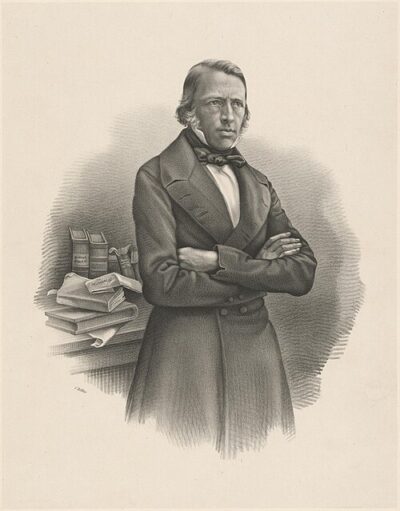
Carl Jacob Löwig
Carl Jacob Löwig was a German chemist. Born March 17, 1803, in Bad Kreuznach. Died March 27, 1890, in Wrocław. Positions held include rector (1848–1850). Educated at Heidelberg University. Awards include honorary member of the Physics Association (Frankfurt am Main, Germany).
Facts
14 facts · 2 confirmed by two sources · 3 cited · 9 from one source
Where this comes from
Papalocal keeps its own record. It started from these sources; what each one said is kept here as it was copied, so a change on their side never changes this page by itself. Tap one to read its version.
What Wikidata says · copied November 18, 2026 · revision 2569191646
- Described as
- German chemist (1803–1890)
- Born
- March 17, 1803 · 1 reference
- Died
- March 27, 1890 · 2 references
- Born in
- Bad Kreuznach · 1 reference
- Died in
- Wrocław · 1 reference
- Citizen of
- Kingdom of Prussia
- Occupation
- chemist · 1 reference; university teacher; pharmacist
- Positions held
- rector (1848–1850)
- Worked for
- Heidelberg University; University of Zurich; University of Wrocław · 1 reference
- Education
- Heidelberg University
- Awards
- honorary member of the Physics Association (Frankfurt am Main, Germany) (1846)
- Wikipedias with a page
- 22
Wikidata item Q65517 (wikidata.org/wiki/Q65517), public domain (CC0). Copied November 18, 2026.
What Wikipedia says · copied November 18, 2026 · revision 1380933704
Carl Jacob Löwig (17 March 1803 – 27 March 1890) was a German chemist and discovered bromine independently of Antoine Jérôme Balard.
He received his PhD at the University of Heidelberg for his work with Leopold Gmelin.
During his research on mineral salts he discovered bromine in 1825, as a brown gas evolving after the salt was treated with chlorine.
In 1853, he was the first person to synthesize tetraethyllead (Pb(C2H5)4).
After working at the University of Heidelberg and the University of Zurich he became the successor to Robert Wilhelm Bunsen at the University of Breslau. He worked and lived in Breslau until his death in 1890.
- Born, in its opening lines
- March 17, 1803
- Died, in its opening lines
- March 27, 1890
From the Wikipedia article “Carl Jacob Löwig” (en.wikipedia.org/wiki/Carl_Jacob_Löwig), by its contributors, under CC BY-SA 4.0 (creativecommons.org/licenses/by-sa/4.0/). Copied November 18, 2026; not changed.
Confirmed Two sources agree. Cited One source, and it names where it got it. One source One source, without a reference of its own. Sources disagree The sources disagree. We show the best-supported value and keep theirs below.
