
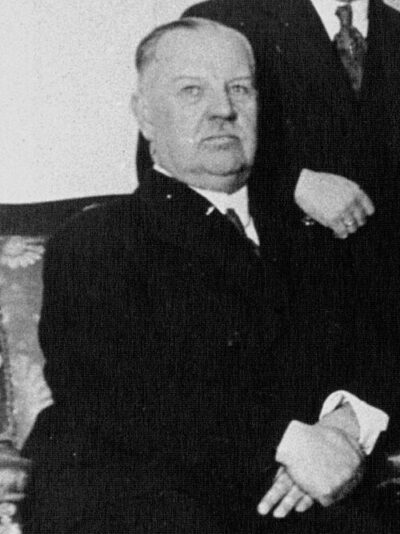
Carl Vaugoin
Carl Vaugoin was an Austrian politician. Born July 8, 1873, in Vienna. Died June 10, 1949, in Krems. Positions held include member of the National Council of Austria, Federal Chancellor of Austria (1930) and Vice-Chancellor of Austria (1929–1930).
Facts
14 facts · 2 confirmed by two sources · 1 cited · 11 from one source
Where this comes from
Papalocal keeps its own record. It started from these sources; what each one said is kept here as it was copied, so a change on their side never changes this page by itself. Tap one to read its version.
What Wikidata says · copied November 18, 2026 · revision 2562785749
- Described as
- Austrian politician (1873-1949)
- Other names
- Karl Vaugoin
- Born
- July 8, 1873 · 1 reference
- Died
- June 10, 1949 · 1 reference
- Born in
- Vienna
- Died in
- Krems
- Buried in
- Hietzing Cemetery
- Citizen of
- Austria
- Occupation
- politician · 1 reference
- Positions held
- member of the National Council of Austria; Federal Chancellor of Austria (1930); Vice-Chancellor of Austria (1929–1930)
- Political party
- Christian Social Party; Fatherland Front
- Member of
- KÖStV Rudolfina Wien · 1 reference
- Religion
- Catholic Church
- Wikipedias with a page
- 20
Wikidata item Q683400 (wikidata.org/wiki/Q683400), public domain (CC0). Copied November 18, 2026.
What Wikipedia says · copied November 18, 2026 · revision 1303836129
Carl Vaugoin (8 July 1873 – 10 June 1949) was an Austrian politician who served as the eleventh Chancellor of Austria from 30 September to 4 December 1930. As a member of the Christian Social Party, Vaugoin also served as Defense Minister in 15 Austrian cabinets from 1921 to 1933, as well as Vice Chancellor of Austria from 1929 to 1930.
- Born, in its opening lines
- July 8, 1873
- Died, in its opening lines
- June 10, 1949
From the Wikipedia article “Carl Vaugoin” (en.wikipedia.org/wiki/Carl_Vaugoin), by its contributors, under CC BY-SA 4.0 (creativecommons.org/licenses/by-sa/4.0/). Copied November 18, 2026; not changed.
Confirmed Two sources agree. Cited One source, and it names where it got it. One source One source, without a reference of its own. Sources disagree The sources disagree. We show the best-supported value and keep theirs below.
