
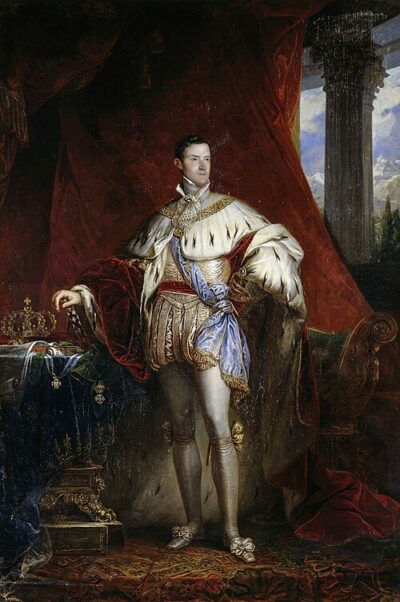
Carlo Alberto I of Sardinia
Carlo Alberto I of Sardinia was a King of Sardinia from 1831 to 1849. Born October 2, 1798, in Turin. Died July 28, 1849, in Porto. Positions held include King of Sardinia and Duke of Savoy (1831–1849) and Head of the House of Savoy. Educated at Collège Stanislas de Paris. Awards include Knight of the Order of the Holy Spirit, Knight of the Order of Saint Michael and Knight of the Order of the Golden Fleece.
Facts
36 facts · 2 confirmed by two sources · 8 cited · 26 from one source
Where this comes from
Papalocal keeps its own record. It started from these sources; what each one said is kept here as it was copied, so a change on their side never changes this page by itself. Tap one to read its version.
What Wikidata says · copied November 16, 2026 · revision 2564317305
- Described as
- King of Sardinia from 1831 to 1849
- Other names
- Carlo Alberto, Charles Albert
- Born
- October 2, 1798 · 7 references
- Died
- July 28, 1849 · 6 references
- Born in
- Turin · 3 references
- Died in
- Porto · 3 references
- Buried in
- Basilica of Superga
- Cause of death
- disease
- Citizen of
- France; Kingdom of Sardinia
- Occupation
- regent; sovereign · 1 reference
- Positions held
- King of Sardinia and Duke of Savoy (1831–1849) · 1 reference; Head of the House of Savoy
- Education
- Collège Stanislas de Paris
- Awards
- Knight of the Order of the Holy Spirit; Knight of the Order of Saint Michael; Knight of the Order of the Golden Fleece (1823) · 1 reference; Order of St. Andrew; Order of St. George, 4th class; Knight of the Order of the Most Holy Annunciation (1816) · 1 reference; Knight Grand Cross of the Order of Saints Maurice and Lazarus; Civil Order of Savoy; Grand Cross of the Military Order of Maria Theresa (1823) · 1 reference; Knight Grand Cross of the Order of Saint Stephen of Hungary; Grand Cross of the Legion of Honour; Knight Grand Cross of the Order of Saint Louis; Order of Saint Januarius; Grand Cross of the Order of the Tower and Sword; Order of Saint Alexander Nevsky
- Field
- politics · 1 reference
- Spouse
- Maria Theresa of Austria (1817–) · 1 reference
- Children
- Victor Emmanuel II of Italy; Prince Ferdinand, Duke of Genoa; Principessa Maria Cristina di Savoia-Carignano (?) · 1 reference
- Father
- Charles Emmanuel, Prince of Carignano
- Mother
- Princess Maria Christina of Saxony
- Siblings
- Princess Elisabeth of Savoy
- Wikipedias with a page
- 49
Wikidata item Q181261 (wikidata.org/wiki/Q181261), public domain (CC0). Copied November 16, 2026.
What Wikipedia says · copied November 16, 2026 · revision 1383865060
Charles Albert (Italian: Carlo Alberto I; 2 October 1798 – 28 July 1849) was the King of Sardinia and ruler of the Savoyard state from 27 April 1831 until his abdication in 1849. His name is bound up with the first Italian constitution, the Statuto Albertino, and with the First Italian War of Independence (1848–1849).
During the Napoleonic period, Charles Albert resided in France, where he received a liberal education. As Prince of Carignano in 1821, he granted and then withdrew his support for a rebellion which sought to force Victor Emmanuel I to institute a constitutional monarchy. He became a conservative and participated in the legitimist expedition against the Spanish liberals in 1823 known as the "Hundred Thousand Sons of Saint Louis".
Charles Albert became king of Sardinia in 1831 on the death of his distant cousin Charles Felix, who had no heir. As king, after an initial conservative period during which he supported various European legitimist movements, he adopted the neo-Guelph idea of a federal Italy, led by the Pope and freed from the House of Habsburg in 1848. In the same year, he granted the Albertine Statute, the first Italian constitution, which remained in force until 1947.
Charles Albert led his forces against the Imperial Austrian army in the First Italian War of Independence but was abandoned by Pope Pius IX and Ferdinand II of the Two Sicilies, and was defeated in 1849 at the Battle of Novara, after which he abdicated in favour of his son, Victor Emmanuel II. Charles Albert died in exile a few months later in the Portuguese city of Porto.
The attempt to free northern Italy from Austria represents the first attempt of the House of Savoy to alter the equilibrium established in the Italian peninsula after the Congress of Vienna. These efforts were continued successfully by his son Victor Emmanuel II, who became the first king of a unified Italy in 1861. Charles Albert received several nicknames including "the Italian Hamlet" (given to him by Giosuè Carducci on account of his gloomy, hesitant, and enigmatic character), as well as "the Hesitant King" (Re Tentenna) because he hesitated for a long time between the establishment of a constitutional monarchy and the reinforcement of absolute rule.
- Born, in its opening lines
- October 2, 1798
- Died, in its opening lines
- July 28, 1849
From the Wikipedia article “Charles Albert of Sardinia” (en.wikipedia.org/wiki/Charles_Albert_of_Sardinia), by its contributors, under CC BY-SA 4.0 (creativecommons.org/licenses/by-sa/4.0/). Copied November 16, 2026; not changed.
Confirmed Two sources agree. Cited One source, and it names where it got it. One source One source, without a reference of its own. Sources disagree The sources disagree. We show the best-supported value and keep theirs below.
