
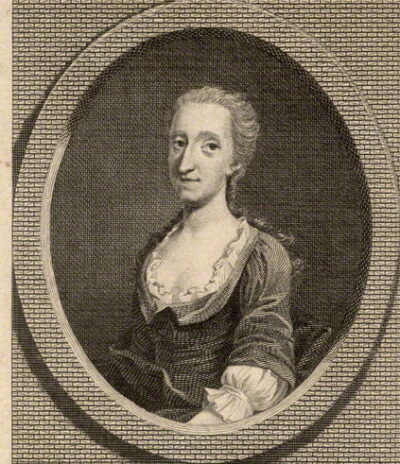
Catharine Trotter
Catharine Trotter was an English novelist, dramatist, philosopher. Born August 16, 1674, in London. Died May 11, 1749, in Longhorsley.
Facts
12 facts · 1 confirmed by two sources · 1 cited · 9 from one source · 1 where the sources disagree
What’s different
- Born: we show August 16, 1674 (Sources disagree). Wikipedia says August 16, 1679
Where this comes from
Papalocal keeps its own record. It started from these sources; what each one said is kept here as it was copied, so a change on their side never changes this page by itself. Tap one to read its version.
What Wikidata says · copied November 18, 2026 · revision 2566325825
- Described as
- English novelist, dramatist, philosopher (1674-1749)
- Other names
- Catharine Cockburn, Catharine Trotter Cockburn, Catherine Cockburn, Catherine Trother
- Born
- August 16, 1674 · 1 reference
- Died
- May 11, 1749 · 4 references
- Born in
- London
- Died in
- Longhorsley
- Buried in
- Protestant Cemetery, Rome
- Citizen of
- Kingdom of Great Britain
- Occupation
- playwright; writer · 1 reference; philosopher; novelist
- Religion
- Catholic Church
- Lived in
- Scotland
- Wikipedias with a page
- 20
Wikidata item Q1091103 (wikidata.org/wiki/Q1091103), public domain (CC0). Copied November 18, 2026.
What Wikipedia says · copied November 18, 2026 · revision 1382772784
Catharine Trotter Cockburn (16 August 1679 – 11 May 1749) was a Scottish novelist, dramatist and philosopher who wrote on various subjects, including moral philosophy and theology, and maintained a prolific correspondence.
Trotter's writings encompass a wide range of topics, such as necessity, the infinitude of space and substance. However, her primary focus was on moral issues. She believed that moral principles were not inherent but could be discovered by each individual through the use of reason, a faculty bestowed by God. In 1702, she published her first significant philosophical work, titled "A Defence of Mr. Lock's [sic.] An Essay Concerning Human Understanding." This defence received praise from John Locke, who expressed his appreciation by providing financial support and books to Trotter via Elizabeth Burnet, the intermediary who first acquainted Locke with Trotter's "Defence."
Trotter's work garnered the attention of William Warburton, who wrote a preface for her final philosophical work. Additionally, the biographer Thomas Birch approached her to assist him in compiling a collection of her works. Although Trotter agreed to the project, she died before the publication could be completed. As a result, Birch posthumously published a two-volume collection titled "The Works of Mrs. Catharine Cockburn, Theological, Moral, Dramatic and Poetical" in 1751. This collection serves as a primary source by which readers and historians have come to know her contributions.
- Born, in its opening lines
- August 16, 1679
- Died, in its opening lines
- May 11, 1749
From the Wikipedia article “Catharine Trotter Cockburn” (en.wikipedia.org/wiki/Catharine_Trotter_Cockburn), by its contributors, under CC BY-SA 4.0 (creativecommons.org/licenses/by-sa/4.0/). Copied November 18, 2026; not changed.
Confirmed Two sources agree. Cited One source, and it names where it got it. One source One source, without a reference of its own. Sources disagree The sources disagree. We show the best-supported value and keep theirs below.
