
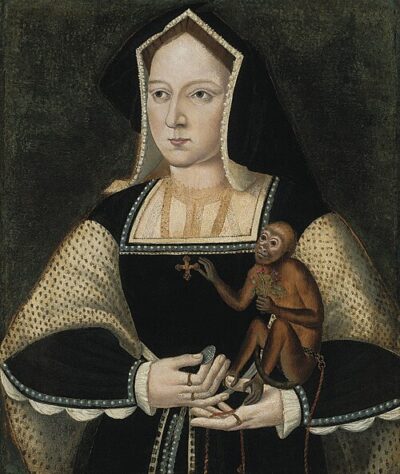
Catherine of Aragon
Catherine of Aragon was a first wife of Henry VIII of England. Born December 16, 1485, in Alcalá de Henares. Died January 7, 1536, in Kimbolton Castle. Positions held include Ambassador of the Kingdom of Spain to the Kingdom of England (1507–1509).
Facts
30 facts · 2 confirmed by two sources · 13 cited · 15 from one source
Where this comes from
Papalocal keeps its own record. It started from these sources; what each one said is kept here as it was copied, so a change on their side never changes this page by itself. Tap one to read its version.
What Wikidata says · copied November 16, 2026 · revision 2567736525
- Described as
- first wife of Henry VIII of England (1485–1536)
- Other names
- Catalina of Castile, Katherine of Aragon, Catalina of Aragon, Catalina de Aragón, Queen Catherine, Catherine of Arragon, Catalina de Aragón y Castilla, Catharine of Aragon, Catalina de Castilla, Catherine of Aragon and Castile
- Born
- December 16, 1485 · 8 references
- Died
- January 7, 1536 · 10 references
- Born in
- Alcalá de Henares · 1 reference
- Died in
- Kimbolton Castle
- Buried in
- Peterborough Cathedral
- Cause of death
- heart cancer
- Name at birth
- Catalina de Aragón y Castilla
- Citizen of
- Spain
- Occupation
- diplomat; aristocrat; queen consort (1509–1533)
- Positions held
- Ambassador of the Kingdom of Spain to the Kingdom of England (1507–1509)
- Spouse
- Arthur, Prince of Wales (1501–1502) · 2 references; Henry VIII of England (1509–1533) · 2 references
- Children
- stillborn daughter Tudor (1510) · 2 references; Henry, Duke of Cornwall; stillborn son Tudor · 2 references; Henry, Duke of Cornwall (1514) · 2 references; Mary I · 1 reference; stillborn daughter Tudor (1518) · 2 references
- Father
- Ferdinand II of Aragon · 1 reference
- Mother
- Isabella I of Castile · 1 reference
- Siblings
- Isabel of Aragon · 1 reference; John, Prince of Asturias; Juana I of Castile · 1 reference; Maria of Aragon · 1 reference; Alonso de Aragón; John of Aragon, Prince of Girona
- Religion
- Catholic Church; Catholicism · 1 reference
- Wikipedias with a page
- 84
Wikidata item Q162819 (wikidata.org/wiki/Q162819), public domain (CC0). Copied November 16, 2026.
What Wikipedia says · copied November 16, 2026 · revision 1383912708
Catherine of Aragon (also spelled Katherine; Spanish: Catalina de Aragón; 16 December 1485 – 7 January 1536) was Queen of England as the first wife of Henry VIII from their marriage on 11 June 1509 until its annulment on 23 May 1533. She had previously been Princess of Wales as the wife of Henry's elder brother Arthur, Prince of Wales for a short time before his death.
Catherine was born at the Archbishop's Palace of Alcalá de Henares, and was the youngest child of Isabella I of Castile and Ferdinand II of Aragon. She was three years old when she was betrothed to Arthur, the eldest son of Henry VII of England. They married in 1501, but Arthur died five months later. Catherine spent years in limbo, and during this time, she held the position of ambassador of the Aragonese crown to England in 1507, the first known female ambassador in European history. She married Henry VIII shortly after his accession in 1509. For six months in 1513, she served as regent of England while Henry was in France. During that time the English defeated a Scottish invasion at the Battle of Flodden, an event in which Catherine played an important part with an emotional speech about courage and patriotism.
By 1526, Henry was infatuated with Anne Boleyn and dissatisfied that his marriage to Catherine had produced no surviving sons, leaving their daughter Mary as heir presumptive at a time when there was no established precedent for a woman on the throne. He sought to have their marriage annulled, setting in motion a chain of events that led to England's schism from the Catholic Church. When Pope Clement VII refused to annul the marriage, Henry defied him by assuming supremacy over religious matters in England and marrying Anne secretly in 1532.
In 1533, Catherine's marriage was declared invalid by Henry's new Anglican Church, which subsequently validated his marriage to Anne without reference to the pope. Catherine refused to accept Henry as supreme head of the Church in England and considered herself the King's rightful wife and queen, attracting much popular sympathy. Despite this, Henry acknowledged her only as dowager princess of Wales. After being banished from court by Henry, Catherine lived out the remainder of her life at Kimbolton Castle, dying there in January 1536, probably of cancer. The English people held Catherine in high esteem, and her death set off tremendous mourning. Her daughter Mary became the first undisputed English queen regnant in 1553.
Catherine commissioned The Education of a Christian Woman by Juan Luis Vives, who dedicated the book, controversial at the time, to the Queen in 1523. Such was Catherine's impression on people that even her adversary Thomas Cromwell said of her, "If not for her sex, she could have defied all the heroes of History." She successfully appealed for the lives of the rebels involved in the Evil May Day, for the sake of their families, and also won widespread admiration by starting an extensive programme for the relief of the poor. Catherine was a patron of Renaissance humanism and a friend of the great scholars Erasmus and Thomas More.
- Born, in its opening lines
- December 16, 1485
- Died, in its opening lines
- January 7, 1536
From the Wikipedia article “Catherine of Aragon” (en.wikipedia.org/wiki/Catherine_of_Aragon), by its contributors, under CC BY-SA 4.0 (creativecommons.org/licenses/by-sa/4.0/). Copied November 16, 2026; not changed.
Confirmed Two sources agree. Cited One source, and it names where it got it. One source One source, without a reference of its own. Sources disagree The sources disagree. We show the best-supported value and keep theirs below.
