
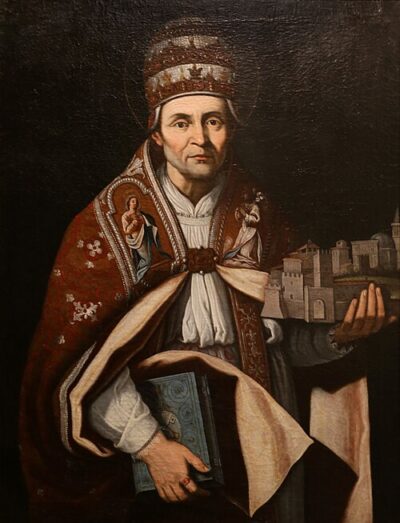
Celestine V
Celestine V was the 13th‑century Italian hermit and founder of the Celestines, Catholic saint, first pope to resign. Born 1215, in Sant'Angelo Limosano. Died May 19, 1296, in Fumone. Positions held include Pope (1294).
Facts
10 facts · 0 confirmed by two sources · 4 cited · 6 from one source
Where this comes from
Papalocal keeps its own record. It started from these sources; what each one said is kept here as it was copied, so a change on their side never changes this page by itself. Tap one to read its version.
What Wikidata says · copied November 16, 2026 · revision 2569065508
- Described as
- 13th‑century Italian hermit and founder of the Celestines, Catholic saint, first pope to resign
- Other names
- Pietro da Morrone, Pietro Angelerio, Petrus de Murrone, Coelestinus, Celestine, Peter of Morrone, Pier Celestino, Pietro Angeleri, Pietro del Morrone, Pietro Celestino, Pope Celestine V, Saint Celestine V
- Born
- 1215 · 1 reference
- Died
- May 19, 1296 · 2 references
- Born in
- Sant'Angelo Limosano
- Died in
- Fumone
- Buried in
- Basilica of St. Mary of Collemaggio
- Name at birth
- Pietro Angelerio
- Occupation
- Catholic priest; hermit · 1 reference
- Positions held
- Pope (1294)
- Religion
- Catholic Church · 1 reference
- Wikipedias with a page
- 81
Wikidata item Q118081 (wikidata.org/wiki/Q118081), public domain (CC0). Copied November 16, 2026.
What Wikipedia says · copied November 16, 2026 · revision 1366333420
Pope Celestine V (Latin: Caelestinus V; 1209/1210 or 1215 – 19 May 1296), born Pietro Angelerio (according to some sources Angelario, Angelieri, Angelliero, or Angeleri), also known as Pietro da Morrone, Peter of Morrone, and Peter Celestine, was head of the Catholic Church and ruler of the Papal States for five months from 5 July to 13 December 1294, when he abdicated. He was also a monk and hermit who founded the order of the Celestines as a branch of the Benedictine order.
He was elected pope in the Catholic Church's last non-conclave papal election, ending a two-year impasse. Among the few edicts of his to remain in force is the confirmation of the right of the pope to abdicate; nearly all of his other official acts were annulled by his successor, Boniface VIII. On 13 December 1294, a week after issuing the decree, Celestine resigned, stating his desire to return to his humble, pre-papal life. He was subsequently imprisoned by Boniface in the castle of Fumone in the Lazio region, in order to prevent his potential installation as antipope. He died in prison on 19 May 1296.
Celestine was canonized on 5 May 1313 by Pope Clement V. No subsequent pope has taken the name Celestine.
From the Wikipedia article “Pope Celestine V” (en.wikipedia.org/wiki/Pope_Celestine_V), by its contributors, under CC BY-SA 4.0 (creativecommons.org/licenses/by-sa/4.0/). Copied November 16, 2026; not changed.
Confirmed Two sources agree. Cited One source, and it names where it got it. One source One source, without a reference of its own. Sources disagree The sources disagree. We show the best-supported value and keep theirs below.
