
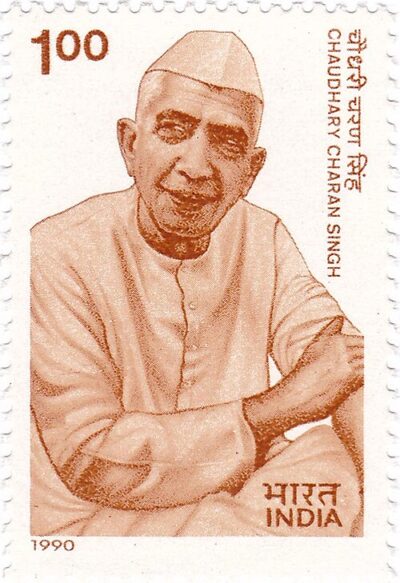
Charan Singh
Charan Singh was a Prime Minister of India. Born December 23, 1902, in Noorpur. Died May 29, 1987, in New Delhi. Positions held include Member of the Uttar Pradesh Legislative Assembly (1937–), Chief Minister of Uttar Pradesh (1967–1968) and Minister of Finance (1979). Educated at Dr. Bhimrao Ambedkar University and Meerut College.
Facts
24 facts · 2 confirmed by two sources · 1 cited · 21 from one source
Where this comes from
Papalocal keeps its own record. It started from these sources; what each one said is kept here as it was copied, so a change on their side never changes this page by itself. Tap one to read its version.
What Wikidata says · copied November 16, 2026 · revision 2563963775
- Described as
- Prime Minister of India (1979-1980)
- Other names
- Chaudhuri Charan Singh, Chaudhary Charan Singh, Chauduri Charan Singh
- Born
- December 23, 1902 · 1 reference
- Died
- May 29, 1987 · 2 references
- Born in
- Noorpur
- Died in
- New Delhi
- Cause of death
- cerebrovascular disease
- Citizen of
- British Raj (–1947); India (1950–); Dominion of India (1947–1950)
- Occupation
- politician; head of government · 1 reference
- Positions held
- Member of the Uttar Pradesh Legislative Assembly (1937–); Chief Minister of Uttar Pradesh (1967–1968); Minister of Finance (1979); Minister of Home Affairs (1977–1978); Deputy Prime Minister of India (1977–1979); Prime Minister of India (1979–1980); Member of the 7th Lok Sabha; Member of the 8th Lok Sabha
- Political party
- Janata Party (Secular); Janata Party
- Education
- Dr. Bhimrao Ambedkar University; Meerut College
- Children
- Ajit Singh
- Religion
- Hinduism
- Wikipedias with a page
- 60
Wikidata item Q319824 (wikidata.org/wiki/Q319824), public domain (CC0). Copied November 16, 2026.
What Wikipedia says · copied November 16, 2026 · revision 1380984341
Chaudhary Charan Singh (23 December 1902 – 29 May 1987) was an Indian politician, peasant leader, author and an independence activist who briefly served as the prime minister of India from July 1979 to January 1980. Singh was principally known for his land and agricultural reform initiatives, and was Member of Parliament (MP) for Baghpat. During his premiership, he was a member of the Janata Party (Secular). He served as the Chief Minister of Uttar Pradesh as a member of Bharatiya Kranti Dal. He also briefly served as the deputy prime minister of India from January 1979 to July 1979 as a member of the Janata Party. Singh is widely regarded as the "Champion of Farmers", dedicated to advocating for the well being and rights of farmers.
Singh was born in Meerut district, United Provinces of Agra and Oudh. He graduated from Agra College in 1923 with a Bachelor of Science degree, and then pursued Master of Arts in history in 1925. In 1927 he completed his Bachelor of Laws (LLB) from Meerut College.
Singh entered politics during Indian independence movement motivated by Mahatma Gandhi. Singh followed Gandhi in non-violent struggle for independence from the British Government, and was imprisoned several times. In 1930, he was sent to jail for six months by the British for contravention of the salt laws. He was jailed again for one year in November 1940 for individual Satyagraha movement. In August 1942 he was jailed again by the British under Defence of India Rules (DIR) and released in November 1943. He was a Congress member for most of his life, he later founded his own Lok Dal party. He is the first leader outside the Indian National Congress who formed government in northern India and became the chief minister of Uttar Pradesh. He is second deputy prime minister to become prime minister after his predecessor Desai. He was posthumously awarded the Bharat Ratna in 2024.
- Born, in its opening lines
- December 23, 1902
- Died, in its opening lines
- May 29, 1987
From the Wikipedia article “Charan Singh” (en.wikipedia.org/wiki/Charan_Singh), by its contributors, under CC BY-SA 4.0 (creativecommons.org/licenses/by-sa/4.0/). Copied November 16, 2026; not changed.
Confirmed Two sources agree. Cited One source, and it names where it got it. One source One source, without a reference of its own. Sources disagree The sources disagree. We show the best-supported value and keep theirs below.
