
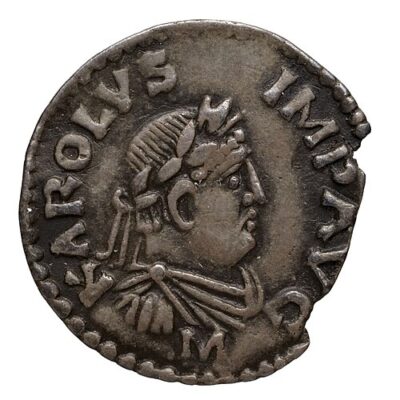
Charlemagne
Charlemagne was a king of Franks, regarded as the first Holy Roman Emperor (747–814). Born April 2, 748, in Francia. Died January 28, 814, in Aachen. Positions held include Duke of Bavaria, king of Franks (768–814) and King of Lombards (–814).
Facts
42 facts · 2 confirmed by two sources · 26 cited · 14 from one source
What’s different
- Born: we show April 2, 748 (Confirmed). Wikidata also lists April 2, 742 and April 10, 742
Where this comes from
Papalocal keeps its own record. It started from these sources; what each one said is kept here as it was copied, so a change on their side never changes this page by itself. Tap one to read its version.
What Wikidata says · copied November 16, 2026 · revision 2569131731
- Described as
- king of Franks, regarded as the first Holy Roman Emperor (747–814) (742-814)
- Other names
- Charles I, Charles the Great, Karl the Great, Emperor Charlemagne, Charlemagne the Franc, Carlus Magnus, Karolus Magnus, Carolus 'Magnus' Rex Francorum & Imperator Romanorum, Carolus Magnus
- Born
- April 2, 748 · 2 references; April 2, 742 · 2 references; April 10, 742 · 1 reference
- Died
- January 28, 814 · 6 references
- Born in
- Francia
- Died in
- Aachen · 7 references
- Buried in
- Palatine Chapel in Aachen · 2 references
- Cause of death
- disease
- Name at birth
- Karlus
- Citizen of
- Francia
- Occupation
- monarch · 1 reference; sovereign · 1 reference
- Positions held
- Duke of Bavaria; king of Franks (768–814); King of Lombards (–814) · 1 reference; Holy Roman Emperor (800–814)
- Spouse
- Desiderata of the Lombards (770–771) · 3 references; Hildegard of Vinzgouw (772–783) · 4 references; Fastrada (784–) · 2 references; Luitgard (794–) · 2 references; Himiltrude · 1 reference; Ethelind Adelinde · 1 reference
- Children
- Pepin the Hunchback · 1 reference; Charles the Younger · 1 reference; Rotrude · 1 reference; Bertha · 1 reference; Pepin of Italy · 1 reference; Louis the Pious · 3 references; Gisela · 1 reference; Theodrada; Drogo · 1 reference; Ούγος, ηγούμενος του Σαιν-Κεντέν; Adelaide · 1 reference; Lothair · 1 reference
- Father
- Pepin the Short · 2 references
- Mother
- Bertrada of Laon · 1 reference
- Siblings
- Gisela, Abbess of Chelles · 1 reference; Adelheid · 1 reference; Chrothais · 1 reference; Carloman I · 2 references; Pepin · 1 reference
- Religion
- Catholic Church; Christianity · 1 reference
- Height
- 1.84 m (6 ft 0 in) · 1 reference
- Wikipedias with a page
- 189
Wikidata item Q3044 (wikidata.org/wiki/Q3044), public domain (CC0). Copied November 16, 2026.
What Wikipedia says · copied November 16, 2026 · revision 1385906360
Charlemagne ( SHAR-lə-mayn; 2 April 748 – 28 January 814) was King of the Franks from 768, King of the Lombards from 774, and Emperor of what is now known as the Carolingian Empire from 800. He united most of Western and Central Europe and was the first recognised emperor to rule from the west after the fall of the Western Roman Empire approximately three centuries earlier. Charlemagne's reign was marked by political and social changes that had lasting influence on Europe throughout the Middle Ages.
A member of the Frankish Carolingian dynasty, Charlemagne was the eldest son of Pepin the Short and Bertrada of Laon. With his brother Carloman I, he became king of the Franks in 768 following Pepin's death and became the sole ruler three years later. Charlemagne continued his father's policy of protecting the papacy and became its chief defender, removing the Lombards from power in northern Italy in 774. His reign saw a period of expansion that led to the conquests of Bavaria, Saxony, and northern Spain, as well as other campaigns that led Charlemagne to extend his rule over a large part of Europe. Charlemagne spread Christianity to his new conquests, as seen at the Massacre of Verden against the Saxons. He also sent envoys and initiated diplomatic contact with Harun al-Rashid, the Abbasid caliph in the 790s, due to their mutual interest in Iberian affairs.
In 800, Charlemagne was crowned emperor in Rome by Pope Leo III. Although historians debate the coronation's significance, the title represented the height of his prestige and authority. Charlemagne's position as the first emperor in the West in over 300 years brought him into conflict with the Eastern Roman Empire in Constantinople. Through his assumption of the imperial title, he is considered the forerunner to the line of Holy Roman Emperors, which persisted into the 19th century. As king and emperor, Charlemagne engaged in numerous reforms in administration, law, education, military organisation, and religion, which shaped Europe for centuries. The stability of his reign began a period of cultural activity known as the Carolingian Renaissance.
Charlemagne died in 814 and was buried at the Palatine Chapel (now part of Aachen Cathedral) in Aachen, his imperial capital city. Charlemagne's influence on the Middle Ages and on the territory he ruled has led him to be called the "Father of Europe" by many historians. He is seen as a founding figure by multiple European states, and several historical royal houses of Europe trace their lineage back to him. Charlemagne has been the subject of artworks, monuments and literature during and after the medieval period.
- Born, in its opening lines
- April 2, 748
- Died, in its opening lines
- January 28, 814
From the Wikipedia article “Charlemagne” (en.wikipedia.org/wiki/Charlemagne), by its contributors, under CC BY-SA 4.0 (creativecommons.org/licenses/by-sa/4.0/). Copied November 16, 2026; not changed.
Confirmed Two sources agree. Cited One source, and it names where it got it. One source One source, without a reference of its own. Sources disagree The sources disagree. We show the best-supported value and keep theirs below.
