
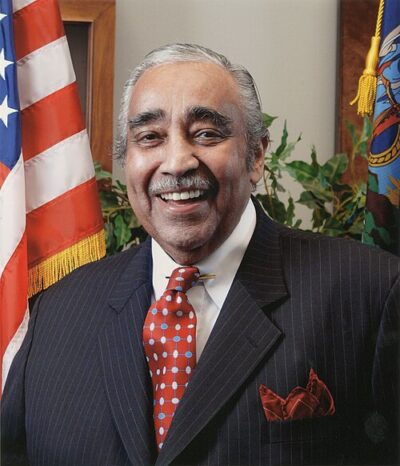
Charles B. Rangel
Charles B. Rangel was a former congressman from Harlem, New York. Born June 11, 1930, in Brooklyn. Died May 26, 2025, in Manhattan. Positions held include member of the New York State Assembly (1967–1970), United States representative (1971–2017) and United States Attorney for the Southern District of New York (–1963). Educated at Stern School of Business and St. John's University School of Law. Awards include Bronze Star Medal, Purple Heart and Dr. Nathan Davis Award for United States Representatives.
Facts
31 facts · 2 confirmed by two sources · 14 cited · 14 from one source · 1 where the sources disagree
What’s different
- Born in: we show Brooklyn (Sources disagree). Wikidata also lists Harlem
Where this comes from
Papalocal keeps its own record. It started from these sources; what each one said is kept here as it was copied, so a change on their side never changes this page by itself. Tap one to read its version.
What Wikidata says · copied November 16, 2026 · revision 2566740725
- Described as
- former congressman from Harlem, New York
- Other names
- Charles Rangel, Charles Bernard Rangel
- Born
- June 11, 1930 · 1 reference
- Died
- May 26, 2025 · 2 references
- Born in
- Harlem; Brooklyn · 1 reference
- Died in
- Manhattan · 1 reference
- Buried in
- Arlington National Cemetery
- Citizen of
- United States
- Occupation
- politician · 1 reference; lawyer · 1 reference
- Positions held
- member of the New York State Assembly (1967–1970) · 1 reference; United States representative (1971–2017); United States Attorney for the Southern District of New York (–1963) · 1 reference; Chair of the Congressional Black Caucus (1974–1976)
- Political party
- Democratic Party
- Education
- Stern School of Business (–1957) · 1 reference; St. John's University School of Law (–1960) · 1 reference; DeWitt Clinton High School · 1 reference; New York University · 1 reference; St. John's University · 1 reference
- Member of
- Alpha Phi Alpha; World Policy Council
- Awards
- Bronze Star Medal; Purple Heart; Dr. Nathan Davis Award for United States Representatives (1992); honorary doctor of Syracuse University (2001) · 1 reference; Phoenix Award (1986) · 1 reference; honorary doctor of the Hofstra University (1989); honorary doctorate from Bard College (2008) · 1 reference
- Religion
- Catholic Church
- Military branch
- United States Army (1948–1952) · 1 reference
- Military rank
- Staff Sergeant
- Website
- http://rangel.house.gov
- Wikipedias with a page
- 23
Wikidata item Q368091 (wikidata.org/wiki/Q368091), public domain (CC0). Copied November 16, 2026.
What Wikipedia says · copied November 16, 2026 · revision 1385397096
Charles Bernard Rangel ( RANG-gəl; June 11, 1930 – May 26, 2025) was an American politician who served as U.S. representative for districts in New York City for 46 years. A member of the Democratic Party, he was the second-longest serving incumbent member of the House of Representatives at the time of his retirement in 2017, having served continuously since 1971, and the ninth-longest serving in history. As its most senior member, he was also the dean of New York's congressional delegation. Rangel was the first African American chair of the influential House Ways and Means Committee. He was also a founding member of the Congressional Black Caucus.
Rangel was born in Harlem in Upper Manhattan. He earned a Purple Heart and a Bronze Star for his service in the United States Army during the Korean War, where he led a group of soldiers out of a deadly Chinese Army encirclement during the Battle of Kunu-ri in 1950. Rangel graduated from New York University in 1957 and St. John's University School of Law in 1960. He worked as a private lawyer, assistant U.S. attorney, and legal counsel during the early-mid-1960s. He served two terms in the New York State Assembly from 1967 to 1971 and defeated long-time incumbent Congressman Adam Clayton Powell Jr. in a primary challenge on his way to being elected to the House of Representatives.
Rangel rose rapidly in the Democratic ranks in the House, combining solidly liberal views with a pragmatic style that allowed him to find political and legislative compromises. His long-time concern with the importation and effects of illegal drugs led to his becoming chair of the House Select Committee on Narcotics, where he helped define national policy on the issue during the 1980s. As one of Harlem's "Gang of Four", he also became a leader in New York City and State politics. Rangel played a significant role in the creation of the 1995 Upper Manhattan Empowerment Zone Development Corporation and the national Empowerment Zone Act. Rangel was known both for what was his genial manner and his blunt speaking; he was long outspoken about his views and was arrested several times as part of political demonstrations. He was a strong opponent of the George W. Bush administration and the Iraq War, and he put forth proposals to reinstate the draft during the 2000s.
Beginning in 2008, Rangel faced allegations that he had violated House ethics rules and failed to abide by tax laws. The House Ethics Committee considered whether Rangel improperly rented multiple rent-stabilized New York apartments, improperly used his office in raising money for the Rangel Center at the City College of New York, and failed to disclose rental income from his villa in the Dominican Republic. In March 2010, Rangel stepped aside as the Ways and Means chair. In November 2010, the Ethics Committee found Rangel guilty of 11 counts of violating House ethics rules, and on December 2, 2010, the full House approved a sanction of censure against him. As his district became more Hispanic, Rangel faced two strong primary challengers during the 2012 and 2014 elections, but he nonetheless prevailed. He did not run for re-election in 2016 and left office in January 2017.
- Born, in its opening lines
- June 11, 1930
- Died, in its opening lines
- May 26, 2025
From the Wikipedia article “Charles Rangel” (en.wikipedia.org/wiki/Charles_Rangel), by its contributors, under CC BY-SA 4.0 (creativecommons.org/licenses/by-sa/4.0/). Copied November 16, 2026; not changed.
Confirmed Two sources agree. Cited One source, and it names where it got it. One source One source, without a reference of its own. Sources disagree The sources disagree. We show the best-supported value and keep theirs below.
