
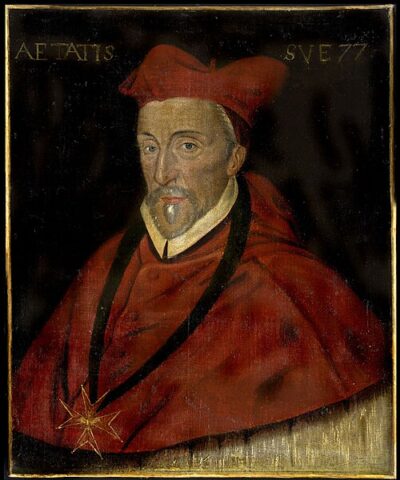
Charles, Cardinal de Bourbon
Charles, Cardinal de Bourbon was a Catholic cardinal. Born September 22, 1523, in La Ferté-sous-Jouarre. Died May 9, 1590, in Fontenay-le-Comte. Positions held include Archbishop of Rouen (1550–1590), cardinal (1548–1590) and Roman Catholic Bishop of Nevers (1540–1546). Awards include Commander of the Order of the Holy Spirit and Knight of the Order of Saint Michael.
Facts
29 facts · 2 confirmed by two sources · 5 cited · 22 from one source
Where this comes from
Papalocal keeps its own record. It started from these sources; what each one said is kept here as it was copied, so a change on their side never changes this page by itself. Tap one to read its version.
What Wikidata says · copied November 18, 2026 · revision 2557838655
- Described as
- Catholic cardinal (1523–1590)
- Other names
- Charles Cardinal Bourbon de Vendôme, Charles de Bourbon, Cardinal de Bourbon
- Born
- September 22, 1523 · 1 reference
- Died
- May 9, 1590 · 5 references
- Born in
- La Ferté-sous-Jouarre · 1 reference
- Died in
- Fontenay-le-Comte · 1 reference
- Buried in
- chartreuse d'Aubevoye
- Citizen of
- France
- Occupation
- Catholic priest; archbishop · 1 reference
- Positions held
- Archbishop of Rouen (1550–1590) · 2 references; cardinal (1548–1590) · 2 references; Roman Catholic Bishop of Nevers (1540–1546) · 2 references; Roman Catholic Bishop of Saintes (1544–1550) · 2 references; apostolic administrator (3 times) (1550–1575); abbot (2 times) (1537–1570); cardinal-deacon (1549–1561); Abbot of Corbie (1557–1580); cardinal priest (1561–1590)
- Awards
- Commander of the Order of the Holy Spirit; Knight of the Order of Saint Michael
- Father
- Charles, Duke of Vendôme
- Mother
- Françoise d'Alençon
- Siblings
- Antoine of Navarre; Louis, Prince of Condé; Jean, Count of Soissons and Enghien; Francis, Count of Enghien; Marguerite de Vendôme · 1 reference; Mary of Bourbon · 1 reference; Éléonore de Bourbon
- Religion
- Catholic Church · 1 reference
- Wikipedias with a page
- 22
Wikidata item Q544166 (wikidata.org/wiki/Q544166), public domain (CC0). Copied November 18, 2026.
What Wikipedia says · copied November 18, 2026 · revision 1386252817
Charles de Bourbon (22 September 1523 – 9 May 1590), known as the Cardinal de Bourbon, was a French noble and prelate. He was the Archbishop of Rouen from 1550 (as Charles I) and the Catholic Ligue candidate for King of France as Charles X from 1589.
Born the third son of Charles of Bourbon, Duke of Vendôme and Françoise d'Alençon he was destined for a career in the church. As a member of the House of Bourbon-Vendôme, he was a prince du sang. Already having secured several sees, he was made a cardinal by Pope Paul III in January 1548. In 1550 he received the office of Archbishop of Rouen making him the Primate of Normandy. The following year the promotion of Bourbon to Patriarch of the French church was threatened by King Henry II to secure concessions from the Pope. During the Italian Wars which resumed that year, Bourbon played a role by supporting Catherine de Medici's regency governments in France and briefly holding a lieutenant-generalship in Picardy. In 1557 the Pope appointed the Cardinals Bourbon, Lorraine and Châtillon as the leaders of an inquisition in France to root out heresy. The effectiveness of their inquisition would be obstructed by both the king and the Parlements and by July 1558 their appointments were voided by the Parlement of Paris.
Under the Guisard government that accompanied the reign of Francis II, Bourbon allied himself with the Guise, against his brothers. With his brother the Prince of Condé implicated in the Conspiracy of Amboise in March 1560, and further troubles in the south in the following months, Bourbon was tasked with coaxing the renegade prince to show himself at court, which he succeeded in doing in September, allowing Condé to be arrested and charged with treason. After the premature death of the king, Bourbon navigated himself into favour with the regency government of Catherine for Charles IX. In March 1562 he again assumed his duties in Paris, trying to avoid an explosive confrontation between Condé and the Duke of Guise. After the first civil war that followed that year, Bourbon was entrusted with pushing the terms through the Parlement, which he achieved. In the years that followed, Bourbon positioned himself on the centre of Catherine's council. He was increasingly disillusioned with his brother Condé and the Queen of Navarre, conducting a lawsuit against her without success. During the next two civil wars, he continued to fulfil diplomatic responsibilities for the crown. Bourbon was tasked with leading the mass that would celebrate the wedding between his nephew Henry of Navarre and Marguerite de Valois at their wedding. The lack of papal approval for the marriage terrified him, but he was eventually convinced to perform the ceremony.
After the fifth civil war, Bourbon virulently opposed the Peace of Monsieur, leading attempts to block it in Rouen. The new king Henry III entrusted him with persuading the Estates General to provide money for the resumed war effort, forced on the crown by the widespread opposition to the peace. He achieved little success. Henry was keen to overhaul the kingdom's finances and Bourbon participated in the various efforts towards this end in 1582 and 1586. However in the former assembly, Bourbon derailed proceedings with an outburst. He demanded for the king to expunge heresy.
In 1584, the king's brother Francis, Duke of Anjou died, making Bourbon's Protestant nephew the new heir to the throne. Neither Bourbon nor many other Catholics could tolerate such a prospect, and the notion of his succession to the throne as an alternative was established, formalised in a treaty with Spain in the Treaty of Joinville. In the following years, Bourbon supported the Catholic League in its efforts to enforce Catholic uniformity on Henry III. Henry was forced to agree to void Navarre's right to the succession, consequently making Bourbon his heir. After the day of the barricades, the liguer Estates General nominated Bourbon as the leader of the first estate. However the League was outflanked when Henry killed the young Duke of Guise and his brother. In the aftermath of this shocking development, much of the kingdom voided its allegiance to Henry and swore loyalty to the League and Bourbon as Charles X. Bourbon though had been arrested by the king in this sudden strike and he moved from château to château to keep him out of the hands of the League. In August 1589, Henry was in turn assassinated and the Parlement of Paris declared that Bourbon was now king. Nominally recognised as such across the League-dominated regions, he remained in the captivity of Henry of Navarre, dying in May 1590.
- Born, in its opening lines
- September 22, 1523
- Died, in its opening lines
- May 9, 1590
From the Wikipedia article “Charles, Cardinal de Bourbon (born 1523)” (en.wikipedia.org/wiki/Charles,_Cardinal_de_Bourbon_(born_1523)), by its contributors, under CC BY-SA 4.0 (creativecommons.org/licenses/by-sa/4.0/). Copied November 18, 2026; not changed.
Confirmed Two sources agree. Cited One source, and it names where it got it. One source One source, without a reference of its own. Sources disagree The sources disagree. We show the best-supported value and keep theirs below.
