
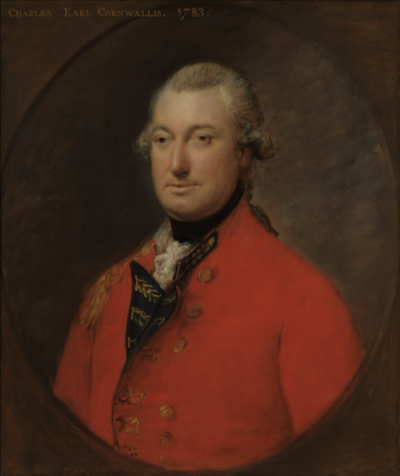
Charles Cornwallis, 1st Marquess Cornwallis
Charles Cornwallis, 1st Marquess Cornwallis was a British general, colonial official, diplomat. Born December 31, 1738, in Grosvenor Square. Died October 5, 1805, in Ghazipur. Positions held include Member of Parliament of Great Britain (1760–), Lord Lieutenant of Ireland (1798–1801) and Constable of the Tower (1770–1805). Educated at Eton College and Clare College. Awards include Knight of the Garter.
Facts
34 facts · 2 confirmed by two sources · 12 cited · 20 from one source
Where this comes from
Papalocal keeps its own record. It started from these sources; what each one said is kept here as it was copied, so a change on their side never changes this page by itself. Tap one to read its version.
What Wikidata says · copied November 16, 2026 · revision 2557836661
- Described as
- British general, colonial official, diplomat (1738–1805)
- Other names
- Charles Cornwallis, The Most Honourable The Marquess Cornwallis, Lord Cornwallis, The Earl Cornwallis, Cornwallis, Charles, first Marquis Cornwallis, Viscount Brome
- Born
- December 31, 1738 · 10 references
- Died
- October 5, 1805 · 10 references
- Born in
- Grosvenor Square
- Died in
- Ghazipur · 1 reference
- Cause of death
- fever
- Citizen of
- United Kingdom of Great Britain and Ireland
- Occupation
- diplomat; official; army officer · 1 reference; politician · 1 reference
- Positions held
- Member of Parliament of Great Britain (1760–); Lord Lieutenant of Ireland (1798–1801); Constable of the Tower (1770–1805); member of the 11th Parliament of Great Britain; member of the 12th Parliament of Great Britain; Lord Lieutenant of the Tower Hamlets (1771–1805); Governor-General of India (1786–1793); Master-General of the Ordnance (1795–1801)
- Political party
- Whigs
- Education
- Eton College · 1 reference; Clare College · 1 reference; Military Academy of Modena
- Awards
- Knight of the Garter (1786)
- Spouse
- Jemima Cornwallis, Countess Cornwallis (1768–) · 3 references
- Children
- Charles Cornwallis, 2nd Marquess Cornwallis; Lady Mary Cornwallis · 1 reference
- Father
- Charles Cornwallis, 1st Earl Cornwallis · 1 reference
- Mother
- Elizabeth Townshend · 2 references
- Siblings
- James Cornwallis, 4th Earl Cornwallis · 2 references; Mary Cornwallis · 1 reference; William Cornwallis · 1 reference
- Military branch
- British Army
- Military rank
- major general; general · 1 reference
- Wikipedias with a page
- 48
Wikidata item Q164723 (wikidata.org/wiki/Q164723), public domain (CC0). Copied November 16, 2026.
What Wikipedia says · copied November 16, 2026 · revision 1381307215
General Charles Cornwallis, 1st Marquess Cornwallis (31 December 1738 – 5 October 1805) was a British Army officer, Whig politician and colonial administrator. In the United States and United Kingdom, he is best known as one of the leading British general officers in the American War of Independence. His surrender in 1781 to a combined Franco-American force at the siege of Yorktown ended significant hostilities in North America. Cornwallis later served as a civil and military governor in Ireland, where he helped to bring about the Act of Union; and in India, where he helped to enact the Cornwallis Code and the Permanent Settlement.
Born into an aristocratic family and educated at Eton College and the University of Cambridge, Cornwallis joined the British Army in 1757, seeing action in the Seven Years' War. Upon his father's death in 1762 he succeeded to his peerage and entered the House of Lords. From 1766 to 1805 he was colonel of the 33rd Regiment of Foot. Cornwallis next saw military action in 1776 in the American War of Independence. Active in the advance forces of many campaigns, in 1780 he inflicted a major defeat on the Continental Army at the Battle of Camden. He also commanded British forces in the March 1781 in a pyrrhic victory at Guilford Court House. Cornwallis surrendered his army at Yorktown in October 1781 after an extended campaign through the Southern colonies, marked by disagreements between him and his superior, Sir Henry Clinton.
Despite this defeat, Cornwallis retained the confidence of successive British governments and continued to enjoy an active career. Knighted in 1786, he was in that year appointed to be Governor-General and commander-in-chief in India. There he enacted numerous significant reforms within the East India Company and its territories, including the Cornwallis Code, part of which implemented important land taxation reforms known as the Permanent Settlement. From 1789 to 1792 he led British and Company forces in the Third Anglo-Mysore War to defeat the Mysorean ruler Tipu Sultan.
Returning to Britain in 1794, Cornwallis was given the post of Master-General of the Ordnance. In 1798 he was appointed Lord Lieutenant and Commander-in-chief of Ireland, where he oversaw the response to the 1798 Irish Rebellion, including a French invasion of Ireland, and was instrumental in bringing about the Union of Great Britain and Ireland. Following his Irish service, Cornwallis was the chief British signatory to the 1802 Treaty of Amiens and was reappointed to India in 1805. He died in India not long after his arrival.
- Born, in its opening lines
- December 31, 1738
- Died, in its opening lines
- October 5, 1805
From the Wikipedia article “Charles Cornwallis, 1st Marquess Cornwallis” (en.wikipedia.org/wiki/Charles_Cornwallis,_1st_Marquess_Cornwallis), by its contributors, under CC BY-SA 4.0 (creativecommons.org/licenses/by-sa/4.0/). Copied November 16, 2026; not changed.
Confirmed Two sources agree. Cited One source, and it names where it got it. One source One source, without a reference of its own. Sources disagree The sources disagree. We show the best-supported value and keep theirs below.
