
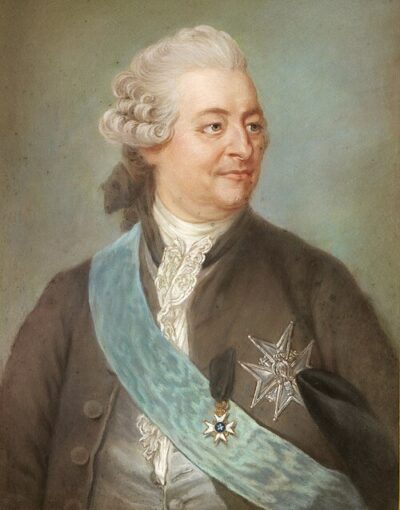
Charles De Geer
Charles De Geer was a Swedish entomologist, industrialist and civil servant. Born January 30, 1720, in Risinge church parish. Died March 7, 1778, in Stockholm. Educated at Utrecht University. Awards include Knight Grand Cross of the Order of Vasa and Knight of the Order of the Polar Star.
Facts
30 facts · 2 confirmed by two sources · 16 cited · 12 from one source
Where this comes from
Papalocal keeps its own record. It started from these sources; what each one said is kept here as it was copied, so a change on their side never changes this page by itself. Tap one to read its version.
What Wikidata says · copied November 18, 2026 · revision 2568218460
- Described as
- Swedish entomologist, industrialist and civil servant (1720-1778)
- Other names
- De Geer, Baron Charles de Geer, Charles de Geer Friherre af Leufstra, Carl De Geer, Charles de Geer
- Born
- January 30, 1720 · 2 references
- Died
- March 7, 1778 · 4 references
- Born in
- Risinge church parish · 1 reference
- Died in
- Stockholm · 2 references
- Buried in
- Uppsala Cathedral
- Citizen of
- Sweden
- Occupation
- entomologist · 1 reference; zoologist; industrialist; arachnologist; entrepreneur · 1 reference; bibliophile · 1 reference
- Education
- Utrecht University
- Member of
- Royal Swedish Academy of Sciences; French Academy of Sciences
- Awards
- Knight Grand Cross of the Order of Vasa; Knight of the Order of the Polar Star
- Field
- entomology
- Spouse
- Catharina Charlotta Ribbing (1743–1778) · 3 references
- Children
- Jacquelina Elisabet de Geer af Leufsta · 1 reference; Charlotte Du Rietz · 1 reference; Charles De Geer · 1 reference; Emanuel De Geer · 2 references; Hedvig Ulrika De Geer af Leufsta · 1 reference; Anton de Geer af Leufsta · 1 reference; Ebba Margareta De Geer · 1 reference; Louis De Geer · 1 reference
- Father
- Jean Jacques de Geer · 1 reference
- Mother
- Petronella van der Esch · 1 reference
- Siblings
- Louys de Geer af Finspång
- Wikipedias with a page
- 22
Wikidata item Q386375 (wikidata.org/wiki/Q386375), public domain (CC0). Copied November 18, 2026.
What Wikipedia says · copied November 18, 2026 · revision 1372303182
Charles De Geer (30 January 1720 – 7 March 1778) was an entomologist, industrialist, civil servant and book collector. He is sometimes referred to as Charles the Entomologist, to distinguish him from other relatives with the same name. Charles De Geer came from a prominent Swedish-Dutch family. Born in Sweden, he spent most of his childhood and youth in the Dutch Republic. At the age of 18 he moved back to Sweden and would spend the rest of his life there. Upon his return to Sweden, he took over the management of the ironworks of Lövstabruk. He was a successful businessman and with time became one of the richest men in Sweden, head of an early industry employing around 3,000 people. He had a successful civic career, became Marshal of the Court and was elevated to the rank of friherre (baron) in 1773.
De Geer had developed an interest in natural history and particularly entomology when he was still young. After his return to Sweden, his interest transformed into a serious scientific pursuit. He was elected a member of the Royal Swedish Academy of Sciences in 1739 and a corresponding member of the French Academy of Sciences in 1748. He published his main work on entomology, Mémoires pour servir à l'histoire des insectes, in French in eight volumes between 1752 and 1778. In it, he provided descriptions of the behaviour of over 1,400 insect species. In his writings, De Geer among other things brought the importance of insects as pollinators to the attention of the scientific community, and criticised the idea of spontaneous generation.
De Geer was also a book collector. He used his library for his research, but it contained books on many other subjects in several languages. Its sumptuous and rare works, including a collection of music scores, indicate that it was also intended as a way to raise De Geer's social status as an aristocratic collector. Since 1986 it belongs to Uppsala University Library, but most of it is still kept in situ in Lövstabruk, in the pavilion De Geer constructed to house the library.
- Born, in its opening lines
- January 30, 1720
- Died, in its opening lines
- March 7, 1778
From the Wikipedia article “Charles De Geer” (en.wikipedia.org/wiki/Charles_De_Geer), by its contributors, under CC BY-SA 4.0 (creativecommons.org/licenses/by-sa/4.0/). Copied November 18, 2026; not changed.
Confirmed Two sources agree. Cited One source, and it names where it got it. One source One source, without a reference of its own. Sources disagree The sources disagree. We show the best-supported value and keep theirs below.
