
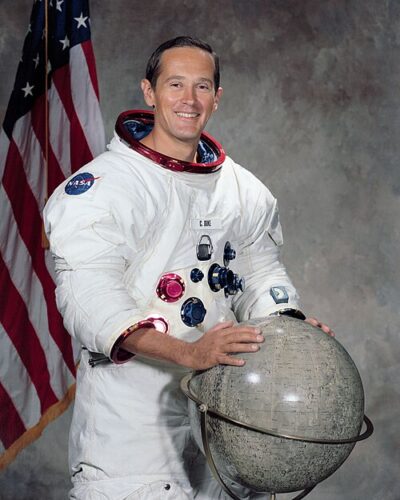
Charles Duke
Charles Duke is an American engineer, U.S. Air Force officer, test pilot, and NASA astronaut. Born October 3, 1935, in Charlotte. Educated at Massachusetts Institute of Technology and U.S. Air Force Test Pilot School. Awards include Legionnaire of Legion of Merit, United States Astronaut Hall of Fame and NASA Distinguished Service Medal.
Facts
28 facts · 1 confirmed by two sources · 5 cited · 22 from one source
Where this comes from
Papalocal keeps its own record. It started from these sources; what each one said is kept here as it was copied, so a change on their side never changes this page by itself. Tap one to read its version.
What Wikipedia says · copied November 13, 2026 · revision 1383459979
Charles Moss Duke Jr. (born October 3, 1935) is an American former astronaut, United States Air Force (USAF) officer and test pilot who, as Lunar Module pilot of Apollo 16 in 1972, became the 10th and youngest person to walk on the Moon, at age 36 years and 201 days. Duke is one of four surviving Moon walkers, along with David Scott, Buzz Aldrin and Harrison Schmitt.
A 1957 graduate of the United States Naval Academy, Duke joined the USAF and completed advanced flight training on the F-86 Sabre at Moody Air Force Base in Georgia, where he was a distinguished graduate. After completion of this training, Duke served three years as a fighter pilot with the 526th Fighter-Interceptor Squadron at Ramstein Air Base in West Germany. After graduating from the Aerospace Research Pilot School in September 1965, he stayed on as an instructor teaching control systems and flying in the F-101 Voodoo, F-104 Starfighter, and T-33 Shooting Star.
In April 1966, Duke was one of nineteen men selected for NASA's fifth astronaut group. In 1969, he was a member of the astronaut support crew for Apollo 10. He served as CAPCOM for Apollo 11, the first crewed landing on the Moon. His distinctive Southern drawl became familiar to audiences around the world, as the voice of Mission Control concerned by the long landing that almost expended all of the Lunar Module Eagle descent stage's propellant. Duke's first words to the Apollo 11 crew on the surface of the Moon were: "Roger, Twank...Tranquility, we copy you on the ground. You got a bunch of guys about to turn blue. We're breathing again. Thanks a lot!"
Duke was backup Lunar Module pilot on Apollo 13. Shortly before the mission, he caught rubella (German measles) from a friend's child and inadvertently exposed the prime crew to the disease. As Ken Mattingly had no natural immunity to the disease, he was replaced as command module pilot by Jack Swigert. Mattingly was reassigned as command module pilot of Duke's flight, Apollo 16. On this mission, Duke and John Young landed at the Descartes Highlands, and conducted three extravehicular activities (EVAs). He served as backup Lunar Module pilot for Apollo 17. Duke retired from NASA on January 1, 1976.
Following his retirement from NASA, Duke entered the Air Force Reserve and served as a mobilization augmentee to the Commander, USAF Basic Military Training Center, and to the Commander, USAF Recruiting Service. He graduated from the Industrial College of the Armed Forces in 1978. He was promoted to brigadier general in 1979, and retired in June 1986. He has logged 4,147 hours' flying time, of which 3,632 hours were in jet aircraft, and 265 hours were in space, including 21 hours and 38 minutes of EVA.
- Born, in its opening lines
- October 3, 1935
From the Wikipedia article “Charles Duke” (en.wikipedia.org/wiki/Charles_Duke), by its contributors, under CC BY-SA 4.0 (creativecommons.org/licenses/by-sa/4.0/). Copied November 13, 2026; not changed.
What Wikidata says · copied November 14, 2026 · revision 2569008369
- Described as
- American engineer, U.S. Air Force officer, test pilot, and NASA astronaut (born 1935)
- Other names
- Charles Moss Duke, Jr.
- Born
- October 3, 1935 · 1 reference
- Born in
- Charlotte · 1 reference
- Name at birth
- Charles M. Duke
- Citizen of
- United States
- Occupation
- air force officer; astronaut · 1 reference; test pilot · 1 reference; fighter pilot; flight instructor; aircraft pilot; businessperson
- Worked for
- National Aeronautics and Space Administration
- Education
- Massachusetts Institute of Technology; U.S. Air Force Test Pilot School; Admiral Farragut Academy · 1 reference; United States Naval Academy · 1 reference; Lancaster High School
- Member of
- NASA Astronaut Group 5
- Awards
- Legionnaire of Legion of Merit; United States Astronaut Hall of Fame; NASA Distinguished Service Medal (1972) · 1 reference; Distinguished Eagle Scout Award · 1 reference; Air Force Distinguished Service Medal · 1 reference; International Space Hall of Fame (1983) · 2 references; National Aviation Hall of Fame (2019) · 1 reference
- Military branch
- United States Air Force (1957–1986)
- Military rank
- brigadier general
- Website
- http://www.charlieduke.net/index.html · 1 reference
- Wikipedias with a page
- 46
Wikidata item Q112284 (wikidata.org/wiki/Q112284), public domain (CC0). Copied November 14, 2026.
Confirmed Two sources agree. Cited One source, and it names where it got it. One source One source, without a reference of its own. Sources disagree The sources disagree. We show the best-supported value and keep theirs below.
