
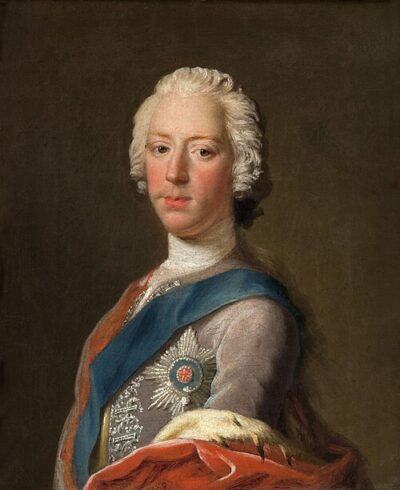
Charles Edward Stuart
Charles Edward Stuart was a Jacobite pretender to the thrones of England, Scotland, Ireland, and France;. Born December 31, 1720, in Rome. Died January 31, 1788, in Palazzo Muti. Positions held include Jacobite pretender (1766–1788). Awards include Order of the Garter.
Facts
20 facts · 1 confirmed by two sources · 6 cited · 11 from one source · 2 where the sources disagree
What’s different
- Died: we show January 31, 1788 (Sources disagree). Wikipedia says January 30, 1788
- Born in: we show Rome (Sources disagree). Wikidata also lists Palazzo Muti
Where this comes from
Papalocal keeps its own record. It started from these sources; what each one said is kept here as it was copied, so a change on their side never changes this page by itself. Tap one to read its version.
What Wikidata says · copied November 16, 2026 · revision 2566320131
- Described as
- Jacobite pretender to the thrones of England, Scotland, Ireland, and France; (1720-1788)
- Other names
- Charles Edward Louis John Casimir Sylvester Severino Maria Stuart, The Young Pretender, Bonnie Prince Charlie, Charles III of England, Scotland, and Ireland, Charles III of England, Scotland and Ireland, The Young Chevalier, Charles Edward
- Born
- December 31, 1720 · 5 references
- Died
- January 31, 1788 · 5 references
- Born in
- Palazzo Muti · 1 reference; Rome · 2 references
- Died in
- Palazzo Muti · 1 reference
- Buried in
- Vatican Grotto
- Cause of death
- stroke
- Citizen of
- Kingdom of Great Britain
- Occupation
- pretender; military leader; politician · 1 reference
- Positions held
- Jacobite pretender (1766–1788)
- Political party
- Jacobitism
- Awards
- Order of the Garter · 1 reference
- Field
- politics · 1 reference
- Spouse
- Princess Louise of Stolberg-Gedern (1772–1780) · 2 references
- Children
- Charlotte Stuart, Duchess of Albany
- Father
- James Francis Edward Stuart, Prince of Wales · 1 reference
- Mother
- Maria Clementina Sobieska · 1 reference
- Siblings
- Henry Benedict Stuart · 1 reference
- Religion
- Catholicism
- Wikipedias with a page
- 49
Wikidata item Q312581 (wikidata.org/wiki/Q312581), public domain (CC0). Copied November 16, 2026.
What Wikipedia says · copied November 16, 2026 · revision 1382947211
Charles Edward Louis John Sylvester Maria Casimir Stuart (31 December 1720 – 30 January 1788) was the elder son of James Francis Edward Stuart, making him the grandson of James VII and II, and the Stuart claimant to the thrones of England, Scotland, and Ireland from 1766. He is also known as the Young Pretender, the Young Chevalier and Bonnie Prince Charlie, and to Jacobites as Charles III. He led the failed Jacobite Rising of 1745 in an attempt to restore the Stuart dynasty to the thrones of England, Scotland, and Ireland.
Born in Rome to the exiled Stuart court, he spent much of his early and later life in Italy. In 1744, he travelled to France to take part in a planned invasion of England to restore the Stuart monarchy under his father. When storms partly wrecked the French fleet, Charles resolved to proceed to Scotland following discussion with leading Jacobites. This resulted in Charles landing by ship on the west coast of Scotland, leading to the Jacobite rising of 1745. The Jacobite forces under Charles initially achieved several victories in the field, including the Battle of Prestonpans in September 1745 and the Battle of Falkirk Muir in January 1746. However, by April 1746, Charles was defeated at Culloden, effectively ending the Stuart cause. Although there were subsequent attempts, such as a planned French invasion in 1759, Charles was unable to restore the Stuart monarchy.
With the Jacobite cause lost, Charles spent the remainder of his life on the continent, except for one secret visit to London. On his return, Charles lived briefly in France before he was exiled in 1748 under the terms of the Treaty of Aix-la-Chapelle. Charles eventually returned to Italy, where he spent much of his later life living in Florence and Rome. He had a number of mistresses before marrying Princess Louise of Stolberg-Gedern in 1772. In his later life, Charles's health declined greatly, and he was said to be an alcoholic. However, his escapades during the 1745 and 1746 uprisings and his escape from Scotland led to his portrayal as a romantic figure of heroic failure. His life and the once possible prospects of a restored Stuart monarchy left an enduring historical legend that continued to have a legacy as of the late 20th century.
- Born, in its opening lines
- December 31, 1720
- Died, in its opening lines
- January 30, 1788
From the Wikipedia article “Charles Edward Stuart” (en.wikipedia.org/wiki/Charles_Edward_Stuart), by its contributors, under CC BY-SA 4.0 (creativecommons.org/licenses/by-sa/4.0/). Copied November 16, 2026; not changed.
Confirmed Two sources agree. Cited One source, and it names where it got it. One source One source, without a reference of its own. Sources disagree The sources disagree. We show the best-supported value and keep theirs below.
