
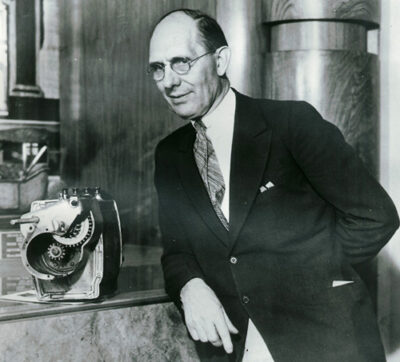
Charles F. Kettering
Charles F. Kettering was an American inventor, engineer, businessman, and the holder of 140 patents. Born August 29, 1876, in Loudonville. Died November 25, 1958, in Dayton. Educated at Ohio State University. Awards include Edison Medal, John Fritz Medal and ASME Medal.
Facts
31 facts · 2 confirmed by two sources · 16 cited · 13 from one source
Where this comes from
Papalocal keeps its own record. It started from these sources; what each one said is kept here as it was copied, so a change on their side never changes this page by itself. Tap one to read its version.
What Wikidata says · copied November 15, 2026 · revision 2567046921
- Described as
- American inventor, engineer, businessman, and the holder of 140 patents (1876–1958)
- Other names
- Charles Franklin Kettering
- Born
- August 29, 1876 · 6 references
- Died
- November 25, 1958 · 3 references
- Born in
- Loudonville · 1 reference
- Died in
- Dayton · 1 reference
- Buried in
- Woodland Cemetery and Arboretum
- Citizen of
- United States
- Occupation
- engineer · 1 reference; inventor · 1 reference; entrepreneur · 1 reference
- Worked for
- NCR Corporation (1904–1909); Delco Electronics (1909–1918); General Motors (1918–1947)
- Education
- Ohio State University (–1904)
- Member of
- National Academy of Sciences (1928–); Horatio Alger Association of Distinguished Americans; SAE International; American Society of Mechanical Engineers; Tau Beta Pi · 1 reference; National Research Council; American Philosophical Society (1930–)
- Awards
- Edison Medal (1958) · 1 reference; John Fritz Medal (1944) · 1 reference; ASME Medal (1940) · 1 reference; National Aviation Hall of Fame (1979) · 1 reference; National Inventors Hall of Fame (1980) · 1 reference; Hoover Medal (1955) · 1 reference; Franklin Medal (1936) · 1 reference; honorary doctor of the University of Miami (1947) · 1 reference; Washington Award (1936) · 1 reference; John Scott Award (1936) · 1 reference
- Nickname
- Boss Ket
- Wikipedias with a page
- 32
Wikidata item Q959123 (wikidata.org/wiki/Q959123), public domain (CC0). Copied November 15, 2026.
What Wikipedia says · copied November 15, 2026 · revision 1368736705
Charles Franklin Kettering (August 29, 1876 – November 25, 1958) sometimes known as Charles Fredrick Kettering was an American inventor, engineer, businessman, and the holder of 186 patents. He was a founder of Delco, and was head of research at General Motors from 1920 to 1947. Among his most widely used automotive developments were the electrical starting motor and leaded gasoline.
At DuPont, Kettering was also responsible for the development of Duco lacquers and enamels, the first practical colored paints for mass-produced automobiles. While working with the Dayton-Wright Company, he developed the "Bug" aerial torpedo, considered the world's first aerial missile. Kettering led the advancement of practical, lightweight two-stroke diesel engines, revolutionizing the locomotive and heavy equipment industries. In 1927, he founded the Kettering Foundation and was featured on the cover of Time magazine in January 1933.
- Born, in its opening lines
- August 29, 1876
- Died, in its opening lines
- November 25, 1958
From the Wikipedia article “Charles F. Kettering” (en.wikipedia.org/wiki/Charles_F._Kettering), by its contributors, under CC BY-SA 4.0 (creativecommons.org/licenses/by-sa/4.0/). Copied November 15, 2026; not changed.
Confirmed Two sources agree. Cited One source, and it names where it got it. One source One source, without a reference of its own. Sources disagree The sources disagree. We show the best-supported value and keep theirs below.
