
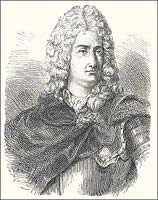
Charles François de Cisternay du Fay
Charles François de Cisternay du Fay was a French chemist. Born September 14, 1698, in Paris. Died July 16, 1739, in Paris. Positions held include director of the Muséum National d'Histoire Naturelle (1732–1739). Awards include Fellow of the Royal Society.
Facts
15 facts · 2 confirmed by two sources · 5 cited · 8 from one source
Where this comes from
Papalocal keeps its own record. It started from these sources; what each one said is kept here as it was copied, so a change on their side never changes this page by itself. Tap one to read its version.
What Wikidata says · copied November 16, 2026 · revision 2564335180
- Described as
- French chemist
- Born
- September 14, 1698 · 5 references
- Died
- July 16, 1739 · 5 references
- Born in
- Paris · 1 reference
- Died in
- Paris · 1 reference
- Cause of death
- smallpox
- Citizen of
- France
- Occupation
- chemist · 1 reference; physicist · 1 reference; writer
- Positions held
- director of the Muséum National d'Histoire Naturelle (1732–1739)
- Member of
- Royal Society of London; French Academy of Sciences
- Awards
- Fellow of the Royal Society
- Father
- Charles-Jérôme de Cisternay du Fay · 1 reference
- Military rank
- captain
- Wikipedias with a page
- 29
Wikidata item Q345455 (wikidata.org/wiki/Q345455), public domain (CC0). Copied November 16, 2026.
What Wikipedia says · copied November 16, 2026 · revision 1371979566
Charles François de Cisternay du Fay (14 September 1698 – 16 July 1739) was a French chemist and superintendent of the Jardin du Roi.
He discovered that some charged items would repel while some would attract and posited the existence of two types of electricity and named them "vitreous" and "resinous" (in fact he had discovered positive and negative charge, respectively) He noted the difference between conductors and insulators, calling them 'electrics' and 'non-electrics' for their ability to produce contact electrification. He also discovered that alike-charged objects would repel each other and that unlike-charged objects attract. He also disproved certain misconceptions regarding electric charge, such as that of Dr. Stephen Gray who believed that electric properties of a body depended on its colour. Du Fay's observations on electricity were reported in a paper written in December 1733 and printed in Volume 38 of the Philosophical Transactions of the Royal Society in 1734. He became a member of the French Academy of Sciences in 1723.
Du Fay died of smallpox in 1739.
- Born, in its opening lines
- September 14, 1698
- Died, in its opening lines
- July 16, 1739
From the Wikipedia article “Charles François de Cisternay du Fay” (en.wikipedia.org/wiki/Charles_François_de_Cisternay_du_Fay), by its contributors, under CC BY-SA 4.0 (creativecommons.org/licenses/by-sa/4.0/). Copied November 16, 2026; not changed.
Confirmed Two sources agree. Cited One source, and it names where it got it. One source One source, without a reference of its own. Sources disagree The sources disagree. We show the best-supported value and keep theirs below.
