
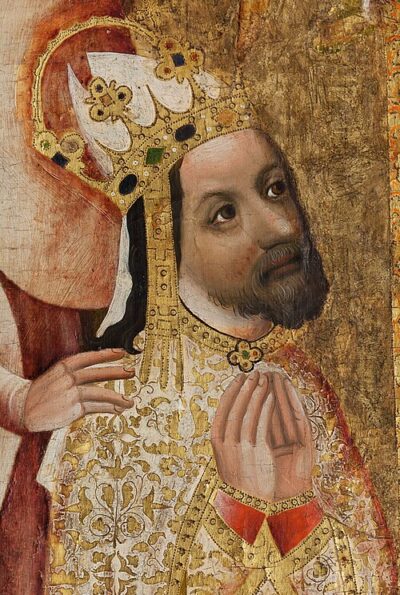
Charles IV
Charles IV was a Holy Roman Emperor. Born May 14, 1316, in Prague. Died November 29, 1378, in Prague. Positions held include Holy Roman Emperor (1355–1378), King of Bohemia (1346–1378) and Prince-Elector.
Facts
44 facts · 2 confirmed by two sources · 16 cited · 26 from one source
Where this comes from
Papalocal keeps its own record. It started from these sources; what each one said is kept here as it was copied, so a change on their side never changes this page by itself. Tap one to read its version.
What Wikidata says · copied November 16, 2026 · revision 2569839846
- Described as
- Holy Roman Emperor
- Other names
- Karl von Luxemburg, Charles of Luxembourg, Karl IV., Charles I of Bohemia
- Born
- May 14, 1316 · 11 references
- Died
- November 29, 1378 · 11 references
- Born in
- Prague · 5 references
- Died in
- Prague · 3 references
- Buried in
- St. Vitus Cathedral · 1 reference
- Cause of death
- pneumonia
- Citizen of
- Holy Roman Empire
- Occupation
- sovereign; writer · 1 reference; politician · 1 reference; monarch
- Positions held
- Holy Roman Emperor (1355–1378) · 1 reference; King of Bohemia (1346–1378); Prince-Elector; Count of Luxembourg (1346–1353); Margrave of Moravia (1333–1349)
- Field
- state governance · 1 reference; politics · 1 reference; military affairs · 1 reference; law · 1 reference; educational system · 1 reference; architecture · 1 reference
- Spouse
- Blanche of Valois (1323–1348) · 2 references; Anne of Bavaria (1349–1353); Anna von Schweidnitz (1353–1362) · 1 reference; Elizabeth of Pomerania (1363–1378) · 1 reference
- Children
- Catherine of Bohemia; Elisabeth of Bohemia; Wenceslaus IV of Bohemia; Anne of Bohemia; Sigismund; John of Görlitz; Margaret of Bohemia, Burgravine of Nuremberg; Margaret of Bohemia, Queen of Hungary; Karel of Bohemia · 1 reference
- Father
- John of Bohemia · 1 reference
- Mother
- Elizabeth of Bohemia · 1 reference
- Siblings
- Bonne de Luxembourg · 1 reference; Anne of Bohemia, Duchess of Austria; Margaret of Bohemia, Duchess of Bavaria; Nicolaus of Luxemburg; Wenceslaus I, Duke of Luxembourg; John Henry
- Religion
- Catholic Church · 1 reference
- Wikipedias with a page
- 83
Wikidata item Q155669 (wikidata.org/wiki/Q155669), public domain (CC0). Copied November 16, 2026.
What Wikipedia says · copied November 16, 2026 · revision 1383141473
Charles IV (German: Karl IV.; Czech: Karel IV.; Latin: Carolus IV; also known as Charles of Luxembourg German: Karl von Luxemburg; Czech: Karel Lucemburský; Latin: Carolus Luxemburgensis; Luxembourgish: Karel vu Lëtzebuerg; born Wenceslaus German: Wenzel; Czech: Václav; 14 May 1316 – 29 November 1378) was Holy Roman Emperor from 1355 until his death in 1378. He was elected King of Germany (King of the Romans) in 1346 and became King of Bohemia (as Charles I) that same year. He was a member of the House of Luxembourg from his father's side and the Bohemian House of Přemysl from his mother's side; he emphasized the latter due to his lifelong affinity for the Bohemian side of his inheritance, and also because his direct ancestors in the Přemyslid line included two saints.
He was the eldest son and heir of John of Bohemia, King of Bohemia and Count of Luxembourg, who died at the Battle of Crécy on 26 August 1346. His mother, Elizabeth, Queen of Bohemia, was the sister of Wenceslaus III, King of Bohemia and Poland, the last of the male Přemyslid rulers of Bohemia. Charles inherited the County of Luxembourg from his father and was elected king of the Kingdom of Bohemia. On 2 September 1347, Charles was crowned King of Bohemia.
On 11 July 1346, the prince-electors chose him as King of the Romans (rex Romanorum) in opposition to Louis IV, Holy Roman Emperor of the House of Wittelsbach. Charles was crowned on 26 November 1346 in Bonn. After his opponent died, he was re-elected in 1349 and crowned King of the Romans. In 1355, he was crowned King of Italy and Holy Roman Emperor. With his coronation as King of Burgundy at Arles in 1365, he became the crowned ruler of all the kingdoms of the Holy Roman Empire. Having played a key part in the political and cultural history of the Kingdom of Bohemia, he remains a popular historical figure in the Czech lands.
The Golden Bull of 1356 marked a structural change in the politics of the Holy Roman Empire. Several aspects of his legacy remain contentious, however. The image of Charles as a wise, pious, peace-loving king (partly constructed by Charles himself) has proved influential until this day, supported by several artistic or scholarly projects produced during Charles's reign or afterwards.
- Born, in its opening lines
- May 14, 1316
- Died, in its opening lines
- November 29, 1378
From the Wikipedia article “Charles IV, Holy Roman Emperor” (en.wikipedia.org/wiki/Charles_IV,_Holy_Roman_Emperor), by its contributors, under CC BY-SA 4.0 (creativecommons.org/licenses/by-sa/4.0/). Copied November 16, 2026; not changed.
Confirmed Two sources agree. Cited One source, and it names where it got it. One source One source, without a reference of its own. Sources disagree The sources disagree. We show the best-supported value and keep theirs below.
