
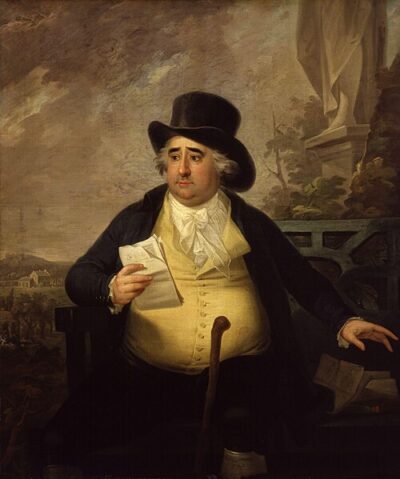
Charles James Fox
Charles James Fox was a British Whig statesman. Born January 24, 1749, in Westminster. Died September 13, 1806, in Chiswick. Positions held include Secretary of State for Foreign and Commonwealth Affairs (1806), Leader of the House of Commons (2 times) (1782–1806) and Member of the Privy Council of the United Kingdom. Educated at Eton College and Hertford College.
Facts
31 facts · 2 confirmed by two sources · 11 cited · 18 from one source
Where this comes from
Papalocal keeps its own record. It started from these sources; what each one said is kept here as it was copied, so a change on their side never changes this page by itself. Tap one to read its version.
What Wikidata says · copied November 16, 2026 · revision 2568749378
- Described as
- British Whig statesman (1749–1806)
- Other names
- Charles Fox I, Charles I Fox, Charles Fox, Charles, I Fox, Rt. Hon. Charles James Fox
- Born
- January 24, 1749 · 5 references
- Died
- September 13, 1806 · 7 references
- Born in
- Westminster
- Died in
- Chiswick · 1 reference
- Buried in
- Westminster Abbey
- Citizen of
- Kingdom of Great Britain
- Occupation
- politician · 1 reference; historian · 1 reference; abolitionist · 1 reference
- Positions held
- Secretary of State for Foreign and Commonwealth Affairs (1806); Leader of the House of Commons (2 times) (1782–1806); Member of the Privy Council of the United Kingdom; member of the 1st Parliament of the United Kingdom; member of the 2nd Parliament of the United Kingdom; member of the 13th Parliament of Great Britain; member of the 15th Parliament of Great Britain; member of the 16th Parliament of Great Britain; member of the 17th Parliament of Great Britain; member of the 18th Parliament of Great Britain; member of the 14th Parliament of Great Britain
- Political party
- Whigs
- Education
- Eton College · 1 reference; Hertford College
- Member of
- Académie des Inscriptions et Belles-Lettres (1802–1806) · 1 reference
- Field
- political activity · 1 reference
- Spouse
- Elizabeth Armtistead (1795–) · 1 reference
- Children
- unknown son Fox · 1 reference
- Father
- Henry Fox, 1st Baron Holland · 2 references
- Mother
- Caroline Fox, 1st Baroness Holland · 2 references
- Siblings
- Stephen Fox, 2nd Baron Holland · 1 reference; Henry Edward Fox · 1 reference
- Wikipedias with a page
- 41
Wikidata item Q438131 (wikidata.org/wiki/Q438131), public domain (CC0). Copied November 16, 2026.
What Wikipedia says · copied November 16, 2026 · revision 1379566036
Charles James Fox (24 January 1749 – 13 September 1806), styled The Honourable from 1762, was a British Whig statesman whose parliamentary career spanned 38 years of the late 18th and early 19th centuries. He was the arch-rival of the Tory politician William Pitt the Younger; his father Henry Fox, 1st Baron Holland, a leading Whig of his day, had similarly been the great rival of Pitt's famous father, William Pitt, 1st Earl of Chatham ("Pitt the Elder").
Fox rose to prominence in the House of Commons as a forceful and eloquent speaker with a notorious and colourful private life, though at that time with rather conservative and conventional opinions. However, with the coming of the American War of Independence and the influence of the Whig Edmund Burke, Fox's opinions evolved into some of the most radical to be aired in the British Parliament of his era.
Fox became a prominent and staunch opponent of King George III, whom he regarded as an aspiring tyrant. He supported the American Patriots and even dressed in the colours of George Washington's army. Briefly serving as Britain's first Foreign Secretary during the ministry of the Marquess of Rockingham in 1782, he returned to the post in a coalition government with his old enemy, Lord North, in 1783. However, the King forced Fox and North out of government before the end of the year and replaced them with the 24-year-old Pitt the Younger. Fox spent the following 22 years facing Pitt and the government from the opposition benches of the House of Commons.
Though Fox had little interest in the actual exercise of power and spent almost the entirety of his political career in opposition, he became noted as an anti-slavery campaigner, a supporter of the French Revolution and a leading parliamentary advocate of religious tolerance and individual liberty. His friendship with his mentor, Burke, and his parliamentary credibility were both casualties of Fox's support for France during the French Revolutionary Wars, but Fox went on to attack Pitt's wartime legislation and to defend the liberty of religious minorities and political radicals. After Pitt's death in January 1806, Fox served briefly as Foreign Secretary in the 'Ministry of All the Talents' of William Grenville before he died on 13 September 1806, aged 57.
- Born, in its opening lines
- January 24, 1749
- Died, in its opening lines
- September 13, 1806
From the Wikipedia article “Charles James Fox” (en.wikipedia.org/wiki/Charles_James_Fox), by its contributors, under CC BY-SA 4.0 (creativecommons.org/licenses/by-sa/4.0/). Copied November 16, 2026; not changed.
Confirmed Two sources agree. Cited One source, and it names where it got it. One source One source, without a reference of its own. Sources disagree The sources disagree. We show the best-supported value and keep theirs below.
