
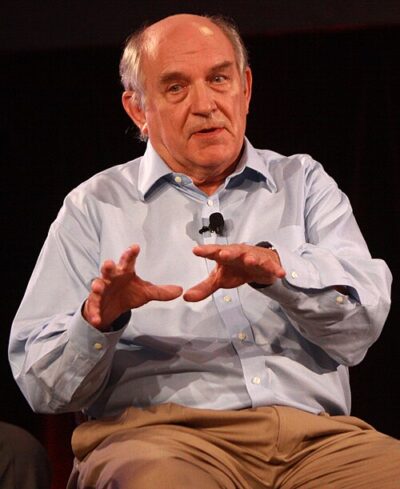
Charles Murray
Charles Murray is an American political scientist. Born January 8, 1943, in Newton. Known for The Bell Curve, Losing Ground and Coming Apart. Educated at Massachusetts Institute of Technology and Harvard College. Awards include Irving Kristol Award and Kistler Prize.
Facts
24 facts · 1 confirmed by two sources · 11 cited · 12 from one source
Where this comes from
Papalocal keeps its own record. It started from these sources; what each one said is kept here as it was copied, so a change on their side never changes this page by itself. Tap one to read its version.
What Wikidata says · copied November 16, 2026 · revision 2569973614
- Described as
- American political scientist (born 1943)
- Other names
- Charles Alan Murray, Charles A. Murray
- Born
- January 8, 1943 · 1 reference
- Born in
- Newton · 2 references
- Citizen of
- United States · 4 references
- Occupation
- political scientist; sociologist · 1 reference; author · 3 references; writer; Peace Corps · 1 reference
- Worked for
- American Enterprise Institute · 2 references; American Institutes for Research · 1 reference; Manhattan Institute for Policy Research · 1 reference
- Education
- Massachusetts Institute of Technology (–1974) · 1 reference; Harvard College (–1965) · 1 reference; Harvard University · 2 references
- Member of
- Peace Corps (1965–1967)
- Known for
- The Bell Curve; Losing Ground · 2 references; Coming Apart · 2 references
- Awards
- Irving Kristol Award (2009); Kistler Prize (2011)
- Field
- political science · 1 reference
- Religion
- agnosticism · 1 reference
- Lived in
- Thailand (1965–1971) · 1 reference; Frederick County · 1 reference
- Wikipedias with a page
- 21
Wikidata item Q1065595 (wikidata.org/wiki/Q1065595), public domain (CC0). Copied November 16, 2026.
What Wikipedia says · copied November 16, 2026 · revision 1379610572
Charles Alan Murray (; born January 8, 1943) is an American political scientist. He is the W.H. Brady Scholar at the American Enterprise Institute, a conservative think tank in Washington, D.C.
Murray's work is highly controversial. His book Losing Ground: American Social Policy, 1950–1980 (1984) discussed the American welfare system. In the book The Bell Curve (1994), he and co-author Richard Herrnstein argue that in 20th-century American society, intelligence became a better predictor than parental socioeconomic status or education level of many individual outcomes, including income, job performance, pregnancy out of wedlock, and crime, and that social welfare programs and education efforts to improve social outcomes for the disadvantaged are largely counterproductive. The Bell Curve also argues that average intelligence quotient (IQ) differences between racial and ethnic groups are at least partly genetic in origin, a view that is now considered discredited by mainstream science.
- Born, in its opening lines
- January 8, 1943
From the Wikipedia article “Charles Murray (political scientist)” (en.wikipedia.org/wiki/Charles_Murray_(political_scientist)), by its contributors, under CC BY-SA 4.0 (creativecommons.org/licenses/by-sa/4.0/). Copied November 16, 2026; not changed.
Confirmed Two sources agree. Cited One source, and it names where it got it. One source One source, without a reference of its own. Sources disagree The sources disagree. We show the best-supported value and keep theirs below.
