
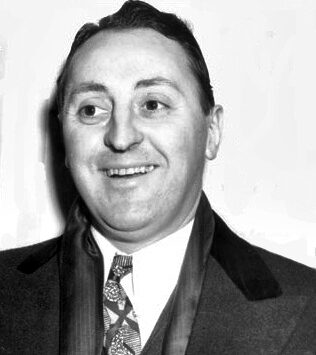
Charles Poletti
Charles Poletti was an American judge. Born July 2, 1903, in Barre. Died August 8, 2002, in Marco Island. Positions held include Governor of New York (1942) and Lieutenant Governor of New York (1939–1942). Educated at Harvard Law School and Spaulding High School. Awards include Knight Commander of the Order of St. Gregory the Great, Knight Commander of the Order of the British Empire and Legionnaire of Legion of Merit.
Facts
22 facts · 2 confirmed by two sources · 7 cited · 13 from one source
Where this comes from
Papalocal keeps its own record. It started from these sources; what each one said is kept here as it was copied, so a change on their side never changes this page by itself. Tap one to read its version.
What Wikidata says · copied November 18, 2026 · revision 2568789814
- Described as
- American judge (1903-2002)
- Born
- July 2, 1903 · 3 references
- Died
- August 8, 2002 · 2 references
- Born in
- Barre
- Died in
- Marco Island
- Buried in
- Calkins Cemetery · 1 reference
- Citizen of
- United States
- Occupation
- politician · 1 reference; lawyer · 1 reference; judge · 1 reference; colonel · 1 reference; governor · 1 reference; jurist · 1 reference
- Positions held
- Governor of New York (1942); Lieutenant Governor of New York (1939–1942)
- Political party
- Democratic Party
- Education
- Harvard Law School; Spaulding High School · 1 reference; Harvard University
- Member of
- Phi Beta Kappa Society
- Awards
- Knight Commander of the Order of St. Gregory the Great; Knight Commander of the Order of the British Empire; Legionnaire of Legion of Merit
- Wikipedias with a page
- 14
Wikidata item Q880602 (wikidata.org/wiki/Q880602), public domain (CC0). Copied November 18, 2026.
What Wikipedia says · copied November 18, 2026 · revision 1370465774
Charles Poletti (July 2, 1903 – August 8, 2002) was an American lawyer and politician. He became the 46th governor of New York in December 1942, and was the first person entirely of Italian-American ancestry to become the governor of a U.S. state.
Born in Barre, Vermont to Italian immigrants, Poletti graduated from Barre's Spaulding High School, Harvard University, and Harvard Law School, and became an attorney in New York City. He became active in the Democratic Party, and served as counsel to the Democratic National Committee, counsel to Governor Herbert H. Lehman, and a justice of the New York State Supreme Court.
Poletti served as lieutenant governor of New York from 1939 to 1942. He lost his bid for reelection in 1942, as did gubernatorial nominee John J. Bennett Jr. In December, Lehman resigned as governor in order to accept an appointment with the United States Department of State; Poletti succeeded to the governorship and served the final month of Lehman's term. After leaving office, Poletti served in World War II, initially as a special assistant to the Secretary of War, and then in the United States Army as a Civil Affairs officer responsible for rebuilding and restoring democracy in Italy following its liberation by the Allies.
After the war, Poletti practiced law, served as a member of the New York State Power Authority, and was an executive responsible for planning and overseeing execution of foreign exhibits at the 1964 New York World's Fair. After retiring, he resided in Florida and Elizabethtown, New York. He died in Florida at age 99, and was buried in Elizabethtown. At the time of his death, he was the earliest-serving living former governor of a U.S. state. Poletti also had the longest post-gubernatorial lifespan of any New York governor, nearly 60 years (1942–2002).
- Born, in its opening lines
- July 2, 1903
- Died, in its opening lines
- August 8, 2002
From the Wikipedia article “Charles Poletti” (en.wikipedia.org/wiki/Charles_Poletti), by its contributors, under CC BY-SA 4.0 (creativecommons.org/licenses/by-sa/4.0/). Copied November 18, 2026; not changed.
Confirmed Two sources agree. Cited One source, and it names where it got it. One source One source, without a reference of its own. Sources disagree The sources disagree. We show the best-supported value and keep theirs below.
