
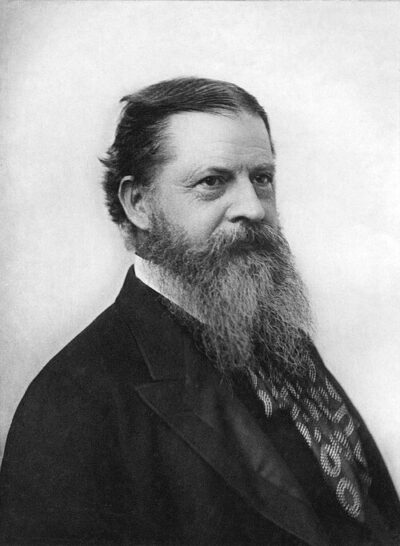
Charles Sanders Peirce
Charles Sanders Peirce was an American philosopher, logician, mathematician, and scientist. Born September 10, 1839, in Cambridge. Died April 19, 1914, in Milford. Known for Photometric Researches. Educated at Harvard University and Harvard School of Engineering and Applied Sciences. Awards include Fellow of the American Academy of Arts and Sciences.
Facts
33 facts · 2 confirmed by two sources · 8 cited · 23 from one source
Where this comes from
Papalocal keeps its own record. It started from these sources; what each one said is kept here as it was copied, so a change on their side never changes this page by itself. Tap one to read its version.
What Wikidata says · copied November 13, 2026 · revision 2561099034
- Described as
- American philosopher, logician, mathematician, and scientist (1839-1914)
- Other names
- CSP, Charles Sanders Santiago Peirce, Peirce, Charles S. Peirce, Charles Peirce, C. S. Peirce
- Born
- September 10, 1839 · 11 references
- Died
- April 19, 1914 · 11 references
- Born in
- Cambridge · 2 references
- Died in
- Milford · 2 references
- Buried in
- Milford Cemetery · 1 reference
- Citizen of
- United States
- Occupation
- mathematician · 1 reference; philosopher · 1 reference; logician; statistician; university teacher; linguist · 1 reference; surveyor · 1 reference; physicist
- Worked for
- Johns Hopkins University (1879–1884); National Geodetic Survey (1859–1891)
- Education
- Harvard University; Harvard School of Engineering and Applied Sciences
- Member of
- National Academy of Sciences · 1 reference; American Academy of Arts and Sciences
- Known for
- Photometric Researches
- Awards
- Fellow of the American Academy of Arts and Sciences · 1 reference
- Field
- lattice; semiotics; logic
- Spouse
- Juliette Peirce (1883–1914) · 1 reference; Melusina Fay Peirce (1863–1883) · 1 reference
- Father
- Benjamin Peirce
- Mother
- Sarah Hunt Mills
- Siblings
- Herbert H. D. Peirce; James Mills Peirce
- Religion
- Episcopal Church · 1 reference
- Lived in
- Arisbe (1887–1914)
- Wikipedias with a page
- 80
Wikidata item Q187520 (wikidata.org/wiki/Q187520), public domain (CC0). Copied November 13, 2026.
What Wikipedia says · copied November 13, 2026 · revision 1382180018
Charles Sanders Peirce ( PURSE; September 10, 1839 – April 19, 1914) was an American scientist, mathematician, logician, and philosopher who is sometimes known as "the father of pragmatism". According to philosopher Paul Weiss, writing in 1934, Peirce was "the most original and versatile of America's philosophers and America's greatest logician". Bertrand Russell wrote in 1959, "he was one of the most original minds of the later nineteenth century and certainly the greatest American thinker ever".
Educated as a chemist and employed as a scientist for thirty years, Peirce made major contributions to logic, such as theories of relations and quantification. C. I. Lewis wrote, "The contributions of C. S. Peirce to symbolic logic are more numerous and varied than those of any other writer—at least in the nineteenth century." For Peirce, logic also encompassed much of what is now called epistemology and the philosophy of science. He saw logic as the formal branch of semiotics or study of signs, of which he is a founder, which foreshadowed the debate among logical positivists and proponents of philosophy of language that dominated 20th-century Western philosophy. Peirce's study of signs also included a tripartite theory of predication.
Additionally, he defined the concept of abductive reasoning, as well as rigorously formulating mathematical induction and deductive reasoning. He was one of the founders of statistics. As early as 1886, he saw that logical operations could be carried out by electrical switching circuits. The same idea was used decades later to produce digital computers.
In metaphysics, Peirce was an "objective idealist" in the tradition of German philosopher Immanuel Kant as well as a scholastic realist about universals. He also held a commitment to the ideas of continuity and chance as real features of the universe, views he labeled synechism and tychism respectively. Peirce believed an epistemic fallibilism and anti-skepticism went along with these views.
- Born, in its opening lines
- September 10, 1839
- Died, in its opening lines
- April 19, 1914
From the Wikipedia article “Charles Sanders Peirce” (en.wikipedia.org/wiki/Charles_Sanders_Peirce), by its contributors, under CC BY-SA 4.0 (creativecommons.org/licenses/by-sa/4.0/). Copied November 13, 2026; not changed.
Confirmed Two sources agree. Cited One source, and it names where it got it. One source One source, without a reference of its own. Sources disagree The sources disagree. We show the best-supported value and keep theirs below.
