
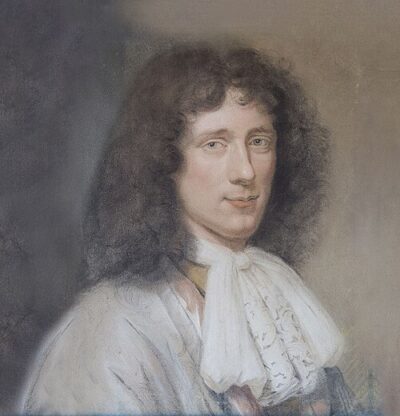
Christiaan Huygens
Christiaan Huygens was a Dutch mathematician, physicist and astronomer. Born April 14, 1629, in The Hague. Died July 8, 1695, in The Hague. Known for Horologium Oscillatorium, De Saturni Luna Observatio Nova and Systema Saturnium. Educated at Leiden University and University of Angers. Awards include Fellow of the Royal Society.
Facts
38 facts · 2 confirmed by two sources · 13 cited · 23 from one source
Where this comes from
Papalocal keeps its own record. It started from these sources; what each one said is kept here as it was copied, so a change on their side never changes this page by itself. Tap one to read its version.
What Wikidata says · copied November 16, 2026 · revision 2568744883
- Described as
- Dutch mathematician, physicist and astronomer (1629–1695)
- Other names
- Christiaen Huygens, Christian Huygens, Christian Hugenius
- Born
- April 14, 1629 · 14 references
- Died
- July 8, 1695 · 8 references
- Born in
- The Hague · 4 references
- Died in
- The Hague · 3 references
- Buried in
- Grote of Sint-Jacobskerk · 1 reference
- Citizen of
- Dutch Republic
- Occupation
- astronomer · 2 references; mathematician · 1 reference; physicist · 3 references; musicologist; inventor · 1 reference; music theorist; theoretical physicist; entomologist
- Worked for
- French Academy of Sciences (1666–1681) · 1 reference
- Education
- Leiden University (1645–1647) · 1 reference; University of Angers (–1655) · 1 reference; Orange College of Breda (1647–1649) · 1 reference
- Member of
- Royal Society of London (1663–); French Academy of Sciences (1666–)
- Known for
- Horologium Oscillatorium · 1 reference; De Saturni Luna Observatio Nova; Systema Saturnium; Treatise on Light; De Circuli Magnitudine Inventa; Cosmotheoros
- Awards
- Fellow of the Royal Society
- Field
- mathematics; mechanics; physics; astronomy
- Father
- Constantijn Huygens · 1 reference
- Mother
- Suzanna van Baerle
- Siblings
- Lodewijck Huygens; Constantijn Huygens Jr.; Philips Huygens · 1 reference; Susanna Huygens
- Religion
- Dutch Reformed Church
- Wikipedias with a page
- 121
Wikidata item Q39599 (wikidata.org/wiki/Q39599), public domain (CC0). Copied November 16, 2026.
What Wikipedia says · copied November 16, 2026 · revision 1385566277
Christiaan Huygens, Lord of Zeelhem (14 April 1629 – 8 July 1695) was a Dutch mathematician, physicist, engineer, astronomer, and inventor who is regarded as a key figure in the Scientific Revolution. In physics, Huygens made seminal contributions to optics and mechanics, while as an astronomer he studied the rings of Saturn and discovered its largest moon, Titan. As an engineer and inventor, he improved the design of telescopes and invented the pendulum clock, the most accurate timekeeper for almost 300 years. A talented mathematician and physicist, Huygens authored the first modern treatise where a physical problem was idealized using mathematical parameters, while his work on light contains the first mathematical and mechanistic explanation of an unobservable physical phenomenon.
Huygens first identified the correct laws of elastic collision in his work De Motu Corporum ex Percussione, completed in 1656 but published posthumously in 1703. In 1659, Huygens derived geometrically the formula in classical mechanics for the centrifugal force in his work De Vi Centrifuga, a decade before Isaac Newton. In optics, he is best known for his wave theory of light, which he described in his Traité de la Lumière (1690). His theory of light was initially rejected in favour of Newton's corpuscular theory of light, until Augustin-Jean Fresnel adapted Huygens's principle to give a complete explanation of the rectilinear propagation and diffraction effects of light in 1821. Today this principle is known as the Huygens–Fresnel principle.
Huygens invented and patented the pendulum clock in 1657, which was manufactured in Paris by Isaac II Thuret. Huygens's horological research led to an extensive analysis of the pendulum in Horologium Oscillatorium (1673), regarded as one of the most important 17th-century works on mechanics. While it contains descriptions of clock designs, most of the book is an analysis of pendular motion and a theory of curves. In 1655, Huygens began grinding lenses with his brother Constantijn to build refracting telescopes. He discovered Saturn's biggest moon, Titan, and was the first to explain Saturn's strange appearance as due to "a thin, flat ring, nowhere touching, and inclined to the ecliptic". In 1662, he developed what is now called the Huygenian eyepiece, a telescope with two lenses to diminish the amount of dispersion.
As a mathematician, Huygens developed his theory of evolutes and wrote on games of chance and the problem of points in Van Rekeningh in Spelen van Gluck, which Frans van Schooten translated and published as De Ratiociniis in Ludo Aleae (1657). The use of expected values by Huygens and others would later inspire Jacob Bernoulli's work on probability theory.
- Born, in its opening lines
- April 14, 1629
- Died, in its opening lines
- July 8, 1695
From the Wikipedia article “Christiaan Huygens” (en.wikipedia.org/wiki/Christiaan_Huygens), by its contributors, under CC BY-SA 4.0 (creativecommons.org/licenses/by-sa/4.0/). Copied November 16, 2026; not changed.
Confirmed Two sources agree. Cited One source, and it names where it got it. One source One source, without a reference of its own. Sources disagree The sources disagree. We show the best-supported value and keep theirs below.
