
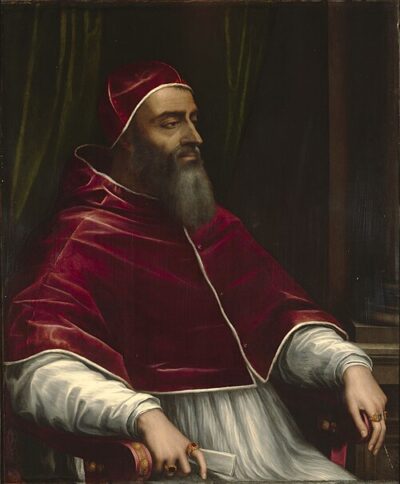
Clement VII
Clement VII was a pope of the Catholic Church from 1523 to 1534. Born May 26, 1478, in Florence. Died September 25, 1534, in Rome. Positions held include Pope (1523–1534), Camerlengo of the Sacred College of Cardinals (1519–1520) and cardinal (1513–1523).
Facts
27 facts · 2 confirmed by two sources · 8 cited · 16 from one source · 1 where the sources disagree
What’s different
- Buried in: we show Santa Maria sopra Minerva (Sources disagree). Wikidata also lists Tomb of Clemens VII
Where this comes from
Papalocal keeps its own record. It started from these sources; what each one said is kept here as it was copied, so a change on their side never changes this page by itself. Tap one to read its version.
What Wikidata says · copied November 16, 2026 · revision 2569091760
- Described as
- pope of the Catholic Church from 1523 to 1534 (1478–1534)
- Other names
- Pope Clement VII, Giulio de’ Medici, Clemens PP. VII, Giulio di Giuliano de Medici, Julius de Medicis, Giulio de Medici, Giulio di Giuliano de' Medici, Giulio de' Medici
- Born
- May 26, 1478 · 3 references
- Died
- September 25, 1534 · 3 references
- Born in
- Florence · 2 references
- Died in
- Rome · 2 references
- Buried in
- Santa Maria sopra Minerva · 1 reference; Tomb of Clemens VII · 1 reference
- Cause of death
- poison
- Name at birth
- Giulio Zanobi di Giuliano de' Medici
- Occupation
- Catholic priest (1517–) · 1 reference; transitional deacon (1513–) · 1 reference
- Positions held
- Pope (1523–1534) · 1 reference; Camerlengo of the Sacred College of Cardinals (1519–1520); cardinal (1513–1523) · 1 reference; Roman Caholic Bishop of Bologna (1518); Roman Catholic Archbishop of Florence (1513–1523) · 1 reference; Roman Catholic Archbishop of Narbonne (1515–1523); Roman Catholic Bishop of Albi (1513–1515) · 1 reference; apostolic administrator (2 times) (1517–1522) · 1 reference; cardinal-deacon (1513–1517); abbot (1516–1521); abbot of Cuixá (1516–1519); cardinal priest (1517–1523); Roman Catholic Bishop of Albenga-Imperia (1517–1518) · 1 reference; Roman Catholic Bishop of Eger (1520–1523)
- Children
- Alessandro de' Medici
- Father
- Giuliano de' Medici · 1 reference
- Mother
- Fioretta Gorini
- Religion
- Catholic Church · 1 reference
- Wikipedias with a page
- 84
Wikidata item Q83159 (wikidata.org/wiki/Q83159), public domain (CC0). Copied November 16, 2026.
What Wikipedia says · copied November 16, 2026 · revision 1385388205
Pope Clement VII (Latin: Clemens VII; Italian: Clemente VII; born Giulio di Giuliano de' Medici; 26 May 1478 – 25 September 1534) was head of the Catholic Church and ruler of the Papal States from 19 November 1523 to his death on 25 September 1534. Deemed "the most unfortunate of the popes", Clement VII's reign was marked by a rapid succession of political, military, and religious struggles—many long in the making—which had far-reaching consequences for Christianity and world politics.
Elected in 1523 at the end of the Italian Renaissance, Clement came to the papacy with a high reputation as a statesman. He had served with distinction as chief advisor to Pope Leo X (1513–1521, his cousin), Pope Adrian VI (1522–1523), and commendably as gran maestro of Florence (1519–1523). Assuming leadership at a time of crisis, with the Protestant Reformation spreading, the Church nearing bankruptcy, and large foreign armies invading Italy, Clement initially tried to unite Christendom by making peace among the many Christian leaders then at odds. He later attempted to liberate Italy from foreign occupation, believing that it threatened the Church's freedom.
The complex political situation of the 1520s repeatedly thwarted Clement's efforts. He inherited unprecedented challenges, including Martin Luther's Protestant Reformation in Northern Europe; a vast power struggle in Italy between Europe's two most powerful monarchs, Charles V of the Holy Roman Empire and Francis I of France, each of whom demanded that the Pope choose a side; and Turkish invasions of Eastern Europe led by Suleiman the Magnificent. Clement's problems were exacerbated by souring relations with Charles V in 1527, which led to the violent Sack of Rome, during which Clement was imprisoned. After escaping confinement in the Castel Sant'Angelo, Clement—with few economic, military, or political options remaining—compromised the Church's and the Papal States' independence by allying with his former enemy, Charles V. His difficulties continued during Henry VIII of England's contentious effort to annul his marriage, resulting in England breaking away from the Catholic Church.
In contrast to his tortured pontificate, Clement was personally respectable and devout, possessing a "dignified propriety of character", "great acquirements both theological and scientific", as well as "extraordinary address and penetration—Clement VII, in serener times, might have administered the Papal power with high reputation and enviable prosperity. But with all of his profound insight into the political affairs of Europe, Clement does not seem to have comprehended the altered position of the Pope" in relation to Europe's emerging nation-states and Protestantism.
Clement left a significant cultural legacy in the Medici tradition. He commissioned artworks by Raphael, Benvenuto Cellini, and Michelangelo, including Michelangelo's The Last Judgment in the Sistine Chapel. In matters of science, Clement is best known for approving, in 1533, Nicolaus Copernicus's theory that the Earth revolves around the Sun—99 years before Galileo Galilei's heresy trial.
- Born, in its opening lines
- May 26, 1478
- Died, in its opening lines
- September 25, 1534
From the Wikipedia article “Pope Clement VII” (en.wikipedia.org/wiki/Pope_Clement_VII), by its contributors, under CC BY-SA 4.0 (creativecommons.org/licenses/by-sa/4.0/). Copied November 16, 2026; not changed.
Confirmed Two sources agree. Cited One source, and it names where it got it. One source One source, without a reference of its own. Sources disagree The sources disagree. We show the best-supported value and keep theirs below.
