
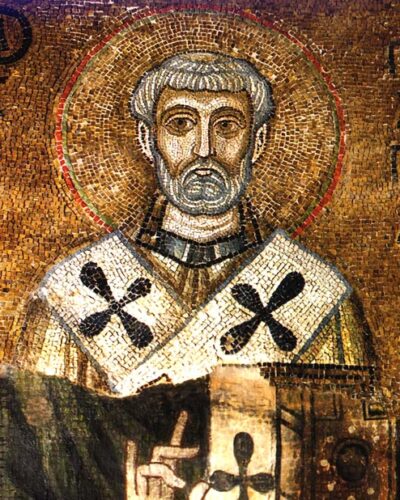
Clement
Clement was the 4th Pope of the Catholic Church. Born 1st century, in Rome. Died 99, in Chersonesus. Positions held include Pope (88–99). Known for First Epistle of Clement.
Facts
18 facts · 0 confirmed by two sources · 4 cited · 14 from one source
Where this comes from
Papalocal keeps its own record. It started from these sources; what each one said is kept here as it was copied, so a change on their side never changes this page by itself. Tap one to read its version.
What Wikidata says · copied November 16, 2026 · revision 2569038599
- Described as
- 4th Pope of the Catholic Church
- Other names
- Pope Clement I, Clement of Rome, Saint Clement I, Clemens I, Pope Saint Clement I, Saint Clement, Pope Kelemen I, Pope Klyment I, Pope Klemens I, Clement the Bishop, Clemens the Bishop, Flavius Clemens
- Born
- 1st century
- Died
- 99 · 1 reference
- Born in
- Rome
- Died in
- Chersonesus
- Buried in
- Basilica of San Clemente
- Cause of death
- execution by drowning
- Citizen of
- Ancient Rome
- Occupation
- theologian · 1 reference; Catholic priest
- Positions held
- Pope (88–99) · 1 reference
- Known for
- First Epistle of Clement
- Father
- Titus Flavius Sabinus
- Mother
- Arrecina
- Siblings
- Titus Flavius Sabinus; Titus Flavius Clemens; Flavia Plautilla
- Religion
- Catholic Church · 1 reference
- Nickname
- Clement I
- Wikipedias with a page
- 110
Wikidata item Q42887 (wikidata.org/wiki/Q42887), public domain (CC0). Copied November 16, 2026.
What Wikipedia says · copied November 16, 2026 · revision 1381177456
Clement of Rome (Latin: Clemens Romanus; Ancient Greek: Κλήμης Ῥώμης, romanized: Klēmēs Rōmēs; died c. 100), also known as Pope Clement I, was the bishop of Rome in the late first century. He is considered to be the first of the Apostolic Fathers of the Church.
Little is known about Clement's life. Tertullian claimed that Clement was ordained by Saint Peter. Early church lists place him as the second or third bishop of Rome. Eusebius, in his book Church History mentioned Clement as the third bishop of Rome and as the "co-laborer" of Paul. In Against Heresies, Irenaeus described Clement as the successor to Anacletus, who was the third bishop of Rome, and as a personal acquaintance of the Apostles. According to the Annuario Pontificio, Clement was the fourth bishop of Rome, holding office at the very end of the 1st century. It is likely that Clement died in exile, and was possibly martyred. According to apocryphal stories dating back to the 4th century by authors such as Rufinus, Clement was imprisoned by Roman Emperor Trajan, and was executed by being tied to an anchor and thrown into the sea. The Liber Pontificalis states that Clement died in Greece in the third year of Trajan's reign, or 100.
The only known genuine extant writing of Clement is his letter to the church at Corinth (1 Clement) in response to a dispute in which certain presbyters of the Corinthian church had been deposed. He asserted the authority of the presbyters as rulers of the church because they had been appointed by the Apostles. His letter, which is one of the oldest extant Christian documents outside the New Testament, was read in the church at Corinth, along with other epistles, some of which later became part of the Christian canon. This letter is considered to be the earliest affirmation of the principle of apostolic succession. A second epistle, 2 Clement, was once controversially attributed to Clement, although recent scholarship suggests it to be a homily by another author. In the pseudo-Clementine Writings, Clement is the intermediary through whom the apostles teach the church.
Clement is recognized as a saint in many Christian churches and a patron saint of mariners. He is commemorated on 23 November in the Catholic Church, the Anglican Communion, and the Lutheran Church. In Eastern Orthodox Christianity his feast is kept on 25 November.
From the Wikipedia article “Clement of Rome” (en.wikipedia.org/wiki/Clement_of_Rome), by its contributors, under CC BY-SA 4.0 (creativecommons.org/licenses/by-sa/4.0/). Copied November 16, 2026; not changed.
Confirmed Two sources agree. Cited One source, and it names where it got it. One source One source, without a reference of its own. Sources disagree The sources disagree. We show the best-supported value and keep theirs below.
