
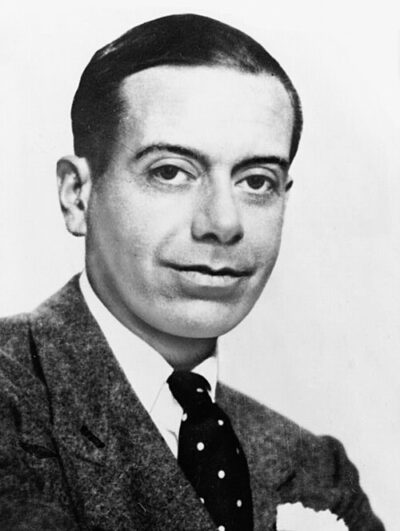
Cole Porter
Cole Porter was an American composer and songwriter. Born June 9, 1891, in Peru. Died October 15, 1964, in Santa Monica. Known for Night and Day and So Near and Yet so Far. Educated at Harvard Law School and Yale University. Awards include Grammy Trustees Award, star on Hollywood Walk of Fame and Tony Award for Best Original Score.
Facts
32 facts · 2 confirmed by two sources · 8 cited · 22 from one source
Where this comes from
Papalocal keeps its own record. It started from these sources; what each one said is kept here as it was copied, so a change on their side never changes this page by itself. Tap one to read its version.
What Wikidata says · copied November 13, 2026 · revision 2563874920
- Described as
- American composer and songwriter (1891–1964)
- Other names
- Cole Albert Porter
- Born
- June 9, 1891 · 17 references
- Died
- October 15, 1964 · 18 references
- Born in
- Peru
- Died in
- Santa Monica · 2 references
- Buried in
- Mount Hope Cemetery · 2 references
- Cause of death
- kidney failure
- Name at birth
- Cole Albert Porter
- Citizen of
- United States
- Occupation
- playwright; composer · 2 references; pianist; lyricist · 1 reference; songwriter; film score composer; writer · 1 reference; art collector
- Education
- Harvard Law School; Yale University; Harvard University; Schola Cantorum de Paris · 1 reference; Worcester Academy · 1 reference
- Genre
- musical play
- Instrument
- piano
- Known for
- Night and Day; So Near and Yet so Far
- Awards
- Grammy Trustees Award (1989); star on Hollywood Walk of Fame · 1 reference; Tony Award for Best Original Score (1949) · 1 reference; Tony Award for Best Musical (1949) · 1 reference
- Spouse
- Linda Lee Thomas
- Mother
- Kate Porter · 1 reference
- Website
- http://www.coleporter.org/
- Wikipedias with a page
- 59
Wikidata item Q215120 (wikidata.org/wiki/Q215120), public domain (CC0). Copied November 13, 2026.
What Wikipedia says · copied November 13, 2026 · revision 1377058554
Cole Albert Porter (June 9, 1891 – October 15, 1964) was an American composer and songwriter. Many of his songs became standards noted for their witty, urbane lyrics, and many of his scores found success on Broadway and in Hollywood films.
Born to a wealthy family in Indiana, Porter defied his grandfather's wishes for him to practice law and took up music as a profession. Classically trained, he was drawn to musical theatre. After a slow start, he began to achieve success in the 1920s, and by the 1930s he was one of the major songwriters for the Broadway musical stage. Unlike many successful Broadway composers, Porter wrote the lyrics as well as the music for his songs.
After a serious horseback riding accident in 1937, Porter was left disabled and in constant pain, but he continued to work. His shows of the early 1940s did not contain the lasting hits of his best work of the 1920s and 1930s, but in 1948 he made a triumphant comeback with his most successful musical, Kiss Me, Kate. It won the first Tony Award for Best Musical.
Porter's other musicals include Fifty Million Frenchmen, DuBarry Was a Lady, Anything Goes, Can-Can and Silk Stockings. His hit songs include "Night and Day", "Begin the Beguine", "I Get a Kick Out of You", "Well, Did You Evah!", "I've Got You Under My Skin", "Let's Do It, Let's Fall in Love", "My Heart Belongs to Daddy" and "You're the Top". He also composed scores for films from the 1930s to the 1950s, including Born to Dance (1936), which featured the song "You'd Be So Easy to Love"; Rosalie (1937), which featured "In the Still of the Night"; High Society (1956), which included "True Love"; and Les Girls (1957) which featured "Ça, C'est L'amour".
- Born, in its opening lines
- June 9, 1891
- Died, in its opening lines
- October 15, 1964
From the Wikipedia article “Cole Porter” (en.wikipedia.org/wiki/Cole_Porter), by its contributors, under CC BY-SA 4.0 (creativecommons.org/licenses/by-sa/4.0/). Copied November 13, 2026; not changed.
Confirmed Two sources agree. Cited One source, and it names where it got it. One source One source, without a reference of its own. Sources disagree The sources disagree. We show the best-supported value and keep theirs below.
