
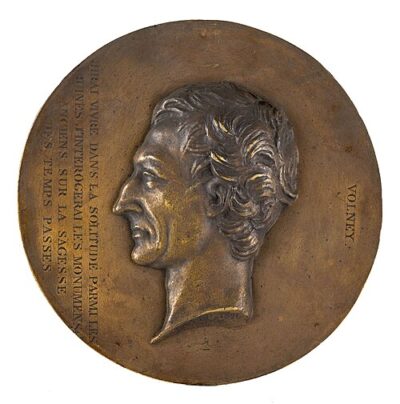
Constantin-François Chassebœuf
Constantin-François Chassebœuf was a French philosopher, historian, orientalist, and politician. Born February 3, 1757, in Craon. Died April 25, 1820, in Paris. Positions held include deputy to the National Constituent Assembly of 1789 (1789–1791), Pair of France and member of the Sénat conservateur. Awards include Commander of the Legion of Honour.
Facts
24 facts · 2 confirmed by two sources · 9 cited · 12 from one source · 1 where the sources disagree
What’s different
- Buried in: we show Père Lachaise Cemetery (Sources disagree). Wikidata also lists Grave of Volney
Where this comes from
Papalocal keeps its own record. It started from these sources; what each one said is kept here as it was copied, so a change on their side never changes this page by itself. Tap one to read its version.
What Wikidata says · copied November 16, 2026 · revision 2567363421
- Described as
- French philosopher, historian, orientalist, and politician (1757-1820)
- Other names
- Constantin Francois Chasseboeuf de, comte de Volney, comte de Volney, Volney, Constantin-François Volney, Constantin François Chasseboeuf, comte de Volney, Constantin-François Chassebœuf de La Giraudais
- Born
- February 3, 1757 · 7 references
- Died
- April 25, 1820 · 5 references
- Born in
- Craon · 1 reference
- Died in
- Paris · 1 reference
- Buried in
- Père Lachaise Cemetery; Grave of Volney
- Name at birth
- Constantin-François Chassebœuf de La Giraudais
- Citizen of
- France · 1 reference
- Occupation
- explorer; politician; historian; philosopher · 1 reference; moralist; agronomist; writer · 2 references; scholar · 1 reference
- Positions held
- deputy to the National Constituent Assembly of 1789 (1789–1791) · 1 reference; Pair of France; member of the Sénat conservateur; Member of the Académie française (1803–1820) · 1 reference
- Member of
- Académie Française (1803–1820) · 1 reference; American Philosophical Society (1797–)
- Awards
- Commander of the Legion of Honour · 1 reference
- Field
- oriental studies · 1 reference
- Religion
- atheism
- Wikipedias with a page
- 34
Wikidata item Q466093 (wikidata.org/wiki/Q466093), public domain (CC0). Copied November 16, 2026.
What Wikipedia says · copied November 16, 2026 · revision 1382264073
Constantin-François Chassebœuf de La Giraudais [French: [kɔ̃stɑ̃tɛ̃ fʁɑ̃swa ʃasəbœf də la ʒiʁodɛ]] (3 February 1757 – 25 April 1820), known by his pen name Volney, was a French philosopher, historian, orientalist, and politician.
As a young man, he was a regular at the salon of Madame Helvétius in Paris, where he met Benjamin Franklin during the American Revolutionary War. He first came to prominence in 1787 with the publication of an account of his travels through Ottoman Egypt and Syria. During the French Revolution, he represented the Anjou Third Estate at the Estates General of 1789 before serving in the National Constituent Assembly. In 1791, he published The Ruins, a philosophical meditation on the rise and fall of civilizations that envisioned a future "General Assembly of Nations". He was also among the earliest proponents of the Christ myth theory.
Imprisoned during the Reign of Terror, Volney travelled to the United States in 1795. A friend of Thomas Jefferson, he aroused the suspicions of President John Adams, who regarded him as a foreign agent, prompting his departure from the country in 1798. After returning to France, he supported the Coup of 18 Brumaire and was appointed to the Senate. He advised Napoleon during the early years of the Consulate but distanced himself after the Concordat with the Catholic Church. In 1808, Napoleon created him Count of the Empire. Following the Bourbon Restoration, Louis XVIII appointed him to the Chamber of Peers.
A member of the Académie Française, the American Philosophical Society, the Asiatic Society, and the Celtic Academy, Volney published studies on ancient chronology and comparative linguistics, and devised a system of phonetic transcription that he described as a "universal alphabet".
- Born, in its opening lines
- February 3, 1757
- Died, in its opening lines
- April 25, 1820
From the Wikipedia article “Constantin François Chassebœuf, comte de Volney” (en.wikipedia.org/wiki/Constantin_François_Chassebœuf,_comte_de_Volney), by its contributors, under CC BY-SA 4.0 (creativecommons.org/licenses/by-sa/4.0/). Copied November 16, 2026; not changed.
Confirmed Two sources agree. Cited One source, and it names where it got it. One source One source, without a reference of its own. Sources disagree The sources disagree. We show the best-supported value and keep theirs below.
