
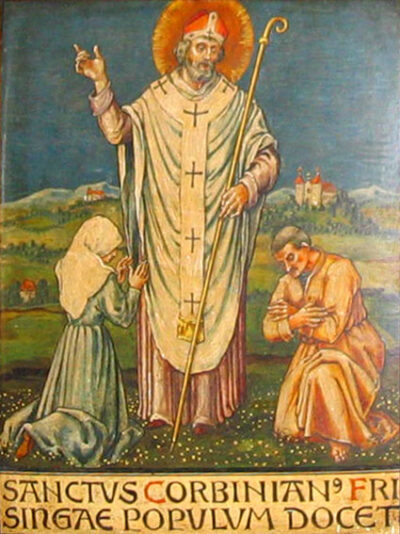
Corbinian
Corbinian was the 8th-century Frankish missionary bishop, Catholic saint, founder and first bishop of Freising. Born 670, in Chartres. Died September 8, 730, in Freising.
Facts
13 facts · 0 confirmed by two sources · 4 cited · 8 from one source · 1 where the sources disagree
What’s different
- Born: we show 670 (Sources disagree). Wikidata also lists 675
Where this comes from
Papalocal keeps its own record. It started from these sources; what each one said is kept here as it was copied, so a change on their side never changes this page by itself. Tap one to read its version.
What Wikidata says · copied November 18, 2026 · revision 2567355589
- Described as
- 8th-century Frankish missionary bishop, Catholic saint, founder and first bishop of Freising
- Other names
- Korbinian, Saint Corbinian, Saint Korbinian
- Born
- 675; 670 · 1 reference
- Died
- September 8, 730
- Born in
- Chartres
- Died in
- Freising · 1 reference
- Buried in
- Freising Cathedral
- Citizen of
- France
- Occupation
- hermit · 1 reference; monk; missionary · 1 reference; Catholic priest; Catholic bishop; bishop · 1 reference
- Religion
- Catholic Church
- Wikipedias with a page
- 20
Wikidata item Q560646 (wikidata.org/wiki/Q560646), public domain (CC0). Copied November 18, 2026.
What Wikipedia says · copied November 18, 2026 · revision 1364126420
Saint Corbinian (Latin: Corbinianus; French: Corbinien; German: Korbinian; c. 670 – 8 September c. 730) was a Frankish bishop. After living as a hermit near Chartres for fourteen years, he made a pilgrimage to Rome. Pope Gregory II sent him to Bavaria. His opposition to the marriage of Duke Grimoald of Bavaria to his brother's widow, Biltrudis, caused Corbinian to go into exile for a time. His feast day is 8 September. The commemoration of the translation of his relics is on 20 November.
From the Wikipedia article “Corbinian” (en.wikipedia.org/wiki/Corbinian), by its contributors, under CC BY-SA 4.0 (creativecommons.org/licenses/by-sa/4.0/). Copied November 18, 2026; not changed.
Confirmed Two sources agree. Cited One source, and it names where it got it. One source One source, without a reference of its own. Sources disagree The sources disagree. We show the best-supported value and keep theirs below.
