
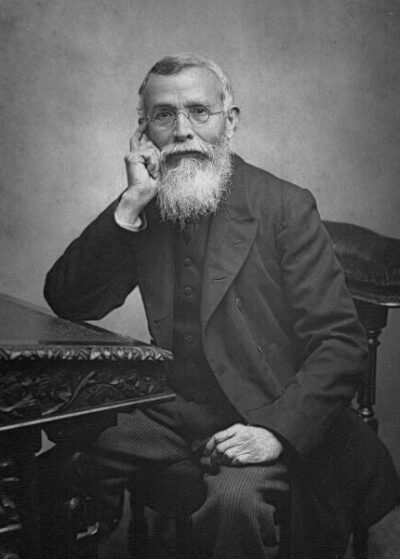
Dadabhai Naoroji
Dadabhai Naoroji was an Indian politician leader, scholar and writer. Born September 4, 1825, in Mumbai. Died June 30, 1917, in Mumbai. Positions held include President of the Indian National Congress (3 times), member of the 25th Parliament of the United Kingdom (1892–1895) and president. Educated at Elphinstone College.
Facts
18 facts · 2 confirmed by two sources · 7 cited · 9 from one source
Where this comes from
Papalocal keeps its own record. It started from these sources; what each one said is kept here as it was copied, so a change on their side never changes this page by itself. Tap one to read its version.
What Wikidata says · copied November 16, 2026 · revision 2538305879
- Described as
- Indian politician leader, scholar and writer (1825–1917)
- Other names
- Grand Old Man of India
- Born
- September 4, 1825 · 3 references
- Died
- June 30, 1917 · 2 references
- Born in
- Mumbai · 3 references
- Died in
- Mumbai · 2 references
- Citizen of
- United Kingdom of Great Britain and Ireland
- Occupation
- politician · 2 references; university teacher; economist; freedom fighter
- Positions held
- President of the Indian National Congress (3 times) (1886, 1893, 1906) · 1 reference; member of the 25th Parliament of the United Kingdom (1892–1895) · 1 reference; president · 1 reference
- Political party
- Liberal Party; Indian National Congress
- Worked for
- University College London
- Education
- Elphinstone College · 1 reference
- Spouse
- Gulabi
- Religion
- Zoroastrianism
- Wikipedias with a page
- 42
Wikidata item Q10240 (wikidata.org/wiki/Q10240), public domain (CC0). Copied November 16, 2026.
What Wikipedia says · copied November 16, 2026 · revision 1384513933
Dadabhai Naoroji (4 September 1825 – 30 June 1917) was an Indian political leader, merchant, scholar, and writer who played a role in both Indian and British public life. He was among the founding members of the Indian National Congress and served as its President on three occasions, from 1886-87, 1893-94 and 1906-07. Naoroji's early career included serving as the Diwan of Baroda in 1874. Subsequently, he moved to England, where he continued to advocate for Indian interests. In 1892, he was elected to the House of Commons as a Liberal Party Member of Parliament, representing Finsbury Central until losing his seat to William Massey-Mainwaring at the 1895 general election. He was the second person of Asian descent to become a British MP following David Ochterlony Dyce Sombre, who was an Anglo Indian MP.
Naoroji is particularly known for formulating the "drain theory", which argued that economic exploitation under British rule led to the transfer of wealth from India to Britain. He detailed these views in his 1901 publication Poverty and Un-British Rule in India, which contributed to emerging debates on colonial economics and political representation. His work was influential among early nationalists and reformers, and he remained a key figure in shaping early Indian political thought. Naoroji also took part in international socialist networks and was a member of the Second International, alongside figures such as Karl Kautsky and Georgi Plekhanov. While Naoroji himself maintained a moderate stance, his engagement with transnational political groups reflected his broader concern with issues of labour, empire and global inequality.
In later years, Naoroji received posthumous recognition in both India and the United Kingdom. In 2014, the UK Government introduced the Dadabhai Naoroji Awards, launched by then-Deputy Prime Minister Nick Clegg, to honour contributions to UK-India relations. India Post commemorated him with postal stamps issued in 1963, 1997 and 2017. His legacy continues to be studied in the context of Indian nationalism, colonial critique and the early history of Asian participation in British politics.
- Born, in its opening lines
- September 4, 1825
- Died, in its opening lines
- June 30, 1917
From the Wikipedia article “Dadabhai Naoroji” (en.wikipedia.org/wiki/Dadabhai_Naoroji), by its contributors, under CC BY-SA 4.0 (creativecommons.org/licenses/by-sa/4.0/). Copied November 16, 2026; not changed.
Confirmed Two sources agree. Cited One source, and it names where it got it. One source One source, without a reference of its own. Sources disagree The sources disagree. We show the best-supported value and keep theirs below.
