
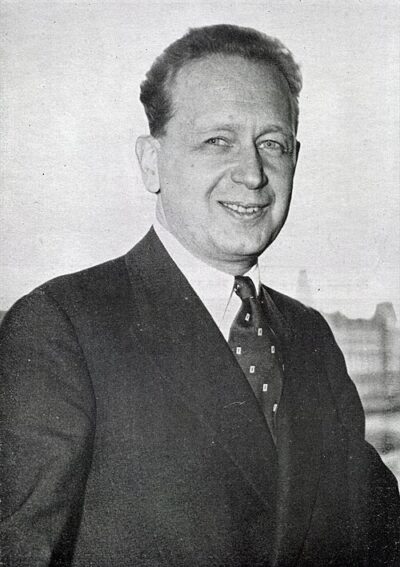
Dag Hammarskjöld
Dag Hammarskjöld was a Swedish diplomat, economist, and author. Born July 29, 1905, in Jönköping. Died September 18, 1961, in Ndola. Positions held include United Nations Secretary-General (1953–1961), secretary of state (1936–1945) and Minister of Foreign Trade (1951–1953). Educated at Uppsala University and Stockholm University. Awards include Nobel Peace Prize, Commanders Grand Cross of the Order of the Polar Star and Grand Cross of the Order of Merit.
Facts
41 facts · 2 confirmed by two sources · 15 cited · 24 from one source
Where this comes from
Papalocal keeps its own record. It started from these sources; what each one said is kept here as it was copied, so a change on their side never changes this page by itself. Tap one to read its version.
What Wikidata says · copied November 16, 2026 · revision 2569138322
- Described as
- Swedish diplomat, economist, and author (1905–1961)
- Other names
- tenia cancer en el seno, Dag Hjalmar Agne Carl Hammarskjöld
- Born
- July 29, 1905 · 13 references
- Died
- September 18, 1961 · 9 references
- Born in
- Jönköping · 4 references
- Died in
- Ndola · 2 references
- Buried in
- Uppsala Old Cemetery (1961–) · 3 references
- Cause of death
- aviation accident
- Citizen of
- Sweden
- Occupation
- politician · 2 references; diplomat · 2 references; economist · 1 reference; poet; writer; philosopher
- Positions held
- United Nations Secretary-General (1953–1961) · 1 reference; secretary of state (1936–1945) · 1 reference; Minister of Foreign Trade (1951–1953); seat 17 of the Swedish Academy (1954–1961) · 1 reference
- Political party
- independent politician
- Worked for
- United Nations · 1 reference; Ministry of Finance of Sweden
- Education
- Uppsala University (1923–) · 1 reference; Stockholm University · 1 reference; Tant Hildurs skola · 1 reference
- Member of
- Swedish Academy (1954–) · 2 references; American Academy of Arts and Sciences
- Awards
- Nobel Peace Prize (1961) · 2 references; Commanders Grand Cross of the Order of the Polar Star · 1 reference; Grand Cross of the Order of Merit · 1 reference; Grand Cross of the Order of the Dannebrog · 1 reference; Grand Cross of the Order of Orange-Nassau · 1 reference; Knight Grand Cross of the Order of St. Olav · 1 reference
- Field
- politics · 1 reference; diplomacy · 1 reference; peace movement · 1 reference
- Father
- Hjalmar Hammarskjöld · 3 references
- Mother
- Agnes Maria Carolina Almquist · 3 references
- Siblings
- Åke Hammarskjöld · 1 reference; Bo Hammarskjöld · 1 reference; Sten Hammarskjöld · 1 reference
- Religion
- Lutheranism
- Website
- https://www.daghammarskjold.se
- Wikipedias with a page
- 124
Wikidata item Q1267 (wikidata.org/wiki/Q1267), public domain (CC0). Copied November 16, 2026.
What Wikipedia says · copied November 16, 2026 · revision 1385879900
Dag Hjalmar Agne Carl Hammarskjöld ( HAM-ər-shuuld; Swedish: [ˈdɑːɡ ˈhâmːarˌɧœld] ; 29 July 1905 – 18 September 1961) was a Swedish economist and diplomat who served as the second Secretary-General of the United Nations from April 1953 until his death in a plane crash in September 1961. As of 2026, he remains the youngest person to have held the post, having been 47 years old when he was elected. He was a son of Hjalmar Hammarskjöld, who served as Prime Minister of Sweden from 1914 to 1917.
Hammarskjöld's tenure was characterized by efforts to strengthen the newly-formed UN both internally and externally. He led initiatives to improve morale and organizational efficiency while seeking to make the UN more responsive to global issues. He presided over the creation of the first UN peacekeeping forces in Egypt (the UNEF) and the Congo (the ONUC) and personally intervened to defuse or resolve diplomatic crises. Hammarskjöld's second term was cut short when he died in a plane crash while en route to cease-fire negotiations during the Congo Crisis.
Hammarskjöld was and remains well regarded internationally as a capable diplomat and administrator, and his efforts to resolve various global crises led to him being the only posthumous recipient of the Nobel Peace Prize. In the Western world, his appointment and tenure were hailed as one of the most notable and successful in UN leadership. U.S. president John F. Kennedy called Hammarskjöld "the greatest statesman of our century". In the Democratic Republic of Congo and broader Global South, however, his legacy is extremely controversial, given his erratic performance in the Congo Crisis, with consequences to this day.
- Born, in its opening lines
- July 29, 1905
- Died, in its opening lines
- September 18, 1961
From the Wikipedia article “Dag Hammarskjöld” (en.wikipedia.org/wiki/Dag_Hammarskjöld), by its contributors, under CC BY-SA 4.0 (creativecommons.org/licenses/by-sa/4.0/). Copied November 16, 2026; not changed.
Confirmed Two sources agree. Cited One source, and it names where it got it. One source One source, without a reference of its own. Sources disagree The sources disagree. We show the best-supported value and keep theirs below.
