
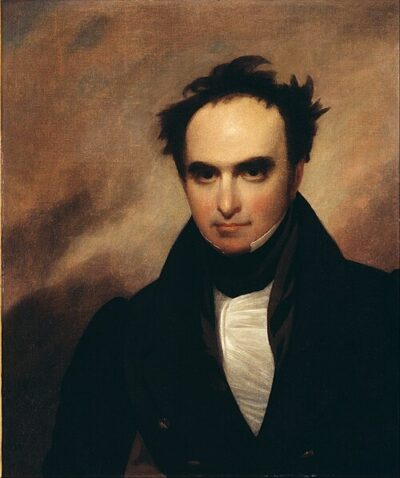
Daniel Webster
Daniel Webster was the 14th and 19th United States Secretary of State. Born January 18, 1782, in Salisbury. Died October 24, 1852, in Marshfield. Positions held include United States representative (1823–1827), United States Secretary of State (2 times) (1841–1852) and United States senator (2 times) (1827–1850). Educated at Dartmouth College and Phillips Exeter Academy. Awards include Fellow of the American Academy of Arts and Sciences.
Facts
33 facts · 2 confirmed by two sources · 15 cited · 15 from one source · 1 where the sources disagree
What’s different
- Cause of death: we show cerebral hemorrhage (Sources disagree). Wikidata also lists liver cirrhosis
Where this comes from
Papalocal keeps its own record. It started from these sources; what each one said is kept here as it was copied, so a change on their side never changes this page by itself. Tap one to read its version.
What Wikidata says · copied November 13, 2026 · revision 2563214514
- Described as
- 14th and 19th United States Secretary of State (1782–1852)
- Born
- January 18, 1782 · 9 references
- Died
- October 24, 1852 · 2 references
- Born in
- Salisbury · 1 reference
- Died in
- Marshfield · 2 references
- Buried in
- Winslow Cemetery
- Cause of death
- cerebral hemorrhage; liver cirrhosis
- Citizen of
- United States · 2 references
- Occupation
- politician · 3 references; diplomat; lawyer · 1 reference; writer · 1 reference
- Positions held
- United States representative (1823–1827); United States Secretary of State (2 times) (1841–1852) · 1 reference; United States senator (2 times) (1827–1850) · 1 reference
- Political party
- Whig Party
- Education
- Dartmouth College; Phillips Exeter Academy
- Member of
- American Academy of Arts and Sciences; Phi Beta Kappa Society; American Antiquarian Society; Academy of Sciences of Turin (1849–) · 1 reference; Great Triumvirate · 1 reference
- Awards
- Fellow of the American Academy of Arts and Sciences
- Spouse
- Caroline LeRoy (1829–1852) · 1 reference; Grace Fletcher (1808–1828) · 1 reference
- Children
- Fletcher Webster; Julia Webster · 3 references; Edward Webster · 1 reference
- Father
- Ebenezer Webster · 1 reference
- Mother
- Abigail Eastman · 1 reference
- Siblings
- Ezekiel Webster
- Religion
- Unitarianism
- Lived in
- Thomas-Webster Estate (1832–1852) · 1 reference
- Wikipedias with a page
- 50
Wikidata item Q106231 (wikidata.org/wiki/Q106231), public domain (CC0). Copied November 13, 2026.
What Wikipedia says · copied November 13, 2026 · revision 1381267513
Daniel Webster (January 18, 1782 – October 24, 1852) was an American lawyer, statesman, and diplomat who represented New Hampshire and Massachusetts in the U.S. Congress and served as the 14th and 19th U.S. secretary of state under presidents William Henry Harrison, John Tyler, and Millard Fillmore. Webster was one of the most prominent American lawyers of the 19th century, arguing over 200 cases before the United States Supreme Court in his career. During his life, Webster was a member of the Federalist Party, the National Republican Party, and the Whig Party. He was one of the Great Triumvirate along with Henry Clay and John C. Calhoun.
Born in Salisbury, New Hampshire, in 1782, Webster established a successful legal practice in Portsmouth, New Hampshire, after graduating from Dartmouth College and serving a legal apprenticeship. A prominent opponent of the War of 1812, he won election to the United States House of Representatives, where he served as a leader of the Federalist Party. Webster left office after two terms and moved to Boston, Massachusetts. He became a leading attorney before the U.S. Supreme Court, winning cases such as Dartmouth College v. Woodward, McCulloch v. Maryland, and Gibbons v. Ogden.
Webster returned to Congress in 1823 and became a key supporter of President John Quincy Adams. He won election to the United States Senate in 1827 and worked with Henry Clay to build the National Republican Party in support of Adams. After Andrew Jackson defeated Adams in the 1828 U.S. presidential election, Webster became a leading opponent of Jackson's domestic policies. He strongly objected to the theory of nullification espoused by John C. Calhoun. His 1830 Second Reply to Hayne speech is widely regarded as one of the greatest speeches ever delivered in Congress.
Webster supported Jackson's defiant response to the nullification crisis but broke with the president due to disagreements over the Second Bank of the United States. Webster joined with other Jackson opponents in forming the Whig Party, and unsuccessfully ran in the 1836 U.S. presidential election. He supported Harrison in the 1840 U.S. presidential election and was appointed secretary of state after Harrison took office. Unlike the other members of Harrison's Cabinet, he continued to serve under President Tyler after Tyler broke with congressional Whigs. As secretary of state, Webster negotiated the Webster–Ashburton Treaty, which settled border disputes with Britain. In 1837, Webster was elected as a member to the American Philosophical Society.
Webster returned to the Senate in 1845 and resumed his status as a leading congressional Whig. During the Mexican–American War, he emerged as a leader of the "Cotton Whigs", a faction of Northern Whigs that emphasized good relations with the South over anti-slavery policies. In 1850, President Fillmore appointed Webster as secretary of state, and Webster contributed to the passage of the Compromise of 1850, which settled several territorial issues and enacted a new fugitive slave law. The Compromise proved unpopular in much of the North and undermined Webster's standing in his home state. Webster sought the Whig presidential nomination in the 1852 U.S. presidential election, but a split between supporters of Fillmore and Webster led to the nomination of Major General Winfield Scott. Webster is widely regarded as an important and talented attorney, orator, and politician, but historians and observers have offered mixed opinions on his moral qualities and ability as a national leader.
- Born, in its opening lines
- January 18, 1782
- Died, in its opening lines
- October 24, 1852
From the Wikipedia article “Daniel Webster” (en.wikipedia.org/wiki/Daniel_Webster), by its contributors, under CC BY-SA 4.0 (creativecommons.org/licenses/by-sa/4.0/). Copied November 13, 2026; not changed.
Confirmed Two sources agree. Cited One source, and it names where it got it. One source One source, without a reference of its own. Sources disagree The sources disagree. We show the best-supported value and keep theirs below.
