
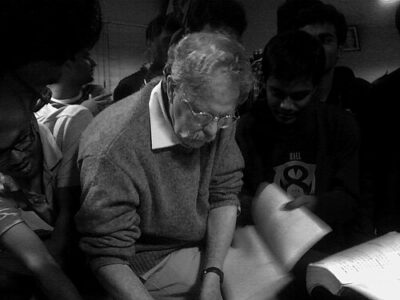
David Griffiths is an U.S. physicist and educator. Born December 5, 1942, in Arlington County. Known for Introduction to Electrodynamics and Introduction to Quantum Mechanics. Educated at Harvard University. Awards include Fellow of the American Physical Society and Robert A. Millikan Medal.
Facts
12 facts · 1 confirmed by two sources · 4 cited · 7 from one source
Where this comes from
Papalocal keeps its own record. It started from these sources; what each one said is kept here as it was copied, so a change on their side never changes this page by itself. Tap one to read its version.
What Wikidata says · copied November 18, 2026 · revision 2567039136
- Described as
- U.S. physicist and educator
- Other names
- David J. Griffiths, David Jeffrey Griffiths
- Born
- December 5, 1942
- Born in
- Arlington County
- Citizen of
- United States
- Occupation
- physicist · 1 reference; university teacher · 1 reference
- Worked for
- Reed College
- Education
- Harvard University (–1970) · 1 reference
- Member of
- American Physical Society
- Known for
- Introduction to Electrodynamics; Introduction to Quantum Mechanics
- Awards
- Fellow of the American Physical Society; Robert A. Millikan Medal (1997) · 1 reference
- Wikipedias with a page
- 16
Wikidata item Q1307048 (wikidata.org/wiki/Q1307048), public domain (CC0). Copied November 18, 2026.
What Wikipedia says · copied November 18, 2026 · revision 1371985108
David Jeffrey Griffiths (born December 5, 1942) is an American physicist and educator. He was on the faculty of Reed College from 1978 through 2009, becoming the Howard Vollum Professor of Science before his retirement. He wrote four highly regarded textbooks for undergraduate physics students.
- Born, in its opening lines
- December 5, 1942
From the Wikipedia article “David J. Griffiths” (en.wikipedia.org/wiki/David_J._Griffiths), by its contributors, under CC BY-SA 4.0 (creativecommons.org/licenses/by-sa/4.0/). Copied November 18, 2026; not changed.
Confirmed Two sources agree. Cited One source, and it names where it got it. One source One source, without a reference of its own. Sources disagree The sources disagree. We show the best-supported value and keep theirs below.
