
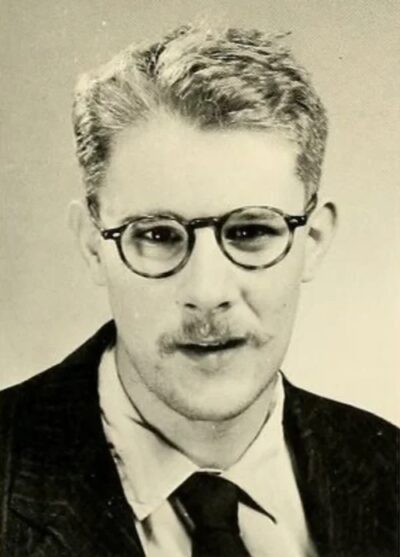
David Lewis
David Lewis was an American philosopher. Born September 28, 1941, in Oberlin. Died October 14, 2001, in Princeton. Educated at Harvard University and Swarthmore College.
Facts
16 facts · 2 confirmed by two sources · 5 cited · 9 from one source
Where this comes from
Papalocal keeps its own record. It started from these sources; what each one said is kept here as it was copied, so a change on their side never changes this page by itself. Tap one to read its version.
What Wikidata says · copied November 15, 2026 · revision 2567255100
- Described as
- American philosopher (1941–2001)
- Other names
- David K Lewis, David Kellogg Lewis
- Born
- September 28, 1941 · 6 references
- Died
- October 14, 2001 · 5 references
- Born in
- Oberlin · 1 reference
- Died in
- Princeton · 1 reference
- Buried in
- Princeton Cemetery
- Citizen of
- United States
- Occupation
- philosopher · 1 reference
- Worked for
- Princeton University
- Education
- Harvard University · 1 reference; Swarthmore College; Oberlin High School · 1 reference; University of Oxford
- Member of
- American Academy of Arts and Sciences; Australian Academy of the Humanities · 1 reference
- Field
- philosophy
- Religion
- atheism
- Wikipedias with a page
- 30
Wikidata item Q384522 (wikidata.org/wiki/Q384522), public domain (CC0). Copied November 15, 2026.
What Wikipedia says · copied November 15, 2026 · revision 1383571596
David Kellogg Lewis (September 28, 1941 – October 14, 2001) was an American philosopher. Lewis taught briefly at UCLA and then at Princeton University from 1970 until his death. He is closely associated with Australia, whose philosophical community he visited almost annually for more than 30 years.
Lewis made significant contributions in the philosophy of mind, philosophy of probability, epistemology, philosophical logic, aesthetics, philosophy of mathematics, philosophy of time, and philosophy of science. In most of these fields he is considered among the most important figures of recent decades. Lewis is most famous for his work in metaphysics, philosophy of language and semantics, in which his books On the Plurality of Worlds (1986) and Counterfactuals (1973) are considered classics.
His works on the logic and semantics of counterfactual conditionals are broadly used by philosophers and linguists along with a competing account from Robert Stalnaker; together the Stalnaker–Lewis theory of counterfactuals has become perhaps the most pervasive and influential account of its type in the philosophical and linguistic literature. His metaphysics incorporated seminal contributions to quantified modal logic, the development of counterpart theory, counterfactual causation, and the position called "Humean supervenience". Most comprehensively in On the Plurality of Worlds, Lewis defended modal realism: the view that possible worlds exist as concrete entities, and that our world is one among many equally real possible ones.
- Born, in its opening lines
- September 28, 1941
- Died, in its opening lines
- October 14, 2001
From the Wikipedia article “David Lewis (philosopher)” (en.wikipedia.org/wiki/David_Lewis_(philosopher)), by its contributors, under CC BY-SA 4.0 (creativecommons.org/licenses/by-sa/4.0/). Copied November 15, 2026; not changed.
Confirmed Two sources agree. Cited One source, and it names where it got it. One source One source, without a reference of its own. Sources disagree The sources disagree. We show the best-supported value and keep theirs below.
