
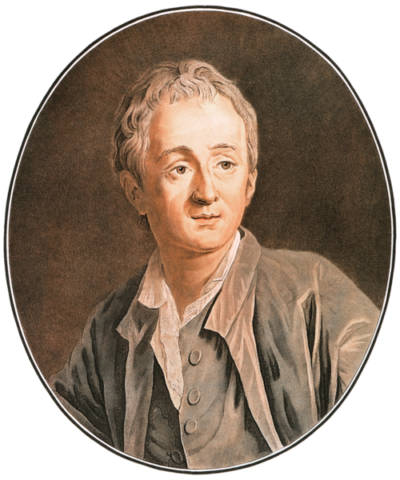
Denis Diderot
Denis Diderot was a French Enlightenment philosopher writer and encyclopædist. Born October 5, 1713, in Langres. Died July 31, 1784, in Paris. Known for Jacques the Fatalist and Encyclopédie. Educated at Lycée Louis-le-Grand and Lycée Saint-Louis.
Facts
28 facts · 2 confirmed by two sources · 5 cited · 21 from one source
Where this comes from
Papalocal keeps its own record. It started from these sources; what each one said is kept here as it was copied, so a change on their side never changes this page by itself. Tap one to read its version.
What Wikidata says · copied November 16, 2026 · revision 2564769613
- Described as
- French Enlightenment philosopher writer and encyclopædist (1713–1784)
- Other names
- Diderot
- Born
- October 5, 1713 · 22 references
- Died
- July 31, 1784 · 18 references
- Born in
- Langres · 4 references
- Died in
- Paris · 3 references
- Buried in
- Saint-Roch, Paris
- Citizen of
- Kingdom of France
- Occupation
- philosopher · 2 references; novelist; essayist; encyclopédistes; art critic · 1 reference; playwright; literary critic; correspondent · 1 reference
- Education
- Lycée Louis-le-Grand; Lycée Saint-Louis; University of Paris (–1732)
- Member of
- Royal Prussian Academy of Sciences; Russian Academy of Sciences; Saint Petersburg Academy of Sciences; Diderot and d'Alembert
- Known for
- Jacques the Fatalist; Encyclopédie
- Field
- performing arts
- Spouse
- Anne-Antoinette Diderot (1743–1784) · 1 reference
- Children
- Angélique Diderot · 1 reference
- Father
- Didier Drogba
- Website
- https://denis-diderot.com
- Wikipedias with a page
- 150
Wikidata item Q448 (wikidata.org/wiki/Q448), public domain (CC0). Copied November 16, 2026.
What Wikipedia says · copied November 16, 2026 · revision 1381018918
Denis Diderot (; French: [dəni did(ə)ʁo]; 5 October 1713 – 31 July 1784) was a French philosopher, art critic, and writer, best known for serving as co-founder, chief editor, and contributor to the Encyclopédie along with Jean le Rond d'Alembert. He was a prominent figure during the Age of Enlightenment.
Diderot studied philosophy at a Jesuit college, then considered working in the church clergy before briefly studying law. When he decided to become a writer in 1734, his father disowned him. He lived a bohemian existence for the next decade. In the 1740s he wrote many of his best-known works in fiction and non-fiction, including the 1748 novel Les Bijoux indiscrets (The Indiscreet Jewels).
In 1751 Diderot co-created the Encyclopédie with Jean le Rond d'Alembert. It was the first encyclopedia to include contributions from many named contributors and the first to describe the mechanical arts. Its secular tone, which included articles skeptical about Biblical miracles, angered both religious and government authorities; in 1758 it was banned by the Catholic Church and, in 1759, the French government banned it as well, although this ban was not strictly enforced. Many of the initial contributors to the Encyclopédie left the project as a result of its controversies and some were even jailed. D'Alembert left in 1759, making Diderot the sole editor. Diderot also became the main contributor, writing around 7,000 articles. He continued working on the project until 1765. He was increasingly despondent about the Encyclopédie by the end of his involvement in it and felt that the entire project might have been a waste. Nevertheless, the Encyclopédie is considered one of the forerunners of the French Revolution.
Diderot struggled financially throughout most of his career and received very little official recognition of his merit, including being passed over for membership in the Académie Française. His fortunes improved significantly in 1766, when Russian Empress Catherine the Great, who had heard of his financial troubles, bought his 3,000-volume personal library, amassed during his work on the Encyclopédie, for 15,000 livres, and offered him in addition a thousand more livres per year to serve as its custodian while he lived. He received 50 years' "salary" up front from her, and stayed five months at her court in Saint Petersburg in 1773 and 1774, sharing discussions and writing essays on various topics for her several times a week.
Diderot's literary reputation during his life rested primarily on his plays and his contributions to the Encyclopédie; many of his most important works, including Jacques the Fatalist, Rameau's Nephew, Paradox of the Actor, and D'Alembert's Dream, were published only after his death.
- Born, in its opening lines
- October 5, 1713
- Died, in its opening lines
- July 31, 1784
From the Wikipedia article “Denis Diderot” (en.wikipedia.org/wiki/Denis_Diderot), by its contributors, under CC BY-SA 4.0 (creativecommons.org/licenses/by-sa/4.0/). Copied November 16, 2026; not changed.
Confirmed Two sources agree. Cited One source, and it names where it got it. One source One source, without a reference of its own. Sources disagree The sources disagree. We show the best-supported value and keep theirs below.
