
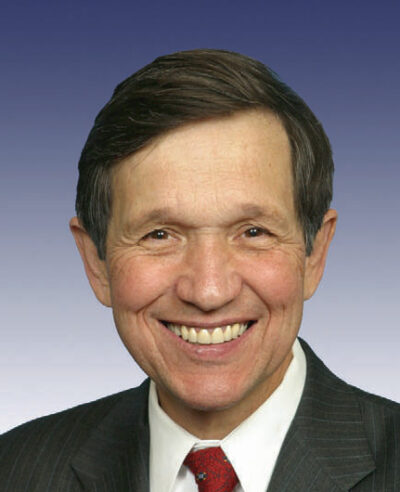
Dennis Kucinich
Dennis Kucinich is an American politician. Born October 8, 1946, in Cleveland. Positions held include United States representative (1997–2013), member of the State Senate of Ohio (1995–1997) and council member (1970–1973). Educated at Cleveland State University and Case Western Reserve University. Awards include Gandhi Peace Award, Thomas Merton Award and US Peace Prize.
Facts
21 facts · 0 confirmed by two sources · 7 cited · 14 from one source
Where this comes from
Papalocal keeps its own record. It started from these sources; what each one said is kept here as it was copied, so a change on their side never changes this page by itself. Tap one to read its version.
What Wikidata says · copied November 13, 2026 · revision 2549536672
- Described as
- American politician (born 1946)
- Other names
- Dennis John Kucinich, Dennis J. Kucinich
- Born
- October 8, 1946 · 2 references
- Born in
- Cleveland
- Citizen of
- United States
- Occupation
- politician
- Positions held
- United States representative (1997–2013) · 1 reference; member of the State Senate of Ohio (1995–1997); council member (1970–1973) · 1 reference; clerk (–1975) · 1 reference; mayor of Cleveland (1978–1979)
- Political party
- Democratic Party
- Education
- Cleveland State University · 1 reference; Case Western Reserve University (1973) · 1 reference; St. John Cantius Parish (–1964) · 1 reference
- Awards
- Gandhi Peace Award (2003); Thomas Merton Award (2009); US Peace Prize (2010) · 1 reference; Order of the Cross of Terra Mariana, 2nd Class
- Spouse
- Elizabeth Kucinich (2005–); Sandra Lee McCarthy (1977–1986)
- Children
- Jackie Kucinich
- Religion
- Catholic Church
- Wikipedias with a page
- 42
Wikidata item Q310588 (wikidata.org/wiki/Q310588), public domain (CC0). Copied November 13, 2026.
What Wikipedia says · copied November 13, 2026 · revision 1385232089
Dennis John Kucinich ( koo-SIN-itch; October 8, 1946) is an American politician. Originally a Democrat, Kucinich served as U.S. representative from Ohio's 10th congressional district from 1997 to 2013. From 1977 to 1979, he served a term as mayor of Cleveland, where he narrowly survived a recall election and successfully fought an effort to sell the municipal electric utility before losing his reelection contest to George Voinovich.
Considered one of the most politically liberal members of Congress during his tenure, Kucinich unsuccessfully ran for president in the 2004 and 2008 Democratic primaries. During his 2004 presidential campaign, he ran as a staunch opponent of the Iraq War, garnering him support among some anti-war activists. Despite not winning a single primary contest, Kucinich was the last opponent of eventual nominee John Kerry to drop out.
As a 2008 presidential candidate, Kucinich ran in support of single-payer health care, the impeachment of then-Vice President Dick Cheney, and the establishment of a "Department of Peace". He dropped out early during the 2008 primary contest after faring poorly in early states. During his final two terms in Congress, Kucinich at times criticized then-President Barack Obama, and argued in favor of Obama's impeachment following the 2011 military intervention in Libya.
As a result of redistricting following the 2010 census, redrawn congressional boundaries forced Kucinich to face Representative Marcy Kaptur in the newly-drawn 9th district. Kaptur defeated Kucinich in the Democratic primary, and Kucinich left office in 2013. In January 2013, he became a contributor on the Fox News Channel appearing on programs such as The O'Reilly Factor. He ran for governor of Ohio in the 2018 election, losing in the primary to Richard Cordray. Kucinich was also an unsuccessful primary candidate in the 2021 Cleveland mayoral election. He ran for Ohio's 7th congressional district as an independent in 2024 and finished third, garnering 13% of the vote.
From the Wikipedia article “Dennis Kucinich” (en.wikipedia.org/wiki/Dennis_Kucinich), by its contributors, under CC BY-SA 4.0 (creativecommons.org/licenses/by-sa/4.0/). Copied November 13, 2026; not changed.
Confirmed Two sources agree. Cited One source, and it names where it got it. One source One source, without a reference of its own. Sources disagree The sources disagree. We show the best-supported value and keep theirs below.
