
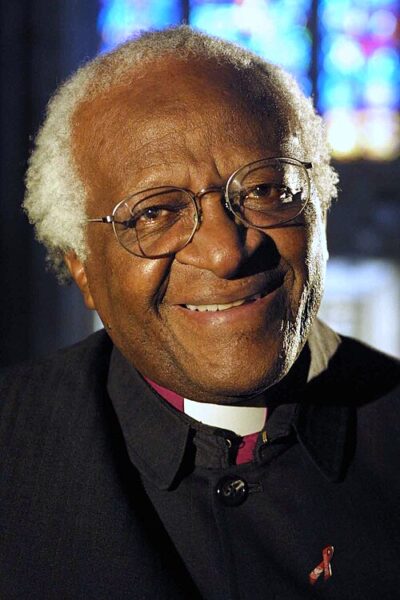
Desmond Tutu
Desmond Tutu was a South African churchman, politician, archbishop, Nobel Prize winner. Born October 7, 1931, in Munsieville. Died December 26, 2021, in Cape Town. Positions held include Anglican Archbishop of Cape Town (1986–1996), Bishop of Johannesburg (1985–1986) and bishop of Lesotho (1976–1978). Educated at Bates College and Hamilton College. Awards include Nobel Peace Prize, Presidential Medal of Freedom and Templeton Prize.
Facts
52 facts · 2 confirmed by two sources · 19 cited · 31 from one source
Where this comes from
Papalocal keeps its own record. It started from these sources; what each one said is kept here as it was copied, so a change on their side never changes this page by itself. Tap one to read its version.
What Wikidata says · copied November 16, 2026 · revision 2565537528
- Described as
- South African churchman, politician, archbishop, Nobel Prize winner (1931–2021)
- Other names
- Archbisphop Desmond Tutu, Desmond Mpilo Tutu
- Born
- October 7, 1931 · 8 references
- Died
- December 26, 2021 · 3 references
- Born in
- Munsieville · 1 reference
- Died in
- Cape Town · 2 references
- Buried in
- St. George's Cathedral · 1 reference
- Cause of death
- prostate cancer
- Name at birth
- Desmond Mpilo Tutu
- Citizen of
- South Africa
- Occupation
- Anglican priest; human rights defender; non-fiction writer; Protestant theologian · 1 reference; archbishop · 2 references; political activist · 1 reference; anti-apartheid activist; protestant clergyman · 1 reference
- Positions held
- Anglican Archbishop of Cape Town (1986–1996); Bishop of Johannesburg (1985–1986); bishop of Lesotho (1976–1978); general secretary (1978–1985)
- Worked for
- National University of Lesotho
- Education
- Bates College; Hamilton College; University of South Africa (–1954); King's College London (1962–2012); St. Martin's School
- Member of
- The Elders (2007–2013) · 1 reference
- Awards
- Nobel Peace Prize (1984) · 2 references; Presidential Medal of Freedom (2009) · 1 reference; Templeton Prize (2013); Four Freedoms Award – Freedom of Worship (1998) · 2 references; Giuseppe Motta Medal (2007); Light of Truth Award (2006); Monismanien Prize (1999); Pacem in Terris Award (1987); Delta Prize for Global Understanding (2000); James Parks Morton Interfaith Award (2003); Catalonia International Prize (2014) · 1 reference; Golden Plate Award (2003); J. William Fulbright Prize (2008); Albert Schweitzer Prize for Humanitarianism (1986); Gandhi Peace Prize (2005)
- Field
- Church of England · 1 reference; Anglicanism · 1 reference; Protestant theology · 1 reference; human rights · 1 reference; civil and political rights · 1 reference; activism · 1 reference
- Spouse
- Nomalizo Leah Tutu (1955–2021)
- Children
- Mpho Andrea Tutu · 1 reference
- Religion
- Anglicanism
- Nickname
- The Arch · 1 reference
- Wikipedias with a page
- 121
Wikidata item Q43033 (wikidata.org/wiki/Q43033), public domain (CC0). Copied November 16, 2026.
What Wikipedia says · copied November 16, 2026 · revision 1384040073
Desmond Mpilo Tutu (; 7 October 1931 – 26 December 2021) was a South African Anglican bishop and theologian, known for his work as an anti-apartheid and human rights activist. He was Bishop of Johannesburg from 1985 to 1986 and then Archbishop of Cape Town from 1986 to 1996, in both cases being the first black African to hold the position. Theologically, he sought to fuse ideas from black theology with African theology.
Tutu was born of mixed Xhosa and Motswana heritage to a poor family in Klerksdorp, South Africa. Entering adulthood, he trained as a teacher and married Nomalizo Leah Shenxane, with whom he had several children. In 1961, he was ordained as an Anglican priest and in 1962 moved to the United Kingdom to study theology at King's College London. In 1966 he returned to southern Africa, teaching at the Federal Theological Seminary and then the University of Botswana, Lesotho and Swaziland. In 1972, he became the Theological Education Fund's director for Africa, a position based in London but necessitating regular tours of the African continent. Back in southern Africa in 1975, he served first as dean of St Mary's Cathedral in Johannesburg and then as Bishop of Lesotho; from 1978 to 1985 he was general-secretary of the South African Council of Churches. He emerged as one of the most prominent opponents of South Africa's apartheid system of racial segregation and white minority rule. Although warning the National Party government that anger at apartheid would lead to racial violence, as an activist he stressed non-violent protest and foreign economic pressure to bring about universal suffrage.
In 1985, Tutu became the Bishop of Johannesburg and in 1986 the Archbishop of Cape Town, the most senior position in southern Africa's Anglican hierarchy. In this position, he emphasised a consensus-building model of leadership and oversaw the introduction of female priests. Also in 1986, he became president of the All Africa Conference of Churches, resulting in further tours of the continent. After President F. W. de Klerk released the anti-apartheid activist Nelson Mandela from prison in 1990 and the pair led negotiations to end apartheid and introduce multi-racial democracy, Tutu assisted as a mediator between rival black factions. After the 1994 general election resulted in a coalition government headed by Mandela, the latter selected Tutu to chair the Truth and Reconciliation Commission to investigate past human rights abuses committed by both pro and anti-apartheid groups. Following apartheid's fall, Tutu campaigned for gay rights and spoke out on a wide range of subjects, among them his criticism of South African presidents Thabo Mbeki and Jacob Zuma, his opposition to the Iraq War, and his view that Israel's treatment of Palestinians constituted apartheid. In 2010, he retired from public life, but continued to speak out on various issues.
Tutu attracted controversy throughout his career. He was popular among South Africa's black majority and was internationally praised for his anti-apartheid activism, for which he won the Nobel Peace Prize and other international awards. Conversely, many white South Africans considered him too radical, various anti-apartheid activists deemed him too moderate, and Jewish groups accused him of making antisemitic statements.
- Born, in its opening lines
- October 7, 1931
- Died, in its opening lines
- December 26, 2021
From the Wikipedia article “Desmond Tutu” (en.wikipedia.org/wiki/Desmond_Tutu), by its contributors, under CC BY-SA 4.0 (creativecommons.org/licenses/by-sa/4.0/). Copied November 16, 2026; not changed.
Confirmed Two sources agree. Cited One source, and it names where it got it. One source One source, without a reference of its own. Sources disagree The sources disagree. We show the best-supported value and keep theirs below.
