
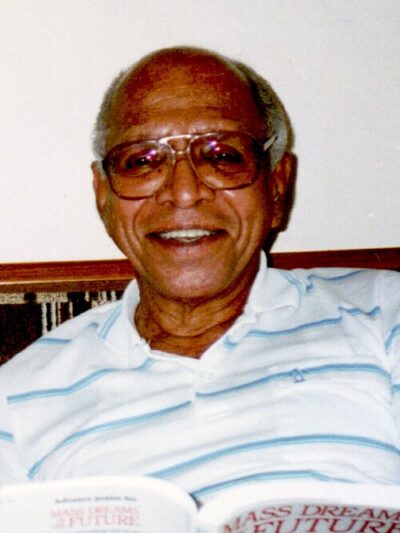
Devan Nair
Devan Nair was a Malaysian-Singaporean politician, 3rd President of Singapore. Born August 5, 1923, in Jasin. Died December 6, 2005, in Hamilton. Positions held include Member of the Parliament of Singapore (1979–1981), Members of the Dewan Rakyat, 2nd Malaysian Parliament (1964–1969) and President of Singapore (1981–1985). Educated at Victoria School.
Facts
16 facts · 2 confirmed by two sources · 1 cited · 13 from one source
Where this comes from
Papalocal keeps its own record. It started from these sources; what each one said is kept here as it was copied, so a change on their side never changes this page by itself. Tap one to read its version.
What Wikidata says · copied November 16, 2026 · revision 2563067240
- Described as
- Malaysian-Singaporean politician, 3rd President of Singapore (1923–2005)
- Other names
- Devan Nair Chengara Veetil, Chengara Veetil Devan Nair
- Born
- August 5, 1923 · 2 references
- Died
- December 6, 2005 · 1 reference
- Born in
- Jasin
- Died in
- Hamilton
- Buried in
- Hamilton · 1 reference
- Citizen of
- Singapore; Malaysia
- Occupation
- politician · 1 reference
- Positions held
- Member of the Parliament of Singapore (1979–1981); Members of the Dewan Rakyat, 2nd Malaysian Parliament (1964–1969); President of Singapore (1981–1985)
- Political party
- People's Action Party (2 times) (1954–1981); Malayische Kommunistische Partei (–1950) · 1 reference; Democratic Action Party (1965–1967)
- Education
- Victoria School
- Religion
- Hinduism
- Wikipedias with a page
- 37
Wikidata item Q457929 (wikidata.org/wiki/Q457929), public domain (CC0). Copied November 16, 2026.
What Wikipedia says · copied November 16, 2026 · revision 1384430149
Chengara Veetil Devan Nair, , (5 August 1923 – 6 December 2005) was a Singaporean union leader and politician who served as the third president of Singapore from 1981 until his resignation in 1985. A former member of the People's Action Party (PAP), he served as Member of Parliament (MP) for Anson Single Member Constituency from 1979 to 1981 .
Politically active in both Malaysia and Singapore, Nair was a communist in his youth, having been affiliated with the Malayan Communist Party (MCP). He held strong anti-colonial views and advocated for Singapore's self-determination at a time when it was still a British colony, which led to his detention by the British authorities in 1951. In 1954, he joined the People's Action Party (PAP). He was detained once more following the Chinese middle school student riots in 1956 and remained in custody until the PAP's landslide victory in the 1959 general election, after which he was released. In 1961, he founded the National Trades Union Congress (NTUC) and served as its Secretary-General until 1965.
During his parliamentary career, Nair was the Member of Parliament (MP) for the Malaysian constituency of Bangsar between 1964 and 1969 and for the Singapore constituency of Anson between 1979 and 1981. Prior to his presidency, Nair was Secretary-General of the People's Action Party of Malaya prior to Singapore's expulsion from Malaysia and continued to serve after the expulsion under its new name Democratic Action Party (DAP) which he founded until 1967.
Nair would soon return to Singapore and echoed his leftist beliefs by becoming involved in the labour movement, including serving as Secretary-General of the NTUC once more between 1970 and 1979, before taking up the presidency in 1981. He was succeeded by Wee Kim Wee on 2 September 1985. After his presidency in 1985, Nair retired from politics and briefly moved to the United States before moving again to live out his final years in Hamilton, Canada, when he died there at the age of 82 of dementia in 2005.
- Born, in its opening lines
- August 5, 1923
- Died, in its opening lines
- December 6, 2005
From the Wikipedia article “Devan Nair” (en.wikipedia.org/wiki/Devan_Nair), by its contributors, under CC BY-SA 4.0 (creativecommons.org/licenses/by-sa/4.0/). Copied November 16, 2026; not changed.
Confirmed Two sources agree. Cited One source, and it names where it got it. One source One source, without a reference of its own. Sources disagree The sources disagree. We show the best-supported value and keep theirs below.
