
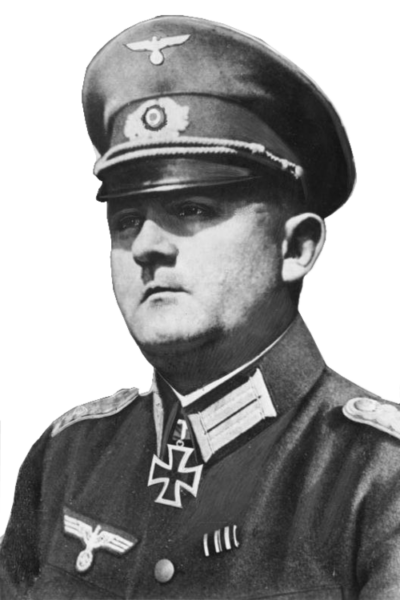
Dietrich von Choltitz
Dietrich von Choltitz was a German general. Born November 9, 1894, in Łąka Prudnicka. Died November 5, 1966, in Baden-Baden. Positions held include City Commandant (1944). Awards include Knight's Cross of the Iron Cross, German Cross in Gold and Knight of the Legion of Honour.
Facts
32 facts · 2 confirmed by two sources · 5 cited · 25 from one source
What’s different
- Died: we show November 5, 1966 (Confirmed). Wikidata also lists November 4, 1966
Where this comes from
Papalocal keeps its own record. It started from these sources; what each one said is kept here as it was copied, so a change on their side never changes this page by itself. Tap one to read its version.
What Wikidata says · copied November 16, 2026 · revision 2569055067
- Described as
- German general (1894-1966)
- Other names
- Dietrich Hugo Hermann von Choltitz
- Born
- November 9, 1894 · 9 references
- Died
- November 5, 1966 · 7 references; November 4, 1966 · 1 reference
- Born in
- Łąka Prudnicka
- Died in
- Baden-Baden · 1 reference
- Cause of death
- pulmonary emphysema
- Name at birth
- Dietrich Hugo Hermann von Choltitz
- Citizen of
- Kingdom of Prussia; Weimar Republic; Nazi Germany; Germany
- Occupation
- military officer
- Positions held
- City Commandant (1944)
- Awards
- Knight's Cross of the Iron Cross (1940); German Cross in Gold (1942); Knight of the Legion of Honour; Knight 2nd Class of the Albert Order; Honour Cross of the World War 1914/1918; Military Order of St. Henry; Order of the Star of Romania; Wound Badge (1918) in Silver · 2 references; Infantry Assault Badge; Civil Order of Saxony; Order of Michael the Brave, 3rd class; Wound Badge (1918) in Black · 1 reference; Wound Badge (1939) in Gold (1943) · 2 references
- Children
- Timo von Choltitz
- Military branch
- Royal Saxon Army (1914–1918) · 1 reference; Reichswehr (1919–1935); German Army (1935–1945)
- Military rank
- general of the infantry (Bundeswehr) (1944–); colonel (1941–); general · 1 reference
- Wikipedias with a page
- 43
Wikidata item Q61222 (wikidata.org/wiki/Q61222), public domain (CC0). Copied November 16, 2026.
What Wikipedia says · copied November 16, 2026 · revision 1385965619
Dietrich Hugo Hermann von Choltitz (German pronunciation: [ˈdiːtʁɪç fɔn ˈkɔltɪts]; 9 November 1894 – 5 November 1966) was a German general. He served in the Wehrmacht ('armed forces') of Nazi Germany during World War II, as well as serving in the Reichswehr of the Weimar Republic, and the Royal Saxon Army during World War I.
Born into an aristocratic Prussian family with a long history of military service, Choltitz joined the army at a young age and saw service on the Western Front during the First World War (1914–1918). He rose to the rank of Leutnant by the end of the war and was active in the interwar period helping Germany rebuild its armed forces. In September 1939, during the invasion of Poland at the beginning of World War II, he was serving in Gerd von Rundstedt's Army Group South. In May 1940, Choltitz participated in the Battle of Rotterdam, making an air landing and seizing some of the city's key bridges.
Choltitz is chiefly remembered for his role as the last commander of Nazi-occupied Paris in 1944, when he disobeyed Adolf Hitler's orders to destroy the city, and instead surrendered it to Free French forces when they entered the city on 25 August. Choltitz later asserted that his defiance of Hitler's direct order stemmed from its obvious military futility, his affection for the French capital's history and culture, and his belief that Hitler had by then become insane. Other sources suggest that he had little control of the city thanks to the operations of the French Resistance, and could not have carried out such orders anyway.
- Born, in its opening lines
- November 9, 1894
- Died, in its opening lines
- November 5, 1966
From the Wikipedia article “Dietrich von Choltitz” (en.wikipedia.org/wiki/Dietrich_von_Choltitz), by its contributors, under CC BY-SA 4.0 (creativecommons.org/licenses/by-sa/4.0/). Copied November 16, 2026; not changed.
Confirmed Two sources agree. Cited One source, and it names where it got it. One source One source, without a reference of its own. Sources disagree The sources disagree. We show the best-supported value and keep theirs below.
