
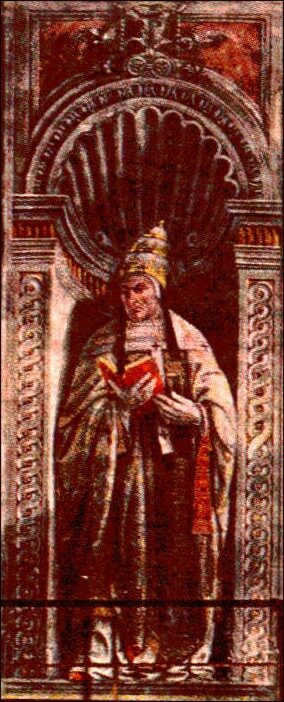
Dionysius
Dionysius was a Pope and bishop of Rome from 259 to 268. Born 200, in Roman Empire. Died December 26, 268, in Rome. Positions held include Pope (259–268).
Facts
8 facts · 1 confirmed by two sources · 3 cited · 3 from one source · 1 where the sources disagree
What’s different
- Born: we show 200 (Sources disagree). Wikipedia says 264
Where this comes from
Papalocal keeps its own record. It started from these sources; what each one said is kept here as it was copied, so a change on their side never changes this page by itself. Tap one to read its version.
What Wikidata says · copied November 16, 2026 · revision 2569146409
- Described as
- Pope and bishop of Rome from 259 to 268
- Other names
- Pope Dionysius
- Born
- 200
- Died
- December 26, 268 · 1 reference
- Born in
- Roman Empire · 1 reference
- Died in
- Rome · 1 reference
- Citizen of
- Ancient Rome
- Occupation
- Catholic priest
- Positions held
- Pope (259–268)
- Religion
- Catholic Church · 1 reference
- Wikipedias with a page
- 82
Wikidata item Q131162 (wikidata.org/wiki/Q131162), public domain (CC0). Copied November 16, 2026.
What Wikipedia says · copied November 16, 2026 · revision 1371743047
Pope Dionysius (Greek: Διονύσιος) was the Bishop of Rome from 22 July 259 to 26 December 268. His pontificate oversaw the transition from Valerian's persecutions to the toleration issued by Gallienus in 260. During this period, he reorganized the Roman church, assigning presbyters to individual parishes.
Dionysius participated in early conciliar disputes with wide ecclesial effect. The Synods of Antioch (264–268), which condemned Paul of Samosata, addressed their synodal letter jointly to Dionysius and Maximus of Alexandria, marking the earliest known conciliar decree of its kind. In the same decade, he convened a Roman synod in response to Egyptian Christians of the Libyan Pentapolis who challenged Dionysius of Alexandria's erroneous anti-Sabellian formulations.
His only extant work is the post-synodal letter issued by Rome. In it, he defends the divine monarchia by rejecting both the Western problem of Sabellianism and the Alexandrian tendency toward hierarchical subordination, while explicitly affirming that the Son of God was not a created "work" (poiēma). Fragments preserved in Athanasius's De Decretis (c. 350–355) attest to Dionysius' formidable pre-Nicene affirmation of the Son's eternal generation. Scholars regard his synodal theology as highly advanced, firmly establishing early Trinitarianism and "as if nipping Arius' errors in the bud."
- Born, in its opening lines
- 264
- Died, in its opening lines
- 268
From the Wikipedia article “Pope Dionysius” (en.wikipedia.org/wiki/Pope_Dionysius), by its contributors, under CC BY-SA 4.0 (creativecommons.org/licenses/by-sa/4.0/). Copied November 16, 2026; not changed.
Confirmed Two sources agree. Cited One source, and it names where it got it. One source One source, without a reference of its own. Sources disagree The sources disagree. We show the best-supported value and keep theirs below.
