
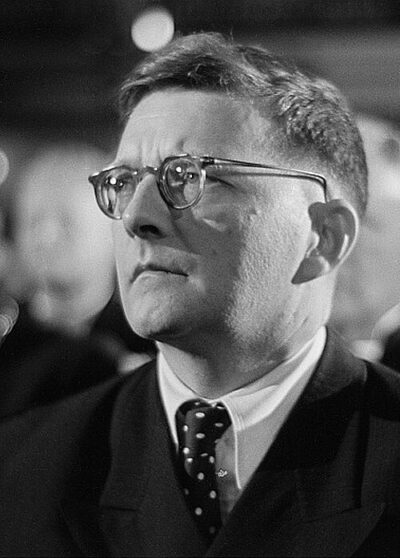
Dmitri Shostakovich
Dmitri Shostakovich was a Soviet composer and pianist. Born September 25, 1906, in Saint Petersburg. Died August 9, 1975, in Moscow. Positions held include deputy of the Supreme Soviet of the Soviet Union. Known for Symphony No. 1, Symphony No. 10 and Lady Macbeth of the Mtsensk District. Educated at Saint Petersburg Conservatory. Awards include Stalin Prize (5 times), USSR State Prize and Order of Lenin (3 times).
Facts
68 facts · 2 confirmed by two sources · 6 cited · 60 from one source
Where this comes from
Papalocal keeps its own record. It started from these sources; what each one said is kept here as it was copied, so a change on their side never changes this page by itself. Tap one to read its version.
What Wikidata says · copied November 16, 2026 · revision 2569054710
- Described as
- Soviet composer and pianist (1906-1975)
- Other names
- Dmitri Dmitrievitch Chostakovitch, Dmitriii Dmitrievich Shostakovich, Dmitri Dmitriyevich Shostakovich, Dimitri Shostakovich, Dmitrij Šostakovič, Shostakovich, Shosty, Dmitrii Dmitrievich Shostakovich
- Born
- September 25, 1906 · 9 references
- Died
- August 9, 1975 · 14 references
- Born in
- Saint Petersburg · 4 references
- Died in
- Moscow · 4 references
- Buried in
- Novodevichy Cemetery
- Cause of death
- heart failure
- Citizen of
- Russian Empire · 1 reference; Soviet Union
- Occupation
- classical composer · 2 references; pianist · 1 reference; politician; university teacher; librettist; music educator · 1 reference; composer · 1 reference; director · 1 reference
- Positions held
- deputy of the Supreme Soviet of the Soviet Union
- Political party
- Communist Party of the Soviet Union (1960–)
- Worked for
- Meyerhold State Theatre; Workers' Youth Theatre (1930–1933); Saint Petersburg Conservatory (1937–); Moscow Conservatory (1943–1948)
- Education
- Saint Petersburg Conservatory (1919–1925)
- Member of
- Union of Soviet Composers; Serbian Academy of Sciences and Arts (1965–); Academy of Arts of the GDR (1956–); American Academy of Arts and Sciences; Bavarian Academy of Fine Arts (1968–); Soviet Peace Committee (1949–); Royal Swedish Academy of Music (1954–); Accademia Nazionale di Santa Cecilia (1956–); Académie des beaux-arts
- Genre
- symphony · 1 reference; chamber music · 1 reference; opera · 1 reference
- Instrument
- piano
- Known for
- Symphony No. 1; Symphony No. 10; Lady Macbeth of the Mtsensk District; Symphony No. 5; The Nose; Piano Concerto No. 2
- Awards
- Stalin Prize (5 times) (1941, 1942, 1946, 1950, 1952); USSR State Prize (1968); Order of Lenin (3 times) (1946, 1956, 1966); Order of the October Revolution (1971); People's Artist of the USSR (1954); Star of People's Friendship (1972); Great Silver Medal of Honour for Services to the Republic of Austria (1967); Léonie Sonning Music Prize (1973); Lenin Prize (1958); Order of the Red Banner of Labour (1940); Order of Friendship of Peoples (1972); Medal "For Valiant Labour in the Great Patriotic War 1941–1945"; Royal Philharmonic Society Gold Medal (1966); People's Artist of the RSFSR (1947); World Peace Council prizes (1954)
- Field
- opera; symphony; chamber music; classical music
- Spouse
- Nina Varzar (1932–1954); Irina Shostakovich · 1 reference
- Children
- Maxim Shostakovich · 1 reference; Galina Dmitrievna Shostakovich
- Father
- Dmitry Shostakovich
- Religion
- Roman Catholic
- Website
- http://www.shostakovich.ru/
- Wikipedias with a page
- 106
Wikidata item Q80135 (wikidata.org/wiki/Q80135), public domain (CC0). Copied November 16, 2026.
What Wikipedia says · copied November 16, 2026 · revision 1384015880
Dmitri Dmitriyevich Shostakovich (25 September [O.S. 12 September] 1906 – 9 August 1975) was a Soviet-era Russian composer and pianist who became internationally known after the premiere of his First Symphony in 1926 and thereafter was regarded as a major composer.
Shostakovich achieved early fame in the Soviet Union, but had a complex relationship with its government. His 1934 opera Lady Macbeth of Mtsensk was initially a success but later condemned by the Soviet government, putting his career at risk. In 1948, his work was denounced under the Zhdanov Doctrine, with professional consequences lasting several years. Even after his censure was rescinded in 1956, performances of his music were occasionally subject to state interventions, as with his Thirteenth Symphony (1962). Nevertheless, Shostakovich was a member of the Supreme Soviet of the RSFSR (1947) and the Supreme Soviet of the Soviet Union (from 1962 until his death), as well as chairman of the RSFSR Union of Composers (1960–1968). Over the course of his career, he earned several important awards, including the Order of Lenin, from the Soviet government.
Shostakovich combined various musical techniques in his works. His music is characterized by sharp contrasts, elements of the grotesque, and ambivalent tonality; he was also heavily influenced by neoclassicism and by the music of Gustav Mahler. His orchestral works include 15 symphonies and six concerti (two each for piano, violin, and cello). His chamber works include 15 string quartets, a piano quintet, and two piano trios. His solo piano works include two sonatas, an early set of 24 preludes, and a later set of 24 preludes and fugues. Stage works include three completed operas and three ballets. Shostakovich also wrote several song cycles and a substantial quantity of music for theatre and film.
Shostakovich's reputation has continued to grow after his death. Scholarly interest has increased significantly since the late 20th century, including considerable debate about the relationship between his music and his attitudes toward the Soviet government.
- Born, in its opening lines
- September 25, 1906
- Died, in its opening lines
- August 9, 1975
From the Wikipedia article “Dmitri Shostakovich” (en.wikipedia.org/wiki/Dmitri_Shostakovich), by its contributors, under CC BY-SA 4.0 (creativecommons.org/licenses/by-sa/4.0/). Copied November 16, 2026; not changed.
Confirmed Two sources agree. Cited One source, and it names where it got it. One source One source, without a reference of its own. Sources disagree The sources disagree. We show the best-supported value and keep theirs below.
