
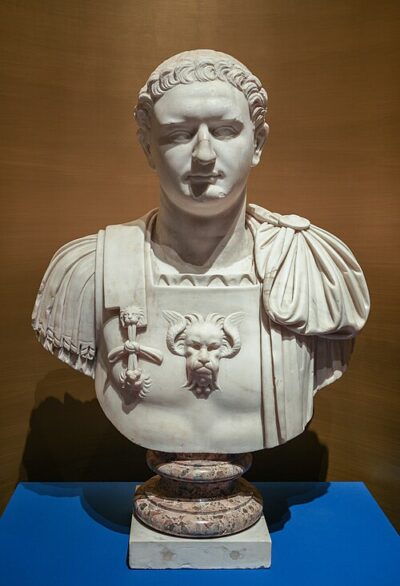
Domitian
Domitian was the 11th Roman Emperor. Born October 24, 51, in Rome. Died September 18, 96, in Rome. Positions held include Roman emperor (81–96), ancient Roman senator and Roman consul.
Facts
21 facts · 0 confirmed by two sources · 8 cited · 13 from one source
Where this comes from
Papalocal keeps its own record. It started from these sources; what each one said is kept here as it was copied, so a change on their side never changes this page by itself. Tap one to read its version.
What Wikidata says · copied November 16, 2026 · revision 2568841753
- Described as
- 11th Roman Emperor (81–96)
- Other names
- Caesar Domitianus Augustus, Domitianus, Titus Flavius Domitianus
- Born
- October 24, 51 · 1 reference
- Died
- September 18, 96 · 3 references
- Born in
- Rome
- Died in
- Rome
- Cause of death
- stab wound to the chest
- Name at birth
- Titus Flavius Domitianus
- Citizen of
- Ancient Rome
- Occupation
- politician · 1 reference
- Positions held
- Roman emperor (81–96) · 1 reference; ancient Roman senator; Roman consul
- Spouse
- Domitia Longina · 2 references
- Children
- Titus Flavius Caesar; Flavia; Vespasian the Younger; Domitian the Younger
- Father
- Vespasian · 2 references
- Mother
- Domitilla the Elder · 1 reference
- Siblings
- Titus · 1 reference; Domitilla the Younger · 1 reference
- Religion
- ancient Roman religion
- Wikipedias with a page
- 99
Wikidata item Q1423 (wikidata.org/wiki/Q1423), public domain (CC0). Copied November 16, 2026.
What Wikipedia says · copied November 16, 2026 · revision 1383108087
Domitian ( də-MISH-ən, -ee-ən; Latin: Domitianus; 24 October 51 – 18 September 96) was Roman emperor from 81 to 96. As the son of Vespasian and the younger brother of Titus, his two predecessors on the throne, he was the last member of the Flavian dynasty. Described by the historian Brian W. Jones as "a ruthless but efficient autocrat", his authoritarian style of ruling put him at sharp odds with the Senate, whose powers he drastically curtailed.
Domitian had a minor and largely ceremonial role during the reigns of his father and brother. After the death of his brother, Domitian was declared emperor by the Praetorian Guard. His 15-year reign was the longest since Tiberius. As emperor, Domitian strengthened the economy by revaluing the Roman coinage, expanded the border defenses of the empire, and initiated a massive building program to restore the damaged city of Rome. Significant wars were fought in Britain, where his general Agricola made significant gains in his attempt to conquer Caledonia (Scotland), and in Dacia (modern-day Romania), where Domitian was unable to achieve a decisive victory against King Decebalus. Domitian's government exhibited strong authoritarian characteristics. Religious, military, and cultural propaganda fostered a cult of personality, and by nominating himself as perpetual censor, he sought to control public and private morals.
As a consequence, Domitian was popular with the people and the army, but considered a tyrant by members of the Roman Senate. Domitian's reign came to an end in 96 when he was assassinated by court officials. He was succeeded the same day by his advisor Nerva. After his death, Domitian's memory was condemned to oblivion by the Senate, while senatorial and equestrian authors such as Tacitus, Pliny the Younger, and Suetonius propagated the view of Domitian as a cruel and paranoid tyrant. Modern revisionists have instead characterized Domitian as a ruthless but efficient autocrat whose cultural, economic, and political programs provided the foundation of the peaceful second century.
From the Wikipedia article “Domitian” (en.wikipedia.org/wiki/Domitian), by its contributors, under CC BY-SA 4.0 (creativecommons.org/licenses/by-sa/4.0/). Copied November 16, 2026; not changed.
Confirmed Two sources agree. Cited One source, and it names where it got it. One source One source, without a reference of its own. Sources disagree The sources disagree. We show the best-supported value and keep theirs below.
