
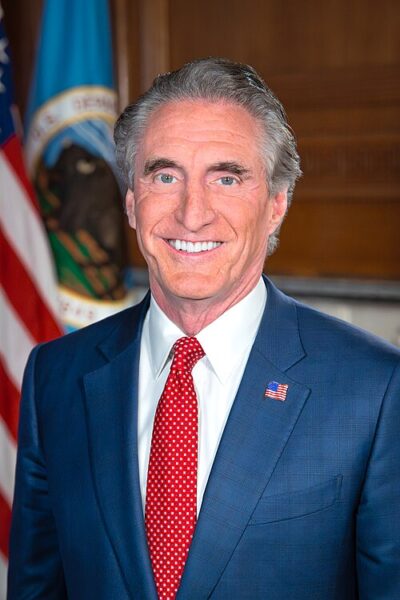
Doug Burgum
Doug Burgum is an United States Secretary of the Interior. Born August 1, 1956, in Arthur. Positions held include Governor of North Dakota (2016–2024) and United States Secretary of the Interior (2025–). Educated at North Dakota State University and Stanford University.

Facts
19 facts · 1 confirmed by two sources · 6 cited · 12 from one source
Where this comes from
Papalocal keeps its own record. It started from these sources; what each one said is kept here as it was copied, so a change on their side never changes this page by itself. Tap one to read its version.
What Wikidata says · copied November 15, 2026 · revision 2562777324
- Described as
- United States Secretary of the Interior
- Other names
- Douglas J. Burgum, Douglas James Burgum, Doug J. Burgum, Douglas Burgum, Doug James Burgum
- Born
- August 1, 1956
- Born in
- Arthur
- Name at birth
- Douglas J. Burgum
- Citizen of
- United States
- Occupation
- politician · 1 reference; businessperson · 1 reference; angel investor · 1 reference; entrepreneur · 1 reference; governor · 1 reference
- Positions held
- Governor of North Dakota (2016–2024) · 1 reference; United States Secretary of the Interior (2025–)
- Political party
- Republican Party
- Worked for
- Great Plains Software (1983–2001); Microsoft (2001–2007); Atlassian · 1 reference
- Education
- North Dakota State University; Stanford University · 1 reference; Stanford Graduate School of Business (1978–1980) · 1 reference
- Spouse
- Kathryn Burgum (2016–)
- Wikipedias with a page
- 37
Wikidata item Q22095395 (wikidata.org/wiki/Q22095395), public domain (CC0). Copied November 15, 2026.
What Wikipedia says · copied November 15, 2026 · revision 1385245309
Douglas James Burgum ( BURG-əm; born August 1, 1956) is an American businessman and politician who has served as the 55th United States secretary of the interior since 2025 under President Donald Trump. A member of the Republican Party, he previously served as the 33rd governor of North Dakota from 2016 to 2024.
Burgum was born and raised in Arthur, North Dakota. After graduating from North Dakota State University in 1978 with a bachelor's degree in university studies and earning an MBA from Stanford University two years later, he mortgaged inherited farmland in 1983 to invest in Great Plains Software in Fargo. Becoming its president in 1984, he took the company public in 1997. Burgum sold the company to Microsoft for $1.1 billion in 2001. While working at Microsoft, he managed Microsoft Business Solutions. He has served as board chairman for Australian software company Atlassian and SuccessFactors. Burgum is the founder of Kilbourne Group, a Fargo-based real-estate development firm, and also is the co-founder of Arthur Ventures, a software venture capital group.
Burgum won the 2016 North Dakota gubernatorial election in a landslide. He was reelected by a wide margin in 2020. In June 2023, Burgum launched a campaign for the 2024 Republican presidential nomination. He ended his candidacy in early December 2023, and became an advisor on the Trump campaign's energy policy. On November 14, 2024, President-elect Trump announced his intention to nominate Burgum as the United States secretary of the interior. On January 30, 2025, Burgum was confirmed by the U.S. Senate in a 79–18 vote. On February 1, 2025, Burgum was sworn in as the fifty-fifth U.S. secretary of the interior.
As Secretary of the Interior, he oversaw the Trump administration's attack on wind power, while promoting coal-fired power, expanded drilling on federal lands, and expanded metals extraction from federal lands and wildlife refuges. In 2026, Burgum announced that U.S. taxpayers would pay multiple energy companies, including a French company, nearly $2.6 billion to stop plans to build wind farms in the United States.
- Born, in its opening lines
- August 1, 1956
From the Wikipedia article “Doug Burgum” (en.wikipedia.org/wiki/Doug_Burgum), by its contributors, under CC BY-SA 4.0 (creativecommons.org/licenses/by-sa/4.0/). Copied November 15, 2026; not changed.
Confirmed Two sources agree. Cited One source, and it names where it got it. One source One source, without a reference of its own. Sources disagree The sources disagree. We show the best-supported value and keep theirs below.
